
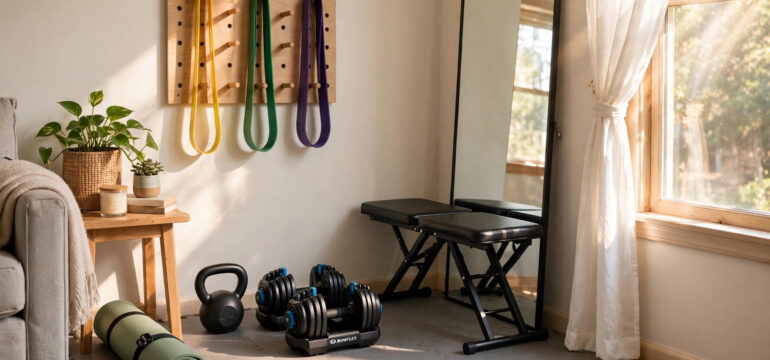
The problem with most home gym advice is that it assumes you have a spare room. In real life, most of us have a corner of the bedroom, a slice of the living room, or a bit of space between the sofa and the wall. A full power rack and a treadmill the size of a car simply do not fit. So people either give up on the idea completely or they buy one big machine that eats the whole room and slowly turns into an expensive place to hang laundry. Neither of those is a good plan. The truth is that you do not need much space to get strong and stay active at home. You need smart choices, a little planning, and gear that works as hard in storage as it does during your workout. A corner that is only six feet wide can hold everything you need for a full body routine, from strength work to stretching to cardio, as long as every piece earns its spot.
Here is the part nobody tells you. A small gym corner is actually easier to stick with than a big one. When your workout space is tiny, there is no hunting around for equipment, no walking across the room between sets, and no big empty floor that makes you feel like you should be doing more. Everything is within arm’s reach, which means your workouts start faster and feel simpler. Beginners especially do well with a small setup because it takes away the pressure. You are not trying to fill a commercial gym. You are just showing up to your corner, doing your thirty minutes, and getting on with your day. And because a small setup costs less, you can start with a few basics and add pieces over time instead of spending a fortune before you even know what kind of exercise you enjoy.
Each of the seventeen ideas below is built around a real problem that people run into when they try to work out in a small space. Things like equipment that is always in the way, floors that are too hard or too loud, gear that ends up scattered around the house, and a corner that looks so sad you avoid it. For every problem there is a practical fix that actually fits in a normal home, with tips on what to buy, where to put it, and how to keep it from taking over your life. Read through all of them, pick the three or four that match the problems you feel most, and start there. You can always add more later. The best home gym is the one you actually use, and the one you actually use is the one that fits your space and your habits.
1. Fold-Away Workout Bench
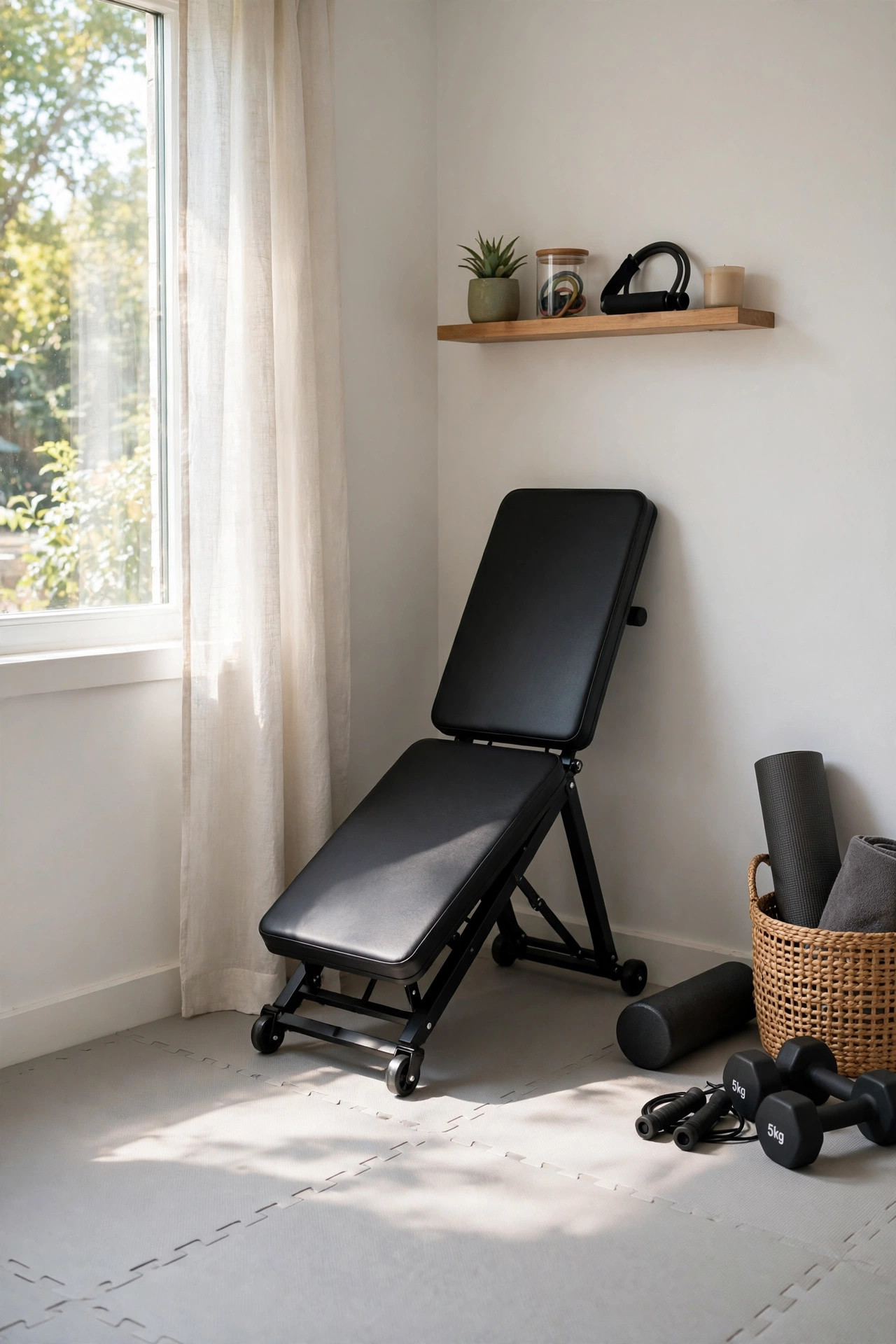
A workout bench is one of the most useful pieces of strength equipment you can own, but it is also one of the most awkward things to live with in a small home. A standard flat bench measures roughly four feet long and two feet wide, and unlike a dumbbell that slides quietly into a corner, the bench claims its patch of floor around the clock even though you only touch it for twenty or thirty minutes a day. In a small bedroom or a corner of the living room, that permanent footprint creates daily friction. You walk around it, you bump your shin on it in the dark on the way to the bathroom, and you start to quietly resent an object that is supposed to make you healthier. Worse still, flat surfaces in a busy home attract clutter like magnets, and within a month your bench is holding folded laundry, shopping bags, and mail you meant to sort last weekend. Many people in small spaces simply skip buying a bench at all, which is a genuine loss, because bench presses, step ups, Bulgarian split squats, single arm rows, and hip thrusts all become harder, less comfortable, and less effective without one. You can do some of these moves on the floor, but your range of motion shrinks, your back gets no support, and exercises that should build real strength start to feel like a compromise. The bench problem is really a space respect problem, and it deserves a better answer than just going without.
The fix is a folding workout bench that collapses flat and rolls away the moment you finish training. A good folding model folds down to just a few inches thick, and most have small transport wheels on one end so you can tip it upright and wheel it into a closet, slide it behind a door, or stand it flush against the wall where it is barely noticeable. When you shop for one, look for a weight rating that comfortably exceeds your body weight plus the heaviest weights you plan to lift, because a wobbly bench is dangerous as well as annoying. Check that the locking pin clicks in loudly and positively so you always know the bench is secure before you lie back with weight over your chest. Firm, dense padding beats soft squishy padding every time, since soft pads make you feel unstable during presses and throw off your balance. Set one household rule from the very first day and never break it. The bench gets folded and put away after every single workout, no exceptions and no I will do it later. That single habit keeps your corner fully usable for stretching, yoga, and cardio on non lifting days, and it stops the bench from quietly turning into furniture. Rolling it out takes about ten seconds when training time comes, and that tiny ritual of setup actually helps your brain switch from rest mode into workout mode, which is a small psychological bonus on top of the space saving.
2. Wall-Mounted Resistance Band Station
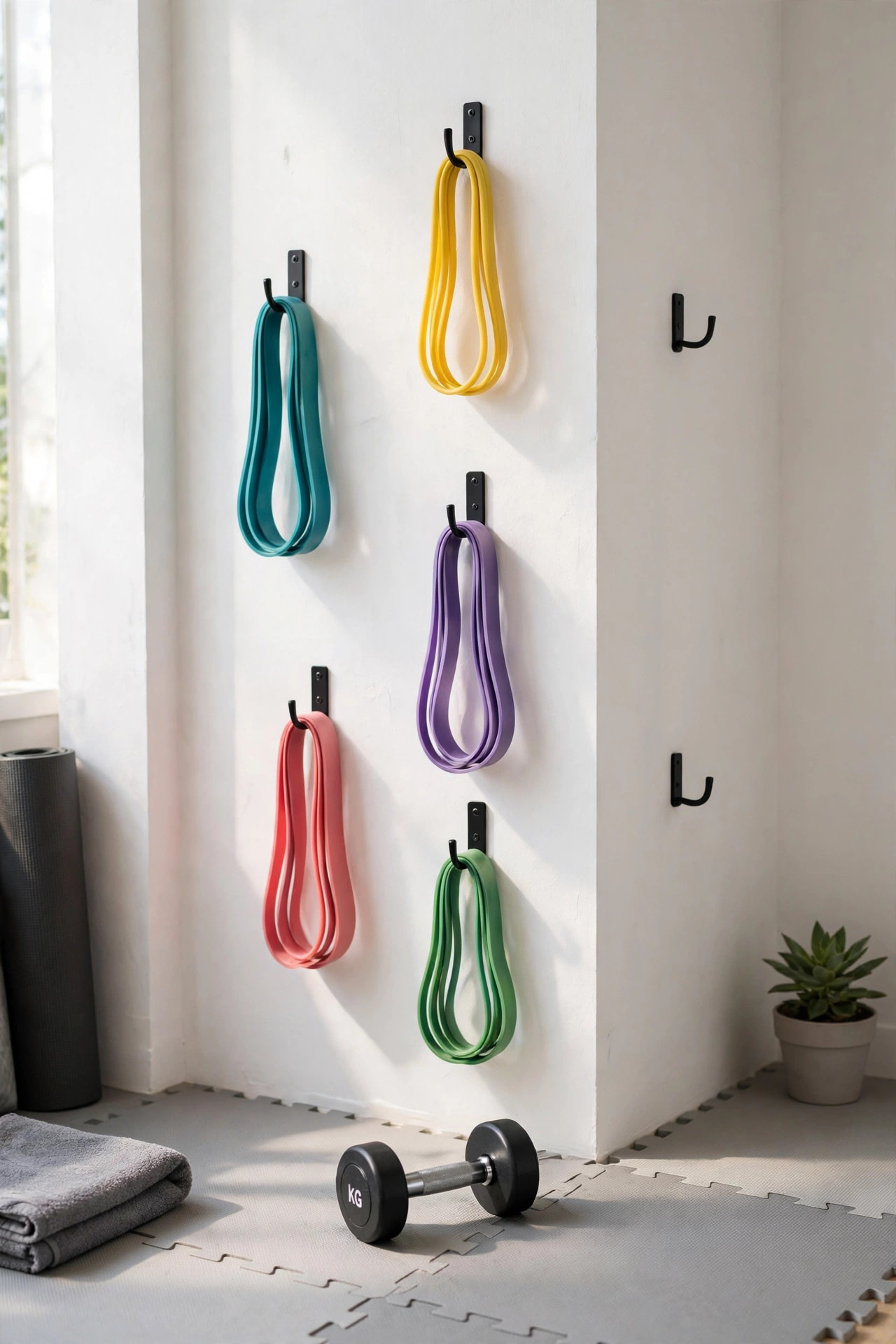
The problem with resistance bands is not the bands themselves but where they live. Most people keep them in a drawer or a gym bag, which means every workout starts with five minutes of untangling a knotted mess while motivation quietly drains away. Cheap door anchors slide around and feel sketchy when you pull hard, and wrapping bands around furniture scratches the wood while giving you an anchor point at exactly the wrong height for most exercises. Bands are genuinely one of the best tools ever made for small spaces because they weigh almost nothing, cost very little, and store in a shoebox, but all of that is wasted if the setup part feels annoying. When getting ready is a hassle, you stop reaching for the bands, and then they join the sad pile of fitness gear that seemed like a brilliant idea in January and was forgotten by March. It is a shame, because bands can train every major muscle group through a full range of motion, and they are kinder to joints than heavy weights for many beginners. Think about how many workouts never happen because of tiny annoyances like this. You tell yourself you will train after work, then you open the drawer, see the tangled mess, and suddenly answering emails feels more appealing. The bands are not the problem and you are not lazy. The system is broken, and a broken system will beat good intentions every single time, no matter how motivated you feel in the moment.
The fix is a small wall mounted anchor station that gives your bands a permanent, always ready home. This can be as simple as two or three sturdy hooks or a short metal rail screwed into a wall stud at different heights, low near the floor for rows and curls, chest height for presses, and high up for pulldowns and tricep work. Screwing into a solid stud matters enormously because a band under full tension pulls surprisingly hard, and drywall alone will crumble and fail, possibly mid rep. If you rent and cannot drill, a wide heavy duty adhesive anchor on a smooth solid door or a freestanding anchor post tucked in the corner can work for lighter bands, though you should test them carefully before trusting them. Hang the bands on the hooks when you finish, sorted by thickness so you can grab the right resistance without thinking. The whole setup takes up zero floor space, the bands are always untangled and waiting, and your workout starts the moment you walk up to the wall instead of after a wrestling match with knotted rubber. That removal of friction is worth more than any fancy equipment. If you ever move, the hooks come off with a little filler and paint, and the whole station costs less than a single dinner out. It is a small weekend project with a daily payoff, which is exactly the kind of upgrade a small home gym needs most.
3. Under-Bed Dumbbell Storage
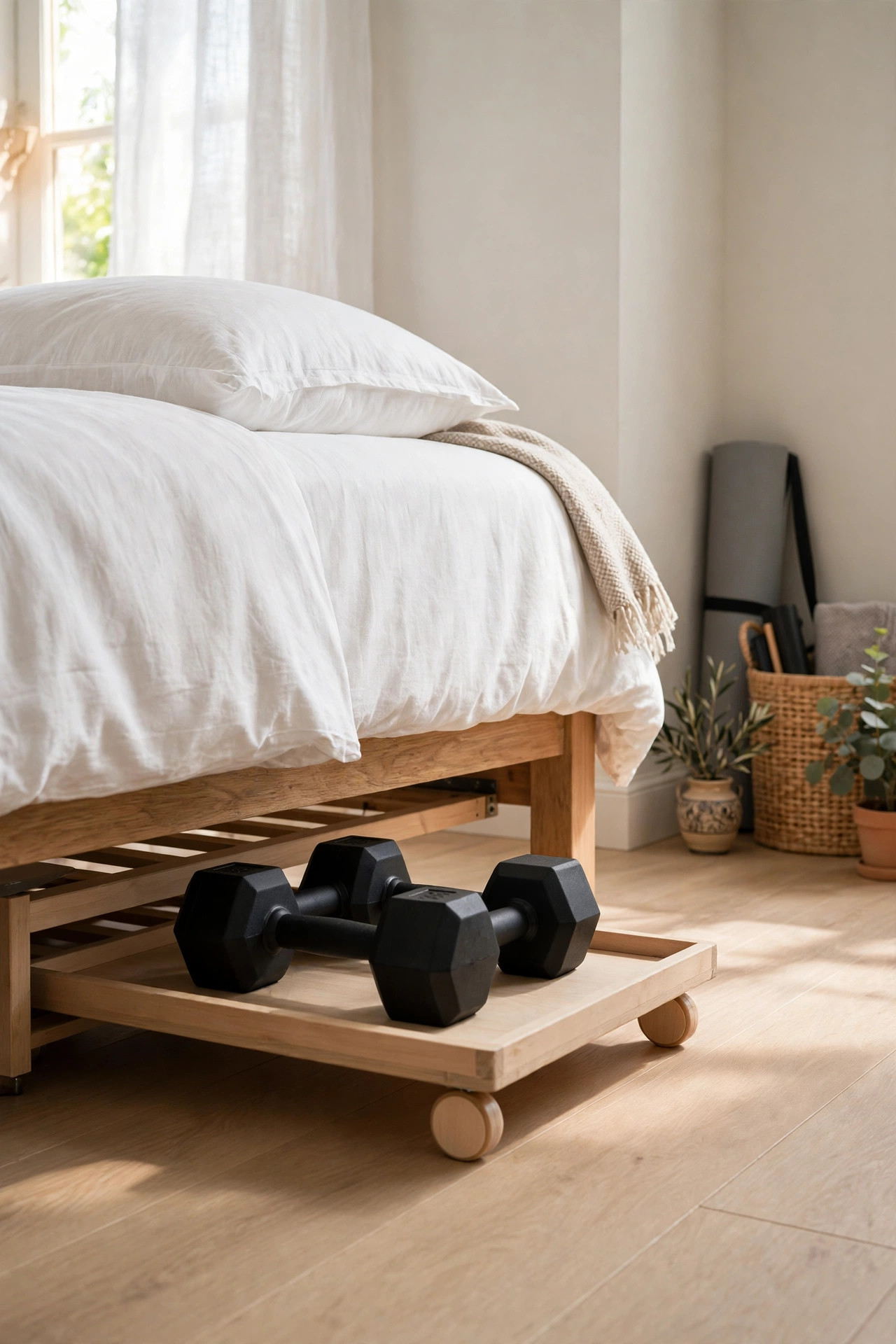
The problem is that dumbbells are heavy, awkward, and honestly ugly when they sit out on the floor. A pair of dumbbells left out in a small room becomes a toe stubbing hazard at midnight and a constant visual reminder of clutter every time you walk past. Traditional dumbbell racks solve the mess but create a brand new problem, because even a compact two tier rack needs about three feet of wall and sticks out a foot and a half into the room. In a bedroom corner gym, that rack can easily swallow a quarter of your workout floor, which defeats the whole purpose. So people leave the weights on the floor, the floor stays messy, and the whole corner slowly starts to feel like a storage unit instead of a place where you want to spend time. Guests notice it, partners complain about it, and you start to feel a little embarrassed about a hobby that should make you proud. There is also the safety angle that people forget until it bites them. A dumbbell on a dark floor is an ankle sprain waiting to happen, and if you have kids or pets, loose weights are genuinely dangerous. A tidy floor is not just about looks. It is about keeping everyone in the home safe, including the half asleep version of you at midnight.
The fix is to store your dumbbells under the bed on a low rolling tray that disappears completely. A shallow wooden or plastic tray with smooth caster wheels, or even a sturdy metal pan with casters added, slides right under most bed frames and easily holds two to four dumbbells plus small plates. You roll it out when your workout starts and roll it back when you finish, which takes seconds and returns your floor to completely clear. This trick works best with adjustable dumbbells or a modest fixed set up to about twenty five pounds each, since very heavy weights are harder to lift in and out of a low tray without hurting your back. Line the tray with a piece of old carpet or a rubber mat so the weights do not rattle, scratch the floor, or slide around. The beauty of this fix is that your bedroom looks like a normal bedroom again the moment you are done, and a guest would never guess that a full set of weights is hiding six inches off the ground. Out of sight, out of mind, and off your floor. Measure the clearance under your bed before you build or buy the tray, since some modern platform beds sit very low to the ground. Most frames give you six to eight inches, which is plenty for dumbbells lying flat. Once the tray is in place, the whole system runs itself, and you will wonder why you ever left weights sitting out on the floor.
4. Corner Yoga Mat Nook
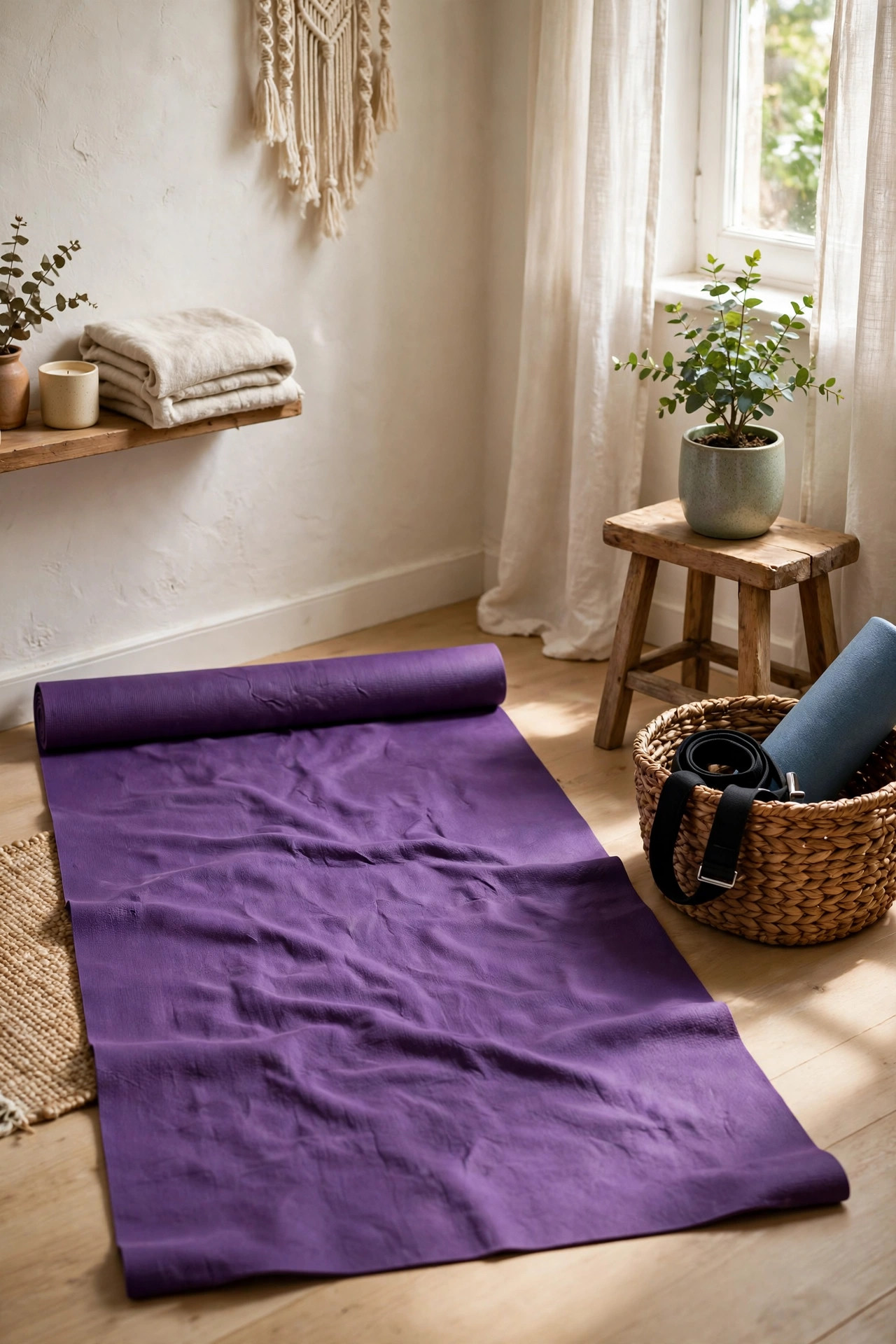
The problem is that stretching and mobility work keeps getting skipped, not because people do not care about it, but because setting up feels like a small project every single time. Unrolling the mat, clearing a patch of floor, finding the foam roller that rolled behind the sofa, hunting for the strap, it is all just enough friction to make you say you will do it tomorrow. Tomorrow quietly becomes next week, and next week becomes next month. Then your hips get tight, your back gets cranky, and your main workouts start to suffer because your body never gets the recovery work it needs to stay healthy. A yoga mat that lives rolled up in a closet might as well not exist at all. Out of sight really does mean out of mind when it comes to exercise habits, and mobility is always the first thing to go because its benefits feel invisible until the pain arrives. The irony is that ten minutes of daily stretching does more for how your body feels than an extra intense workout each week. Flexible hips and a happy lower back change how you sit, stand, walk, and sleep. Skipping mobility is like skipping oil changes for your car. Everything runs fine until it suddenly does not, and then the repair bill is much bigger than the maintenance would have been.
The fix is to give your mat a permanent home in the corner, unrolled and ready to use at a moment’s notice. Pick the corner with the best natural light and lay the mat down flat as the base layer of your gym zone, with a foam roller and a stretching strap stored right beside it in a small basket or bin. When the mat is already on the floor, a ten minute stretch session has zero setup time, which means you will actually do it while dinner heats up or during a long phone call. If the mat must be rolled up between workouts because the space doubles as something else during the day, store it vertically in a tall basket or an umbrella stand right in the corner so it stays visible and grabbable instead of vanishing into a closet. Add one small comfort touch, like a folded towel for knee padding or a plant on a nearby shelf, so the nook feels inviting instead of clinical. The goal is to make the easiest choice the healthy one, and nothing on earth is easier than a mat that is already waiting for you. You can also use the nook for quick morning wake up routines before the day gets busy and distractions multiply. Five minutes of gentle movement on a mat that is already unrolled beats thirty minutes you never get around to doing. Make the nook the most inviting few square feet in your home, and your body will thank you every single day.
5. Over-the-Door Pull-Up Bar
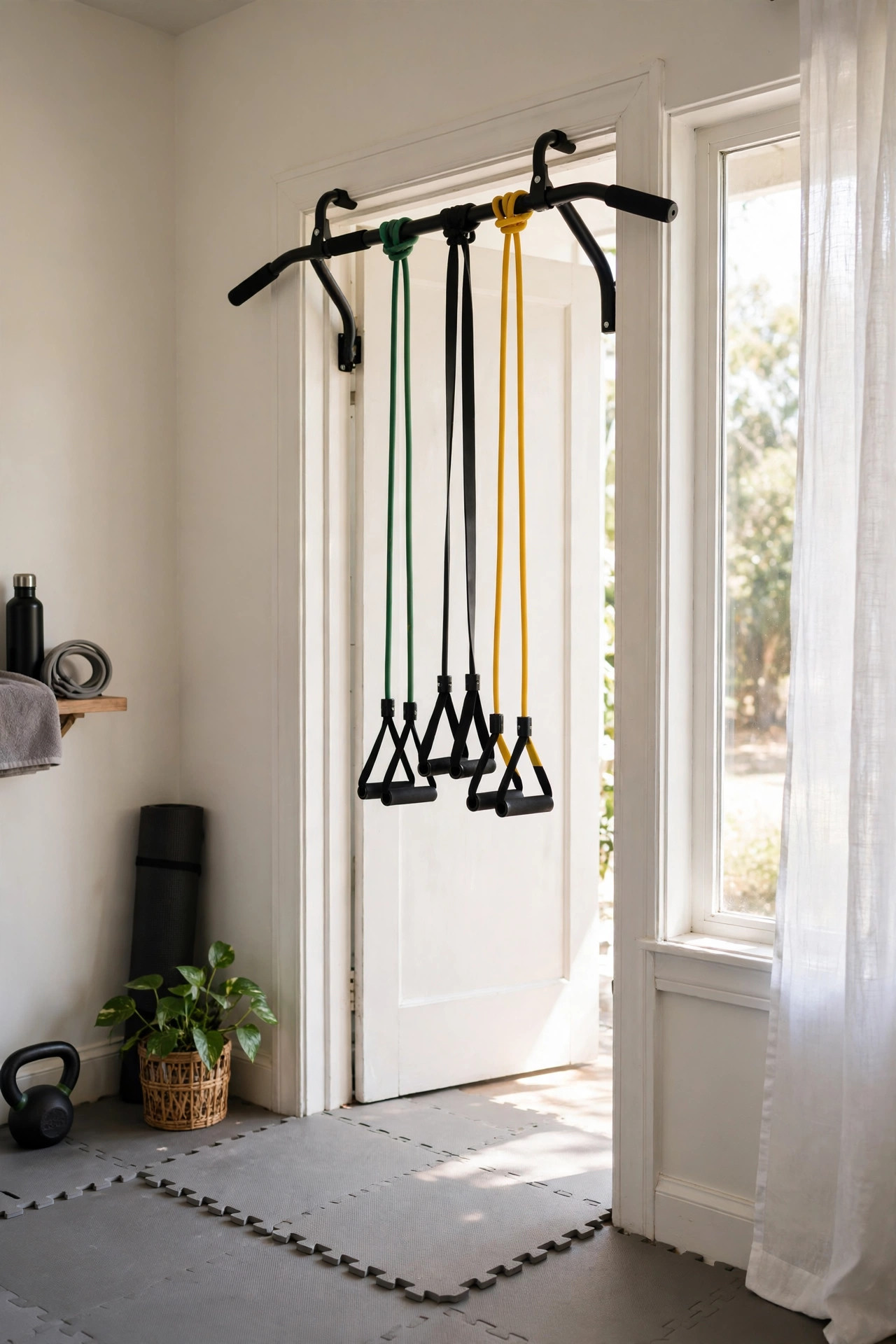
The problem is that upper body pulling strength is genuinely hard to train without big, space hungry equipment. Rows with resistance bands help, but there is no true replacement for hanging from a solid bar and pulling your chin over it. A freestanding pull-up tower is a beast that demands a four by four foot footprint and visually dominates any small room it enters. Wall mounted bars need serious drilling into studs or concrete, which renters cannot do and many homeowners simply do not want to do. So the back and biceps get neglected while pushing muscles get all the attention, posture suffers from endless hours of sitting at desks, and the dream of doing a real pull-up stays a dream instead of becoming a plan. It is frustrating because pulling strength is one of the most useful kinds of fitness for real life, from carrying groceries to climbing and playing with kids. Pull-ups also build the kind of grip strength that carries over into everything else you lift, from deadlifts to grocery bags. Dead hangs alone, just holding the bar for thirty seconds at a time, decompress the spine and strengthen the hands and forearms in a way few exercises match. It is remarkable how much benefit hides in such a simple movement, and how rarely small space lifters get access to it without a real plan.
The fix is a pull-up bar that hooks over a standard door frame with no screws, no drilling, and no damage. These clever bars use leverage physics, pressing against the trim on both sides of the doorway, and they can hold a surprising amount of weight when the frame itself is solid wood. Installation takes about thirty seconds and removal is just as fast, which makes it perfect for renters and for anyone who only wants the bar up during workouts. Check your trim before you buy. It should be real wood at least a few inches wide, not thin decorative molding, and the frame should feel rock solid with zero wobbling when you push on it. Use the bar for pull-ups, chin-ups, and simple dead hangs that decompress your spine after a day of sitting. On days you are not pulling, hang your resistance bands or a suspension trainer from it for extra exercises. One warning deserves your full attention. Always test the bar with a gentle hang and some light bouncing before trusting it with your full weight, and never use it on a hollow, cracked, or damaged frame. When the bar is solid, it is the most space efficient upper body tool you can own.
6. Adjustable Dumbbells Instead of a Full Rack
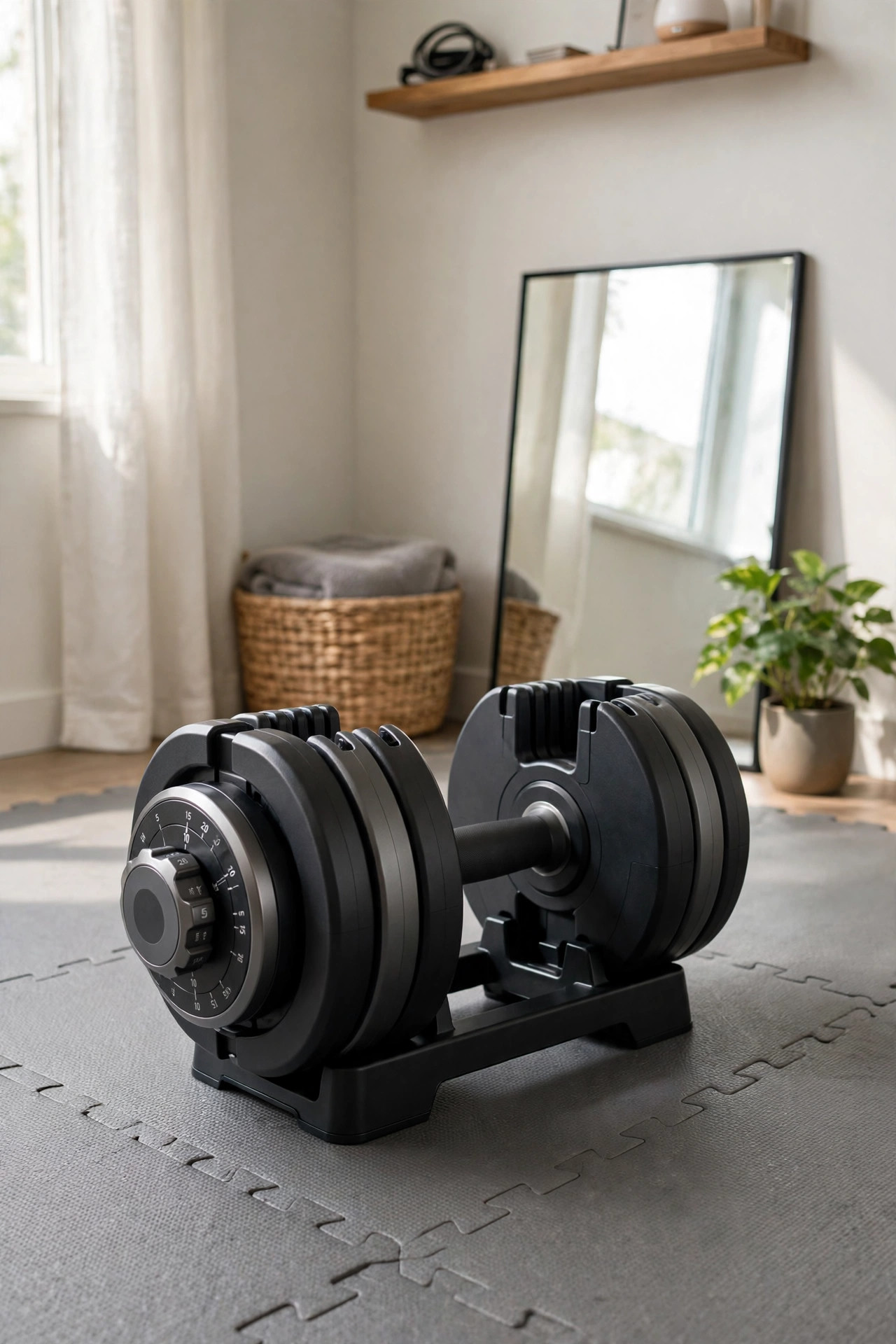
The problem is that a traditional dumbbell collection multiplies like rabbits and eats your room alive. You start with one sensible pair, then you need heavier ones for leg day, lighter ones for shoulder work, and something in between for everything else. Before you know it you own eight or ten pairs that demand a rack the size of a bookshelf just to stay organized. In a small home gym that rack becomes the room, blocking a whole wall, sticking out into your workout floor, collecting dust, and making the entire corner feel like a warehouse instead of a home. Hex dumbbells are wonderful to lift, but storing a full run from five to fifty pounds takes serious square footage that a corner gym simply does not have. Beginners usually make one of two expensive mistakes here. They either buy too many weights before they know what they need, or they buy one pair that is too light and outgrow it within two months. There is a hidden cost too, which is the mental load of managing all that gear day after day. Every extra pair needs a spot on the rack, needs dusting, and needs to be moved aside when you clean the room. A minimalist setup removes dozens of tiny decisions and chores from your week, leaving you with just the training itself, which is the part that actually matters.
The fix is a single pair of adjustable dumbbells that replaces the entire rack in one smart purchase. With a simple twist of the handle or a slide of a selector pin, one dumbbell goes from five pounds to fifty or more, which covers everything from delicate lateral raises to heavy goblet squats and deadlifts. The pair rests on a small cradle about the size of a shoebox, so your whole dumbbell collection occupies less than two square feet of floor. When you choose a set, pick one where the weight changes in small steps of two and a half to five pounds, because big jumps of ten pounds make progressive training frustrating and stall your progress. Also check that the plates lock tightly with no rattling or shifting, since loose plates feel unsafe and distracting when the weight is over your head. Yes, adjustable dumbbells cost more upfront than a couple of fixed pairs, but they cost far less than a full set plus a rack, and they solve the storage problem completely and permanently. For a small space, they are simply the smartest strength purchase you can make. One tip that saves real frustration: practice changing the weight a few times before your first real workout so the motion becomes second nature. Fumbling with the mechanism between sets kills your momentum and stretches your rest periods too long. After a week it becomes as automatic as racking a bar, and your sessions stay short, focused, and effective.
7. Mirror That Makes the Corner Feel Bigger
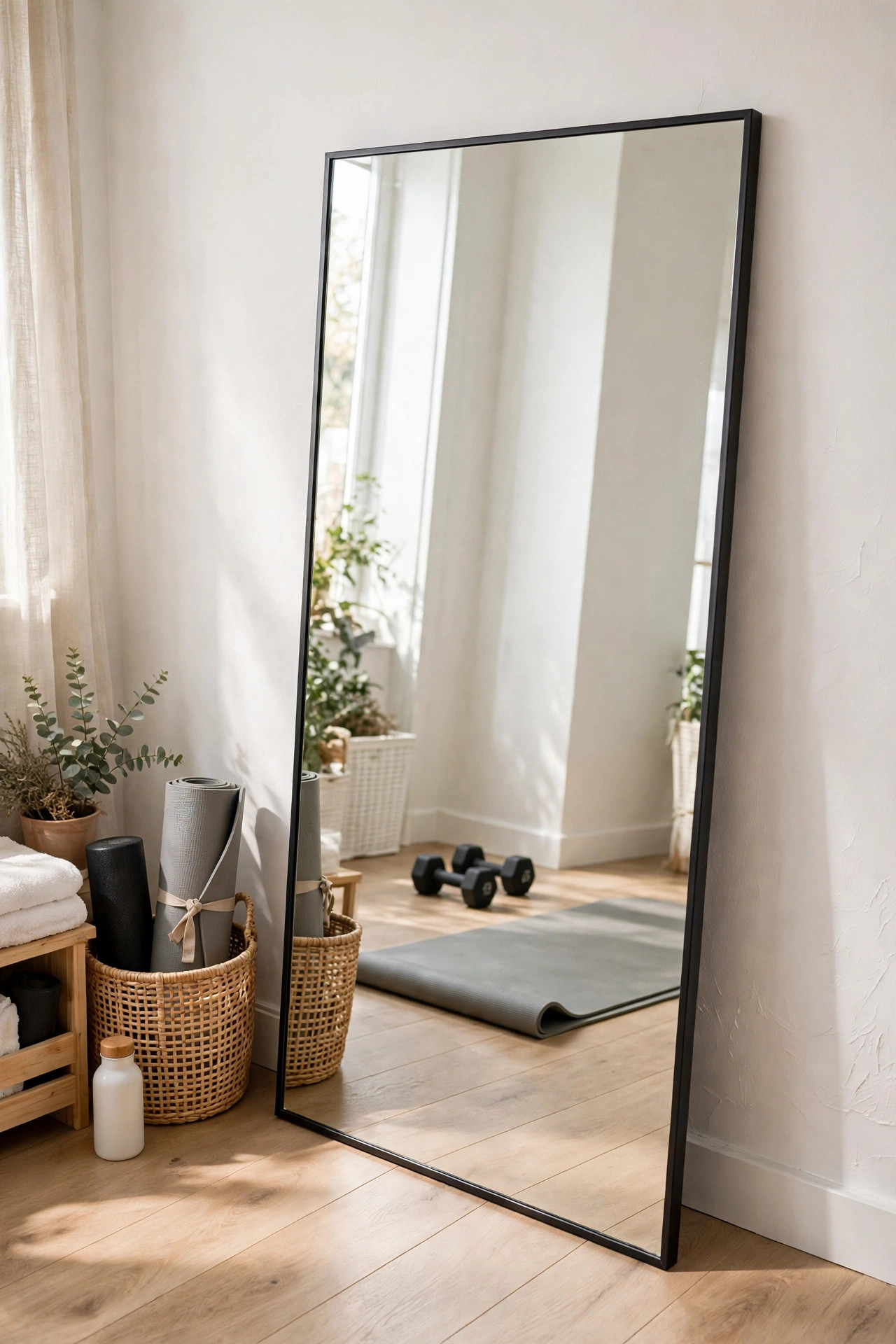
The problem is that small workout corners feel cramped, and a cramped space quietly kills your motivation. Low light, close walls, and no sense of depth make the corner feel like a closet, and nobody looks forward to exercising in a closet five days a week. Poor lighting also makes it genuinely hard to check your exercise form, which matters because squats and presses done blind in a tight space are exactly how knees and backs get hurt. People try to fix the gloom with a brighter bulb, but one harsh bulb in a tiny room just creates ugly shadows and glare. The real issue is that your eye has nowhere to travel, so your brain reads the space as even smaller than it is, and that boxed in feeling makes every workout feel like a chore before you even start. A corner that feels dark and tight is a corner you will avoid, no matter how good your intentions are in January. This is pure psychology, but it matters more than most fitness advice admits. We are naturally drawn to spaces that feel open and bright, and we avoid spaces that feel closed and gloomy without even realizing it. Your gym corner competes with your couch for your attention every single evening, so it needs every visual advantage it can get in that quiet daily battle.
The fix is a large mirror mounted on the main wall of your gym corner, and it does two important jobs at once. Visually, it doubles the space because your eye sees the reflection and reads the room as twice as deep, which instantly makes the corner feel open and airy instead of boxed in. Practically, it lets you watch your form during every single rep, so you can catch your knees caving inward or your back rounding before those mistakes turn into painful habits. A full length mirror about two feet wide and five feet tall is plenty for most people, and leaning it securely against the wall works fine if you cannot or do not want to drill. Anchor the top to the wall with a simple bracket or strap so it cannot tip forward, especially if kids or pets share the space. Place it where it catches soft natural daylight from a window without facing the sun directly, since harsh glare will blind you mid set. Wipe it down weekly because a dusty, streaky mirror in a workout space looks sad fast and ruins the effect. One mirror, and your tiny corner suddenly feels like a real training space.
8. Pegboard Gear Wall
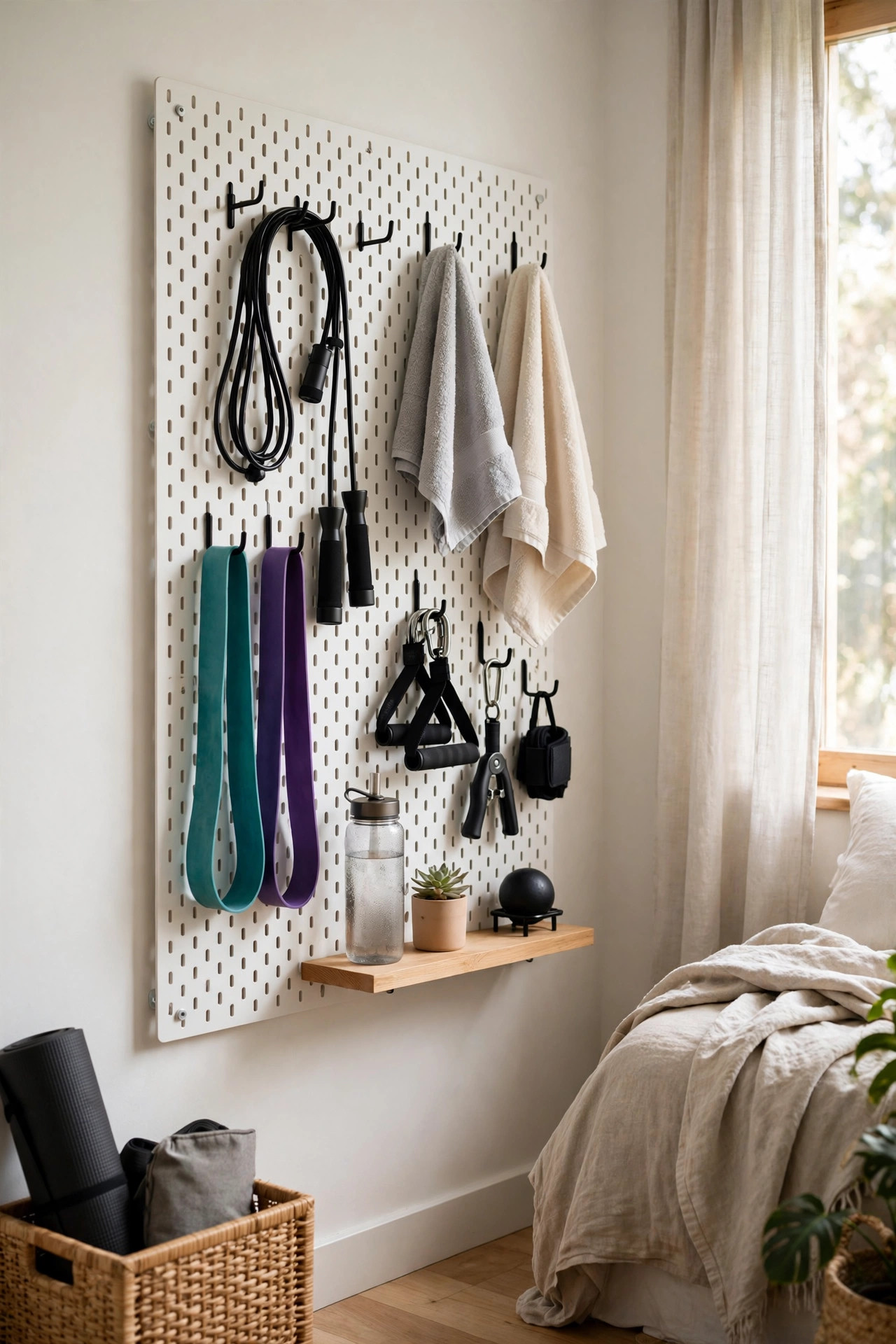
The problem is that small fitness gear has a mysterious talent for disappearing exactly when you need it. Jump ropes tangle themselves around charging cables, ankle straps end up in the laundry room, wrist wraps migrate to the car, and the ab wheel is wherever it rolled last Tuesday. Every workout begins with a scavenger hunt, and in a small space that hunt is extra annoying because there are not that many places to look, yet the stuff still manages to hide. Drawers do not help because small gear sinks to the bottom and forms a junk layer that you dread digging through. The result is wasted time, lost items that you end up buying twice, and a slow growing feeling that your gym corner is chaos rather than a system. That background stress might sound small, but it is exactly the kind of daily friction that makes people quietly quit. Ask anyone who has kept a home gym going for years and they will tell you the same thing. Success comes from systems, not motivation. Motivation gets you through January, but a designated place for every strap and rope gets you through the entire year. Organization is the unglamorous engine behind every consistent routine, and it matters far more than the perfect workout program.
The fix is a pegboard panel on the wall that gives every small item its own visible hook and ends the scavenger hunts forever. A two by four foot pegboard holds an amazing amount of gear, jump ropes, bands, straps, a foam roller in a fabric sling, towels, and even a small shelf for your water bottle and phone. Because everything hangs out in the open, you can see at a glance what is there and what is missing, and putting things back takes about one second, which means you will actually do it instead of dropping stuff on the floor. Mount the board into wall studs with small spacers behind it so the hooks have room to seat properly, or use a freestanding pegboard panel that leans against the wall if drilling is not an option. Arrange your most used items at chest height in the center where they are easiest to grab, lighter things up high, and heavier things down low. If you share the space with family, label the hooks with a marker so everyone knows exactly where the jump rope lives. A pegboard turns empty wall space into the most organized part of your gym. Take a photo of the finished layout on your phone for future reference. If the board ever gets messy, the photo shows you exactly where everything belongs, and tidying the whole wall takes about two minutes.
9. Rolling Storage Cart
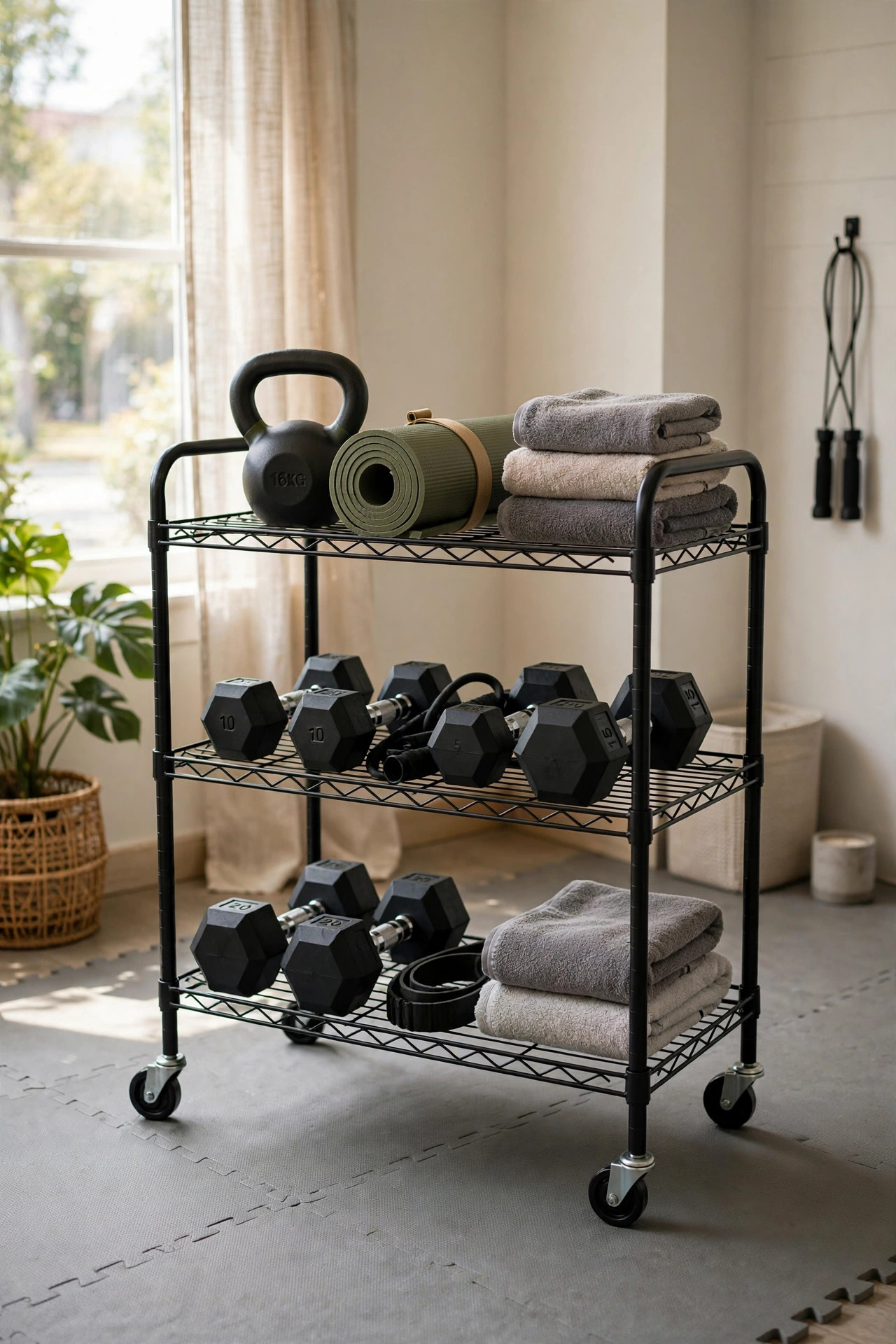
The problem is that gym equipment wanders around the house like it has legs. You work out in the living room, so the kettlebell ends up parked by the sofa. You stretch in the bedroom, so the foam roller takes up permanent residence by the bed. The resistance bands are in the bathroom drawer for reasons nobody can explain. Within a month your fitness gear is spread across every room, which means each workout starts with a collection round and your whole home always looks slightly messy. This slow spread is honestly the number one reason small home gyms fail, and it has nothing to do with willpower. It is not lack of motivation that kills the routine, it is the growing chore of gathering gear and putting it all away again, until working out feels like housework with extra steps. The wandering also creates a subtle mental tax that you might not even notice at first. Every dumbbell sitting in the wrong room is a tiny visual reminder of an unfinished task, and a home full of those reminders never feels fully restful. Containing the gear contains the stress, which makes the whole home calmer, not just the gym corner itself.
The fix is a single rolling cart that holds your entire kit and travels with you to wherever you train. A three tier metal utility cart, the kind sold for kitchens and craft rooms, is absolutely perfect for this job. It is narrow enough to roll through standard doorways, sturdy enough to hold real weights on the bottom shelf, and the top tray keeps small essentials like a timer, a towel, and your water bottle together in one place. Load it once with everything you use, park it in a closet or a quiet corner when you are done, and roll it out when it is time to train. The rule that makes this system work is beautifully simple. Every piece of gear lives on the cart, and every piece goes back on the cart the moment the workout ends, with no exceptions and no stray dumbbells by the couch. For people whose workout spot changes, say the living room in the morning and the bedroom at night, the cart beats fixed storage because your gym travels with you. One cart, zero wandering gear, and a home that stays tidy. Choose a cart with locking wheels so it stays exactly where you put it during workouts on hard floors. There is nothing worse than chasing your equipment across the room in the middle of a set. Lock the wheels, train hard, unlock them, and roll everything home when you finish.
10. Interlocking Floor Tiles
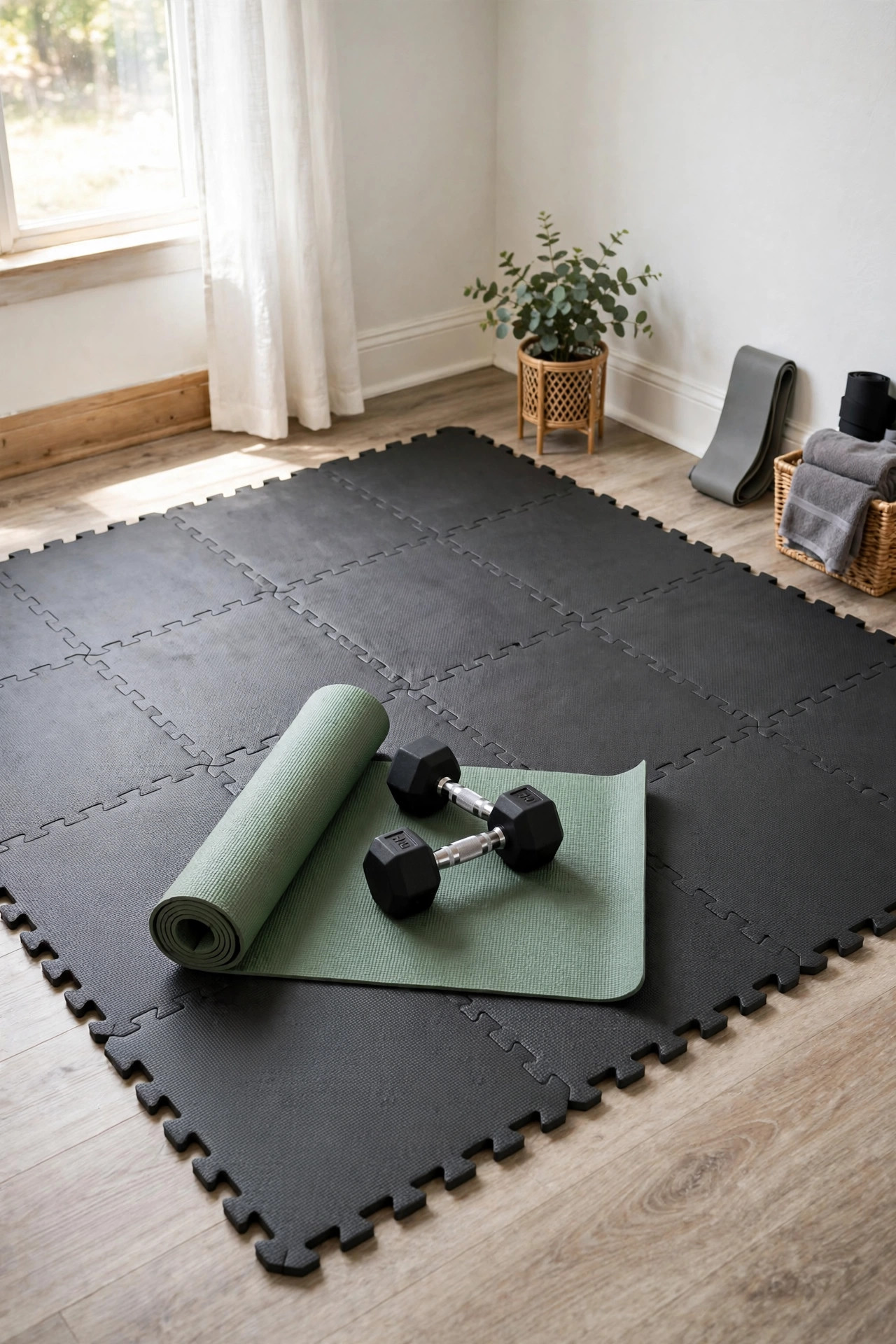
The problem is the floor itself, which is almost never suited for exercise. Hardwood and tile turn slippery the moment your shoes get sweaty, bare concrete is brutally hard on knees, backs, and elbows, and carpet soaks up sweat and starts to smell like a locker room within a few weeks. Then there is the noise problem, which is often worse than the comfort problem. Dumbbells set down a little too fast, jump rope sessions, burpees, and kettlebell work all send thumps straight through the floor to the neighbors below or the family members trying to sleep upstairs. Many people skip floor protection entirely because gym flooring looks like it belongs in a commercial facility, all black rubber and industrial vibes that clash with a cozy home. So they train on the bare floor, their joints complain, the downstairs neighbor complains louder, and the whole setup feels temporary and half hearted. Cold floors deserve a mention too, because they quietly sabotage morning workouts before they begin. Stepping onto icy tile at six in the morning is deeply unpleasant, and foam tiles add just enough insulation to make the space feel welcoming instead of punishing. Comfort might sound like a luxury, but it is often the deciding factor between training and hitting the snooze button.
The fix is interlocking foam tiles that you can lay down in minutes and pull up just as fast whenever you need the room back. These are the puzzle piece style mats sold for kids playrooms and home gyms, usually about two feet square and three quarters of an inch thick. A six by six foot square is plenty for most corner workouts, covering your lifting, stretching, and bodyweight zone in one tidy mat. The tiles cushion your knees during floor work, stop dumbbells from denting hardwood, and cut impact noise dramatically, which your neighbors will appreciate far more than you realize. Choose tiles with a subtle texture for grip and a neutral color like gray or charcoal so the corner still looks like a natural part of your home rather than a gym that crash landed in it. Wipe them down weekly with a damp cloth and a little mild soap, because sweat builds up fast on foam and nobody wants to kneel in that. For less than the cost of one month at a commercial gym, you get a floor that protects your body, your home, and your relationship with the people living below you. If you ever move to a new place, the tiles stack into a neat pile that fits easily in a car trunk, and they work just as well in the next home. Few fitness purchases are this portable, this affordable, and this immediately useful from the very first day you lay them down.
11. Door-Anchored Suspension Trainer
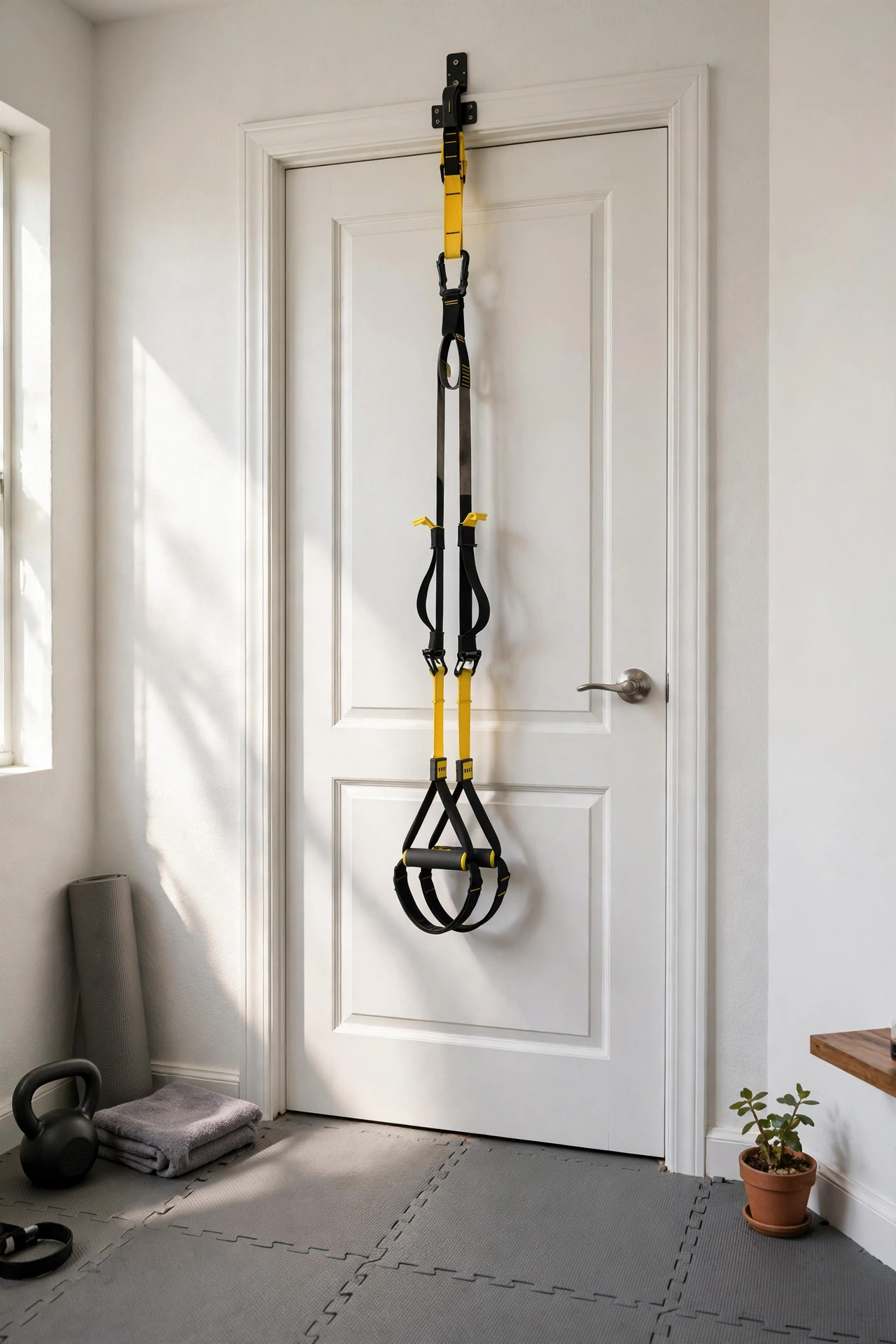
The problem is wanting a genuine full body workout with almost no equipment and almost no space to store it. Push-ups and bodyweight squats are fantastic until they get easy, and then your progress stalls because you cannot add resistance without buying weights and finding somewhere to keep them. Big cable machines and functional trainers solve the resistance problem but cost thousands of dollars and demand a dedicated wall or more. Many beginners get stuck right here in this gap, strong enough that basic bodyweight moves feel too easy, but without the room or the budget for the traditional next step. The distance between bodyweight basics and a full gym feels enormous when your entire workout space is a corner of your bedroom. It is easy to feel like real training is something other people with bigger homes get to do. This plateau is also where many people start telling themselves a discouraging story about bad genetics or no athletic talent. That story is almost never true. The human body adapts to whatever challenge you give it, and when the challenge stops growing, progress stops too. The missing ingredient is almost always adjustable resistance, not talent, and straps solve that elegantly.
The fix is a suspension trainer, those long adjustable straps with handles, anchored over any sturdy interior door. The whole kit weighs about two pounds and fits in a small drawstring bag, yet it unlocks dozens of serious exercises, rows, chest presses, assisted squats, hamstring curls, planks, fallouts, and core rollouts, all performed simply by changing your body angle. Lean back further for an easier rep, step closer to the door for a harder one, so the exact same straps can challenge a total beginner and a seasoned athlete on the same day. The door anchor is a small padded block that slides over the top of the door and locks it shut, with no screws and no damage, though the door must close fully and latch so it cannot swing open mid set. Check the strap buckles and stitching once a month for wear, wipe the handles clean so they do not get slippery, and hang the whole thing on a hook when you are done. For the price of a few restaurant meals you get a gym that fits in a drawer and a workout system that never gets boring. Travel is a bonus benefit that deserves a mention. The whole kit fits easily in a carry on bag, so your routine survives hotel rooms and family visits without missing a beat. Consistency across travel is what separates people who stay fit for decades from people who restart every single January.
12. Kettlebell Corner with a Mat
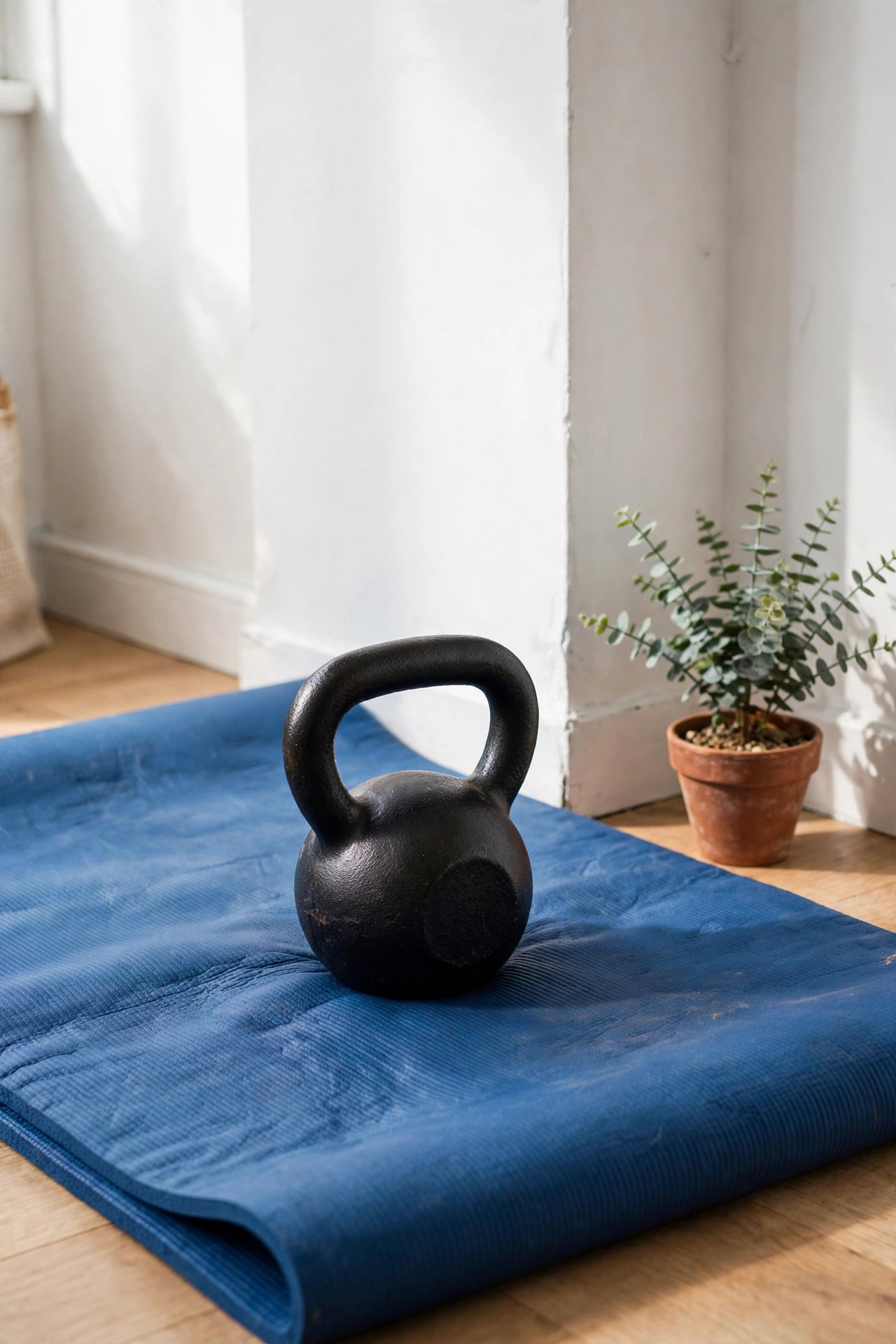
The problem is budget pressure mixed with decision paralysis. When every dollar counts, buying five different tools feels risky, so many beginners freeze and spend weeks researching instead of simply starting. Dumbbells are excellent for slow, controlled strength work but awkward for swings and cardio style movements. Resistance bands are brilliant for travel but do not build grip strength and bone density the way loaded weights do. What you really want is one single tool that covers strength, cardio, and core without demanding a rack, a bench, or much floor space. Most single tools fail this test because they only do one thing well, which sends you right back to buying more gear and needing more room. It is a frustrating loop, and it keeps a lot of people on the couch instead of in their corner. Perfectionism is the real enemy here, much more than the budget itself. People wait until they can afford the ideal setup instead of starting with one good tool today, and waiting becomes a habit of its own. A single kettlebell used three times a week beats a dream gym that never gets built, every single time and without exception. Start small, start now, and let momentum do the rest.
The fix is beautifully simple, one kettlebell and one mat in the corner. A single moderate weight kettlebell, something you can press overhead for solid reps but that still challenges you on swings, handles goblet squats, deadlifts, bent over rows, Turkish get ups, and the famous swing that trains your hips, back, grip, and lungs all at once. Pair it with a thick, grippy mat because kettlebell work happens close to the floor and you want real cushioning for get ups and core exercises. Start with just one bell while you learn the movements properly, then add a second heavier one months later when swings start feeling easy. The footprint is almost funny, one mat plus the floor space of a dinner plate for the bell itself. Stored on the mat in the corner, a kettlebell actually looks tidy and intentional, like it belongs there. Learn the hip hinge first from a good video or a coach, because crisp swing form protects your back while sloppy form punishes it. One bell, one mat, and you own a complete gym in four square feet. Wipe the bell down after sweaty sessions to protect the finish from rust and wear. Store it on the mat rather than directly on bare floor to avoid scratches and dents. Small habits like these keep your gear looking good for years, which genuinely matters when it lives in your bedroom instead of a garage.
13. Fold-Flat Walking Pad
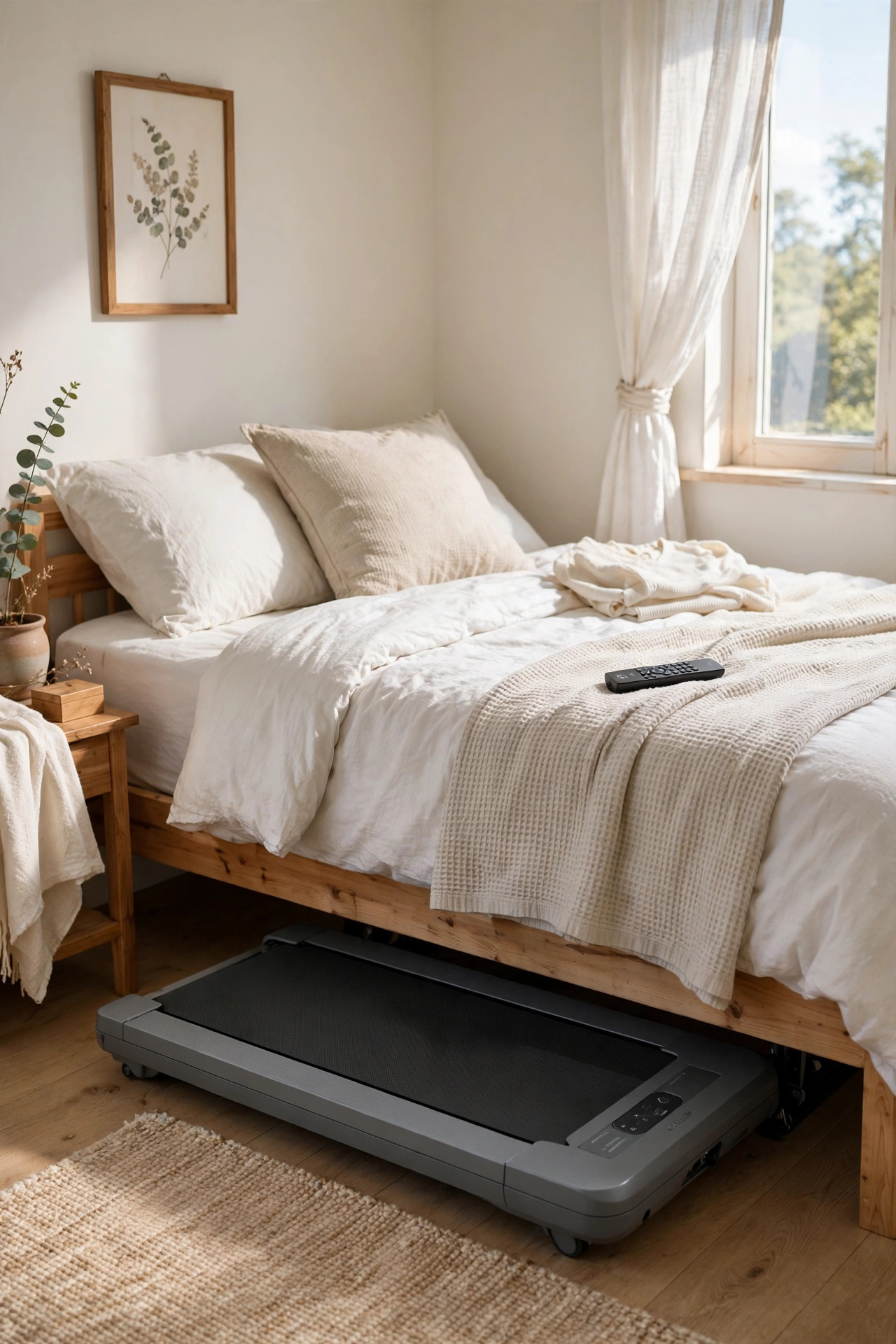
The problem is cardio in a small home, which sounds simple until you try to solve it. Treadmills are the obvious answer and also the worst one for tight spaces, since even folding models are heavy, wide, and still eat a big chunk of floor when stored upright. Exercise bikes are smaller but still demand a permanent two by four foot parking spot that never goes away. Running outside depends on weather, daylight, and safe streets, which is exactly why so many people do zero cardio all winter long. Walking is the most underrated exercise in existence, gentle on joints, wonderful for mood and blood sugar, and free, but pacing around a small apartment for thirty minutes feels silly and gets boring within days. The gap between knowing cardio matters and having a practical way to do it at home stops more routines than any lack of discipline ever could. There is also the hidden time cost that nobody talks about when comparing home and gym cardio. Driving to a gym, changing clothes, waiting for machines, and driving home can turn a thirty minute walk into a ninety minute project. A walking pad at home removes all of that overhead completely, which is why home cardio actually happens while gym cardio keeps getting postponed to tomorrow.
The fix is a slim walking pad that slides under the bed and vanishes when you are done. These are simplified treadmills without the tall console and handrails, usually only five or six inches tall, and they top out at walking or light jogging speeds, which is precisely what most beginners need. Use it while watching a show, taking a phone call, or working at a standing desk, and the steps pile up without requiring a dedicated workout block in your schedule. Look for a model with a simple remote control, a quiet motor under sixty decibels so it does not drive the whole household crazy, and a weight capacity that comfortably covers you with room to spare. Place a mat underneath to protect your floors and dampen vibration noise for the neighbors below. Start with short ten minute sessions because walking pad fatigue sneaks up on your calves in a way outdoor walking does not. When you finish, tilt it up and slide it under the bed or behind the sofa. Cardio stops being a weather dependent event and becomes something that fits naturally into your normal day. Keep a pair of dedicated indoor walking shoes right by the pad so you never skip a session just because your sneakers are out in the car. Tiny barriers like missing shoes quietly kill more workouts than lack of motivation ever will, so remove them in advance.
14. Storage Bench That Hides Weights
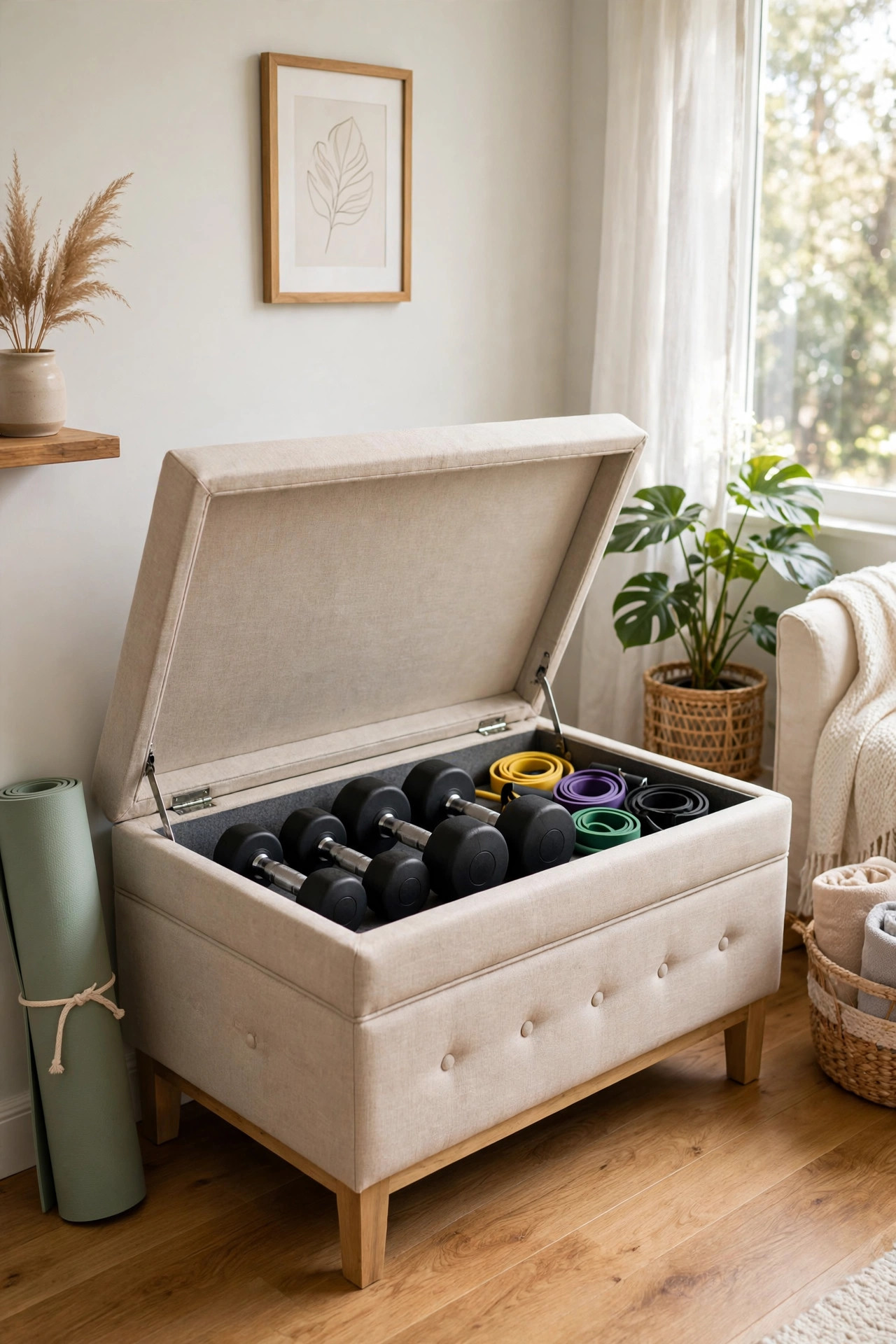
The problem is that a gym corner inside a shared living space has to look like a living space first. When weights, bands, and rollers are always visible, the room never feels restful, and family members or roommates slowly start to resent the corner that took over. Guests notice it too, and nobody wants their living room to look like a sporting goods aisle when friends come over for dinner. Traditional open shelving keeps things tidy but still visible, which does not solve the visual clutter problem at all. The gear is organized, sure, but the room still screams gym, and in a small home every single room has to multitask gracefully. This tension between fitness goals and a peaceful home causes more arguments than any other part of a home gym, and it is completely avoidable with the right furniture. This matters even more in homes with young kids, where visible gear instantly becomes fascinating toys. Dumbbells are not toys, and a curious toddler plus a loose weight is a nightmare scenario no parent wants to imagine. Hidden storage is not just about pretty aesthetics. It is a genuine safety upgrade for the entire family, and that alone justifies the purchase.
The fix is a storage bench that looks like perfectly normal furniture while secretly swallowing your gear. A sturdy ottoman style bench with a hinged lid, the kind sold for entryways and bedrooms, easily holds dumbbells, bands, a jump rope, and towels while looking like a nice place to sit. Choose one with a solid wood or reinforced frame rated for real sitting weight plus the gear inside, because cheap particle board lids crack under actual dumbbells faster than you would believe. Place the bench at the edge of your gym corner where it doubles as a seat for putting on your shoes, a platform for step ups, or extra seating when guests come over. Inside, use small fabric bins to keep heavy and light items separated so the weights do not crush your bands and towels. Close the lid when you finish training and the entire gym vanishes in one motion. This is the fix that keeps the peace in shared homes, because the workout space exists only when you want it to, and the living room stays a living room the rest of the time. Test the lid mechanism in person if you can, because you will open and close it every single day. A soft close hinge that does not slam shut is worth paying a little extra for, especially in a home where people nap, study, or work in nearby rooms.
15. Wall Hooks and Shelves for Small Gear
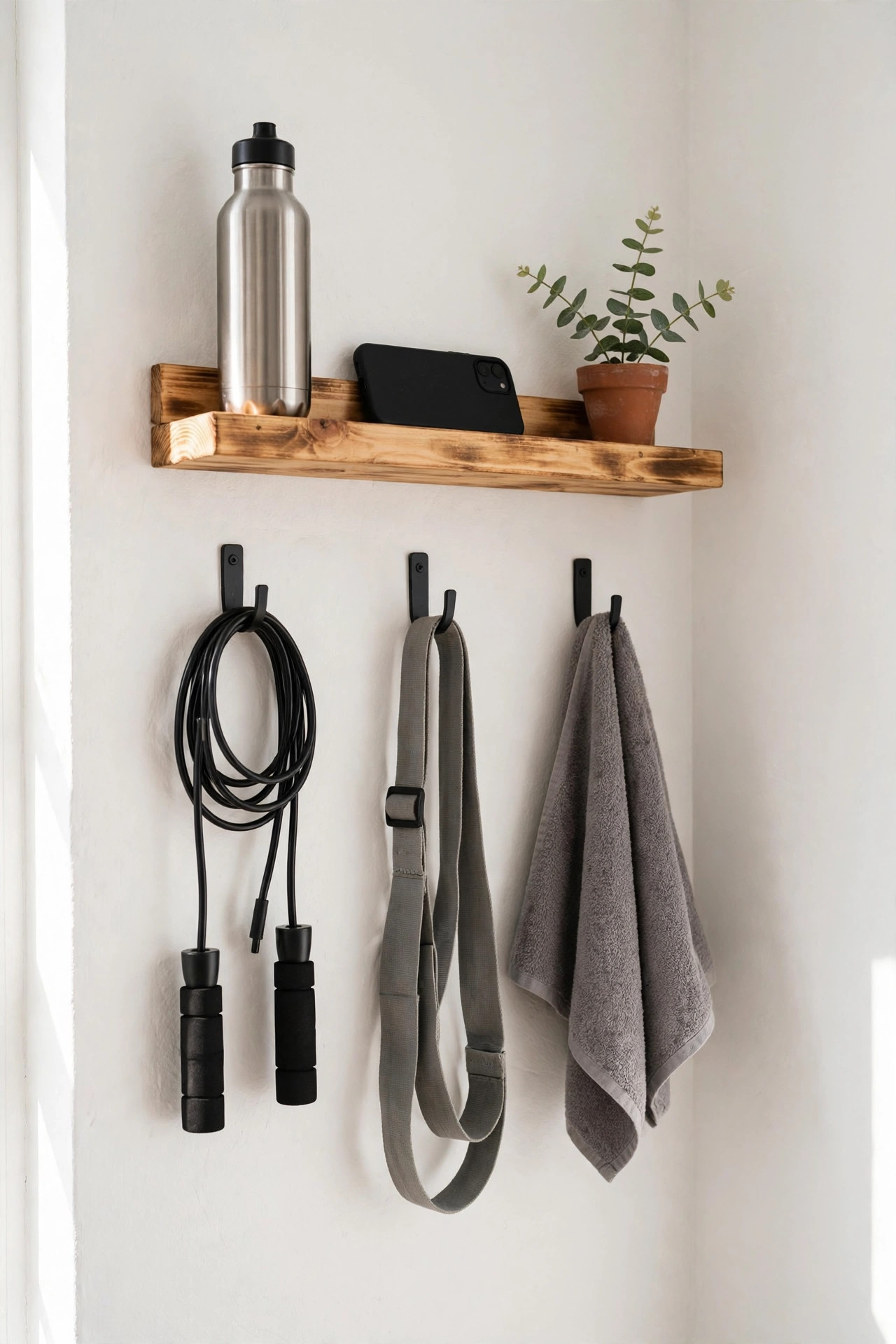
The problem is the pile, that sad little mountain of small fitness gear that forms in every home gym. Jump ropes, stretching straps, lifting gloves, a heart rate monitor, towels, a water bottle, grip pads, every piece is small and light, and small things without designated homes inevitably become a heap on the floor or a tangled jumble in a basket. Piles are the enemy of small spaces because they make even a tidy corner look messy at a glance, and digging through a basket for your jump rope while your warm-up timer counts down is genuinely irritating. Nobody thinks about storage when buying a ten dollar jump rope, but a dozen such items together create daily friction that slowly wears down your routine. It sounds dramatic to blame a pile for quitting, yet these tiny annoyances stack up until working out feels like more trouble than it is worth. The pile also has a sneaky way of growing over time, because every new small purchase joins it by default. A jump rope here, a new band there, and suddenly the basket overflows onto the floor. Hooks create a natural physical limit that forces you to notice when the collection is getting out of hand, which keeps the gear list honest.
The fix is a simple strip of wall hooks plus one small shelf, mounted right inside your gym corner where everything stays visible. Five or six sturdy hooks hold the jump rope, bands, straps, and towels, each item on its own hook so nothing tangles with anything else. The shelf above holds your water bottle, phone, a small speaker, and a notebook if you like tracking your workouts on paper. Everything is off the floor, visible at a glance, and grabbable in one smooth motion, which removes all the little delays that make workouts feel annoying. Use strong adhesive hooks rated for a few pounds each if you cannot drill, but screw into a stud for anything that gets yanked hard, like a heavy jump rope. Keep the setup deliberately minimal. If a new small item arrives and there is no empty hook waiting, something old has to go or the newcomer has to earn its place. This tiny bit of wall organization costs almost nothing and pays you back every single day you train. Mount the strip at a height where you can reach every hook comfortably without stretching or bending down. If grabbing your gear requires real effort, the system has already failed at its one job. Ergonomics apply to storage just as much as they apply to lifting form, so set it up for the laziest version of yourself.
16. Step Platform That Doubles as a Footrest
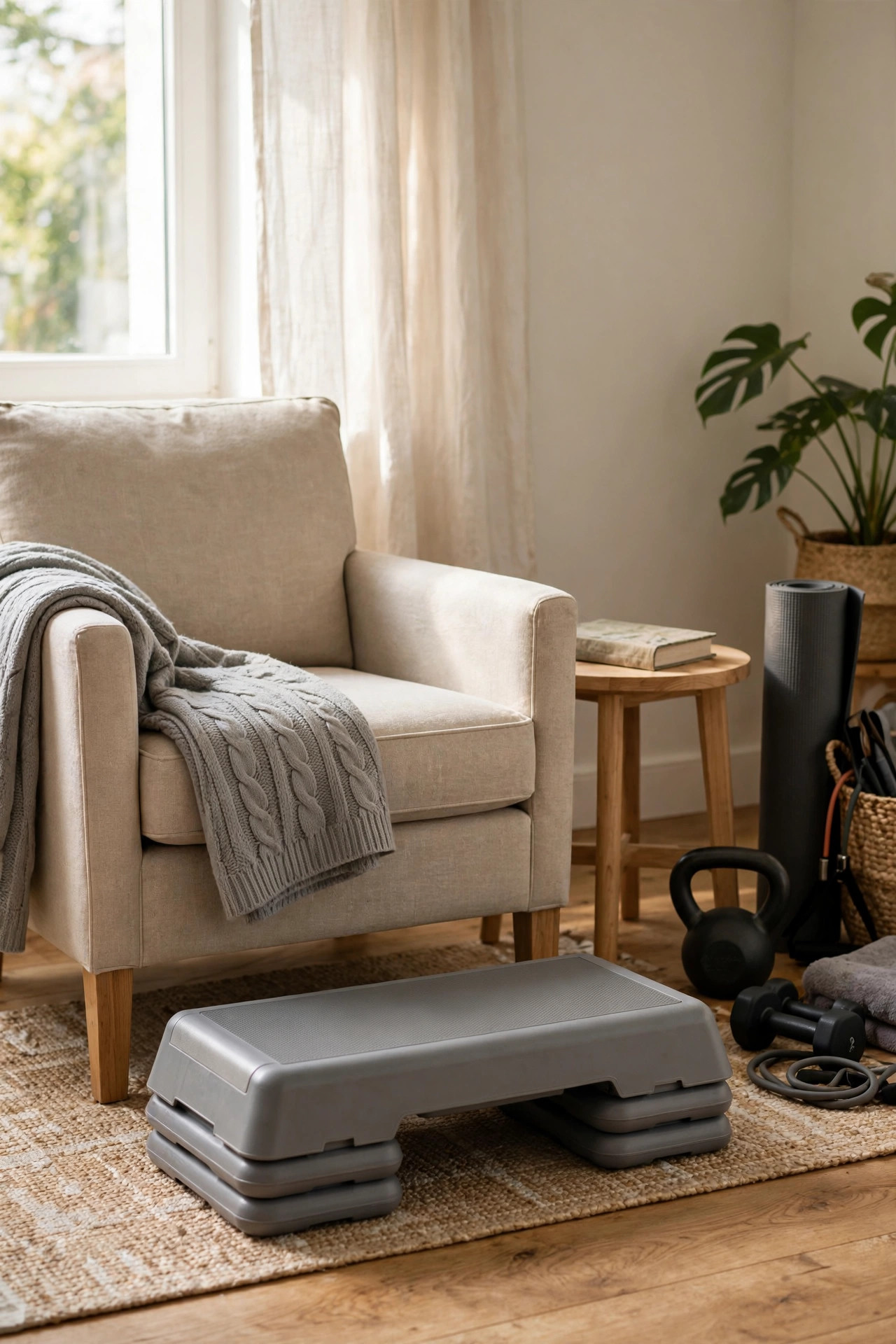
The problem is that step cardio is fantastic exercise, cheap, joint friendly, and wonderful for the heart, but a dedicated step platform is yet another single use object in a home that has no room for single use objects. Aerobic steps are wide and flat and awkward to store, so they end up leaning against a wall where they look cluttered, or shoved into a closet where you completely forget they exist. Buying one feels hard to justify when every inch of floor space is already spoken for, and that hesitation is understandable. Meanwhile your legs miss out on one of the simplest and most effective cardio tools ever invented, all because the storage math does not work. It is a classic small space dilemma, where the exercise is perfect but the object itself is the problem. This is the same logic behind sofa beds, folding tables, and nesting cookware, all furniture that refuses to do only one job. Small homes have run on dual purpose design for generations, and fitness gear should follow the exact same rule. If an object cannot justify its footprint twice over, it simply does not belong in a small space, no matter how good the exercise is.
The fix is an aerobic step that earns its floor space by working a second job as a footrest or low side table when you are not training. A sturdy step platform with a flat, attractive top works perfectly as a footrest in front of your reading chair or as a small side table holding a book and a plant. Choose one with a non slip rubber top and a weight rating well above your body weight, and pick a neutral color that blends quietly with your furniture instead of screaming gym equipment. When workout time arrives, pull it out, stack the risers to your preferred height, and you have step ups, box squats, incline push-ups, and full cardio stepping sessions. Afterward it goes straight back to its day job with zero fuss. This dual purpose trick is the real secret of small space fitness. Every object should do at least two jobs, and a step that is also furniture never feels like clutter, so it never gets banished to the closet and forgotten. Guests will never guess that your footrest is secretly gym equipment, which is exactly the point of the whole trick. The best small space fitness gear hides in plain sight, doing its quiet second job day after day until workout time arrives.
17. Bike Trainer Setup in the Corner
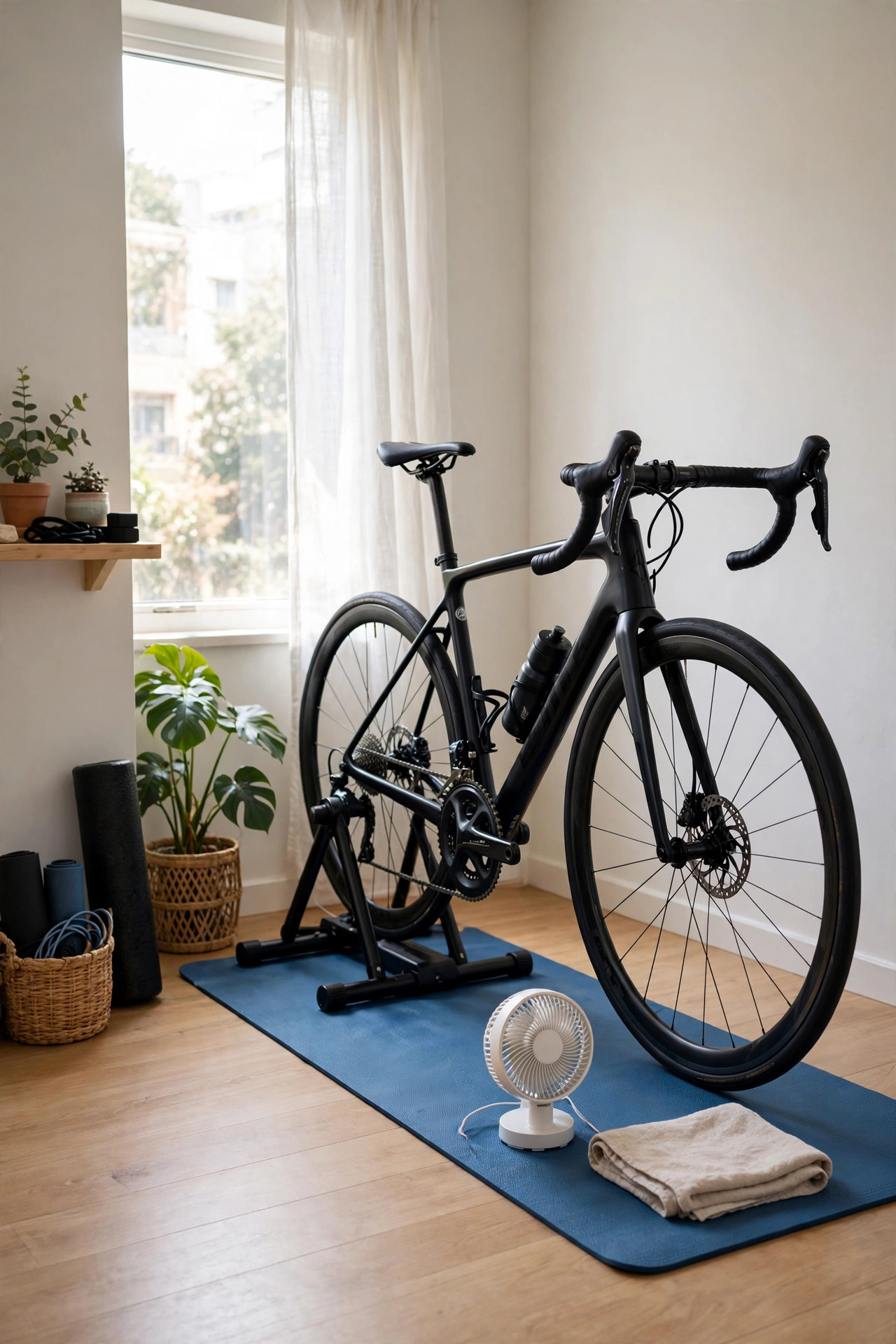
The problem is owning a perfectly good bicycle that sits unused for months because of bad weather, early darkness, or unsafe roads. Buying a separate stationary bike duplicates what you already own, costs hundreds of dollars, and demands a permanent parking spot in a home that has none to spare. Riding outside is wonderful when conditions allow, but a fitness routine that depends on perfect conditions is a routine that quietly dies every single winter. Many bike owners feel a pang of guilt watching their bike gather dust in the hallway, knowing the cardio solution is right there but unusable for half the year. The bike becomes a reminder of good intentions rather than a tool for health, which is the opposite of what it should be. Indoor training also removes every excuse that weather likes to provide. No more too hot, too cold, too dark, too windy, or too rainy to ride. The bike sits right there in the corner, ready to go in minutes, which means the only variable left is your own decision to get on it. When excuses disappear, consistency finally has room to grow and compound. That is the real power of a corner gym. It removes every barrier except the decision itself, and decisions get easier when the bike is already waiting for you.
The fix is an indoor bike trainer stand that converts your regular bike into a stationary bike in about five minutes flat. The rear wheel locks into the trainer, which provides smooth adjustable resistance, and suddenly your corner becomes a proper cycling studio. When the ride is over, the bike lifts off the stand in seconds, and the trainer itself folds flat enough to lean against the wall or slide behind furniture. Look for a trainer with quiet, smooth resistance, since cheap ones whine loudly enough to annoy the entire household, and always put a mat underneath to catch sweat and protect your floor. Add a small fan pointed at your face because indoor riding gets hot fast with no wind cooling you down, and keep a towel draped on the handlebars. If motivation is your struggle, a tablet propped at eye level playing a cycling video or your favorite show makes the minutes fly by. Your bike finally earns its keep all year round, and your corner gym gains serious cardio without a single new large machine taking up residence. Start with shorter rides than your ego suggests, because indoor cycling feels noticeably harder without coasting or downhill breaks. Twenty focused minutes on the trainer can match forty easy minutes outside, so respect the intensity, keep water within reach, and build your ride length gradually over several weeks.
Conclusion
The thread running through all seventeen ideas is simple. Small space fitness is not about cramming big equipment into a small room. It is about choosing gear that respects your space, stores in seconds, and solves a real problem instead of creating new ones. Start with the two or three ideas that fix whatever frustrates you most right now. Maybe that is the noise bothering your neighbors, the dumbbells living on your floor, or the workouts that never start because setup takes too long. Fix the biggest friction first, and the rest gets easier.
Give your corner a month before you judge it. Habits need a little time to settle, and your setup will tell you what it needs next. If you find yourself skipping stretching, the mat nook needs to be more inviting. If gear keeps migrating, the rolling cart rule needs enforcing. Adjust, tweak, and keep going. A year from now you will not remember that your gym was ever just an empty corner. You will just be the person who works out at home, in a space that fits your life perfectly.
FAQs
How much space do I really need for a small home gym?
You can build an effective workout corner in as little as a six by six foot area, which is about the size of a small rug. Most of the ideas in this article use vertical storage or fold-away gear, so the active workout footprint stays small while everything else lives on walls, under beds, or in closets. Measure your corner before you buy anything, and remember that you need a little extra room around you for safe movement, especially for exercises like kettlebell swings or lunges.
What is the best first purchase for a small home gym?
A pair of adjustable dumbbells is the strongest first buy for most beginners because one pair replaces a whole rack and covers dozens of exercises. If your budget is tighter, start with a set of resistance bands and a yoga mat, which together cost very little and still allow full body workouts. Buy for the workouts you will actually do, not the ones you imagine doing, and add equipment only when your current gear starts feeling too easy.
How do I keep my small gym from looking messy?
Give every single item a home and enforce a put away rule after each workout, with no exceptions. Fold-away and hidden storage, like the under bed tray and the storage bench in this article, make cleanup take under two minutes. Visible gear should be organized on hooks or a pegboard rather than piled on the floor, because vertical storage looks intentional while floor piles look like clutter.
Can I do cardio in a tiny space without noisy machines?
Yes, and your neighbors will thank you. A walking pad is quiet and slides under the bed, step platforms are nearly silent, and bodyweight circuits like squats, lunges, and mountain climbers need no machine at all. Foam floor tiles cut impact noise dramatically for anything with jumping. If you own a bike, a trainer stand gives you full cycling cardio in a corner without buying another machine.
Is it safe to mount gym equipment on walls and doors in a rental?
Many options are renter friendly if you choose carefully. Over the door pull-up bars and suspension trainers use leverage and padding instead of screws, and heavy duty adhesive hooks hold light gear on smooth surfaces. For anything screwed into a wall, like a pegboard or band anchors, you must hit a wall stud or use proper anchors, and you should check your lease first. When in doubt, freestanding options like a rolling cart or a leaning mirror give you the same function with zero holes.
How much does a small home gym cost to set up?
A solid starter setup with a mat, resistance bands, and a jump rope can cost less than a single month of a commercial gym membership. Adding adjustable dumbbells and a folding bench brings a complete strength setup into the range of a few hundred dollars, still far less than a year of gym fees. Start small, buy quality on the pieces you touch every day, and expand only when you outgrow what you have.