
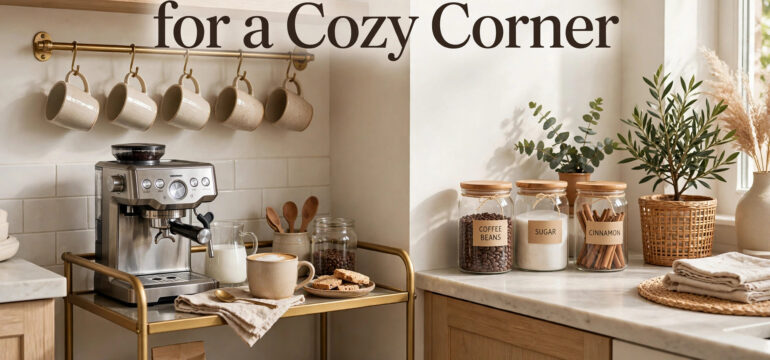
You know that feeling when you walk into a friend’s kitchen and there is a little coffee corner that looks like it belongs in a magazine? The mugs hang in a neat row, the coffee maker sits on a pretty tray, and everything you need is right there within reach. Then you walk back into your own kitchen. The counter is crowded, the coffee maker is squeezed between the toaster and the dish rack, and your mugs live in three different cabinets. You want that cozy coffee spot, but your kitchen is small and your budget is even smaller.
Here is the truth nobody tells you: a coffee bar does not need a big kitchen or a big budget. It needs one small corner and a few smart choices. Every one of these 17 ideas solves a real problem that gets in the way of a good coffee setup, from crowded counters to ugly cords to mugs with no home. Pick the ones that fit your space and your morning routine, and you will have a corner that makes every day start a little better.
1. Turn a Bar Cart Into a Rolling Coffee Station
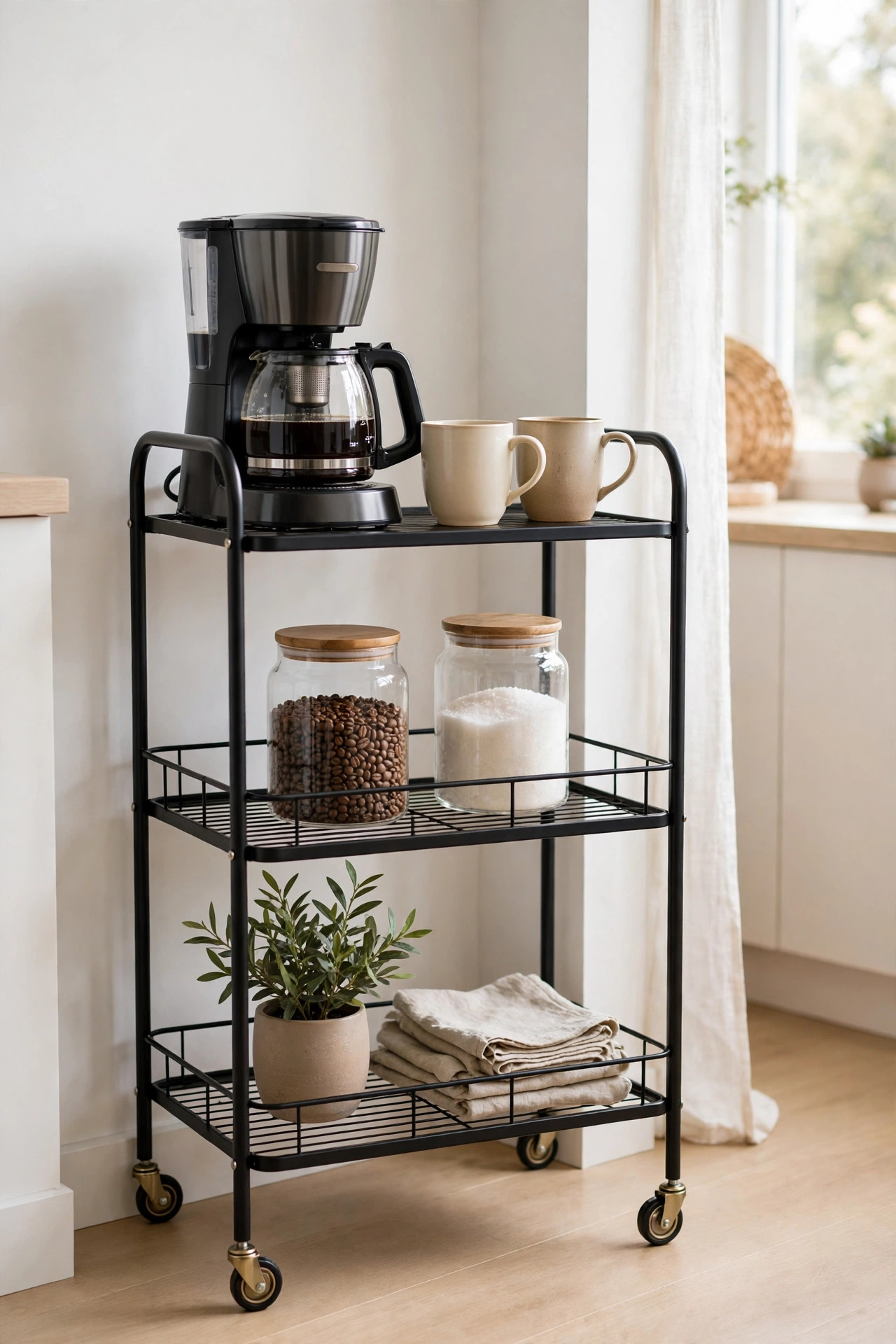
The problem is the crowded counter. Your coffee maker, grinder, and mugs fight for space with the toaster, the fruit bowl, and the mail pile. Every morning feels like a small battle just to make a cup of coffee, and the counter never looks clean no matter how often you wipe it down.
The fix is a bar cart that holds your whole coffee setup on two or three tiers. You park it in a corner or against a free stretch of wall, load the top with the coffee maker and mugs, and use the lower shelves for beans, filters, and sugar. The wheels are the best part. You can roll it next to you while you cook breakfast and push it back into its corner when you are done, which means your counter stays clear all day.
2. Dedicate One Kitchen Cabinet Shelf to Coffee
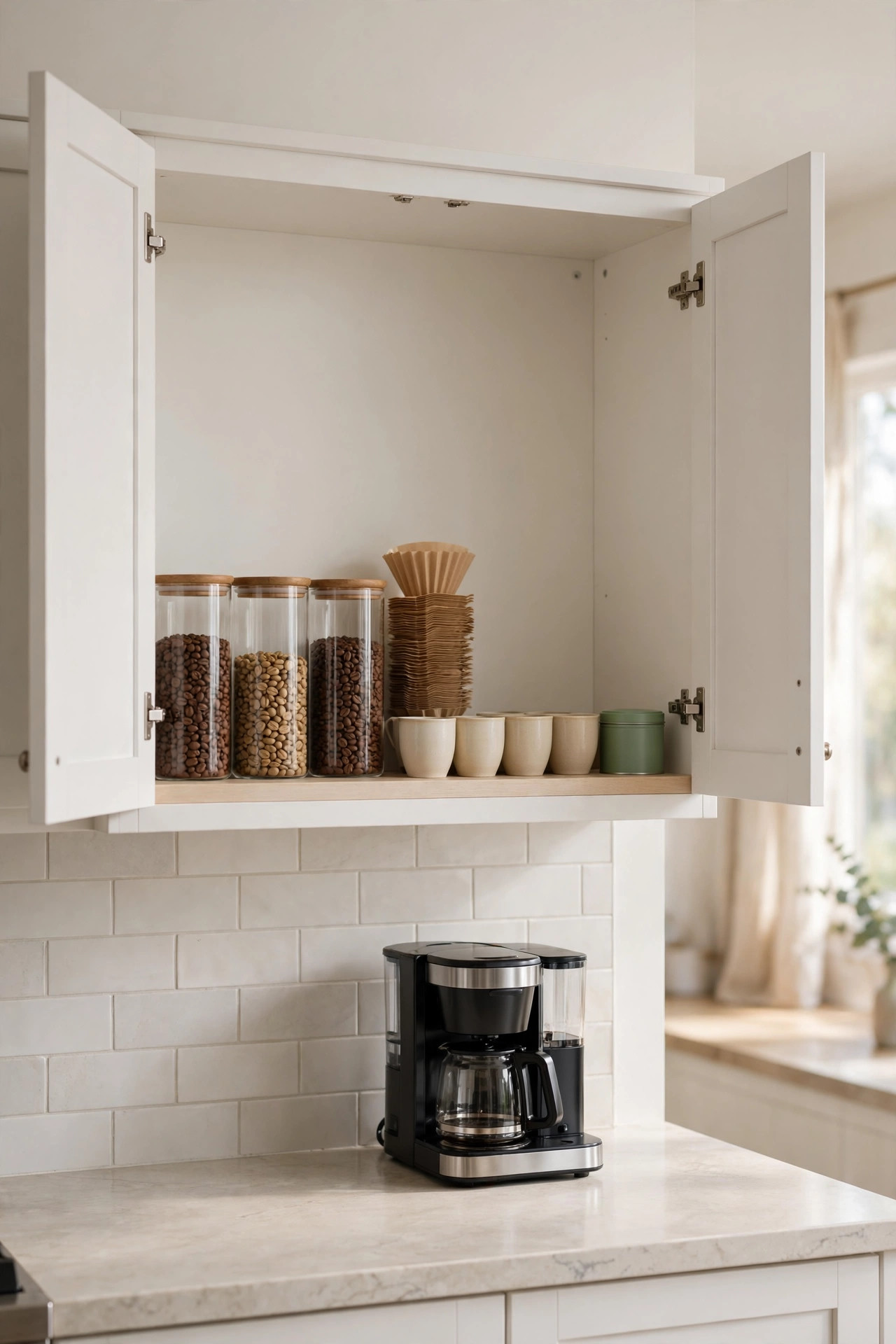
The problem is scattered supplies. Your coffee beans are in the pantry, the filters are above the fridge, and the travel mugs are somewhere you cannot quite remember. Making coffee means opening four doors and walking in circles, which is too much work before caffeine.
The fix is one shelf inside one cabinet that holds everything coffee in a single spot. Clear the shelf, put your beans, filters, sweeteners, and a few mugs there together, and nothing else. It works because your hands learn where everything lives, so making coffee becomes one smooth motion instead of a treasure hunt. If the shelf is near the coffee maker, even better, because then your whole routine happens in one small zone.
3. Use a Small Tray to Corral the Clutter
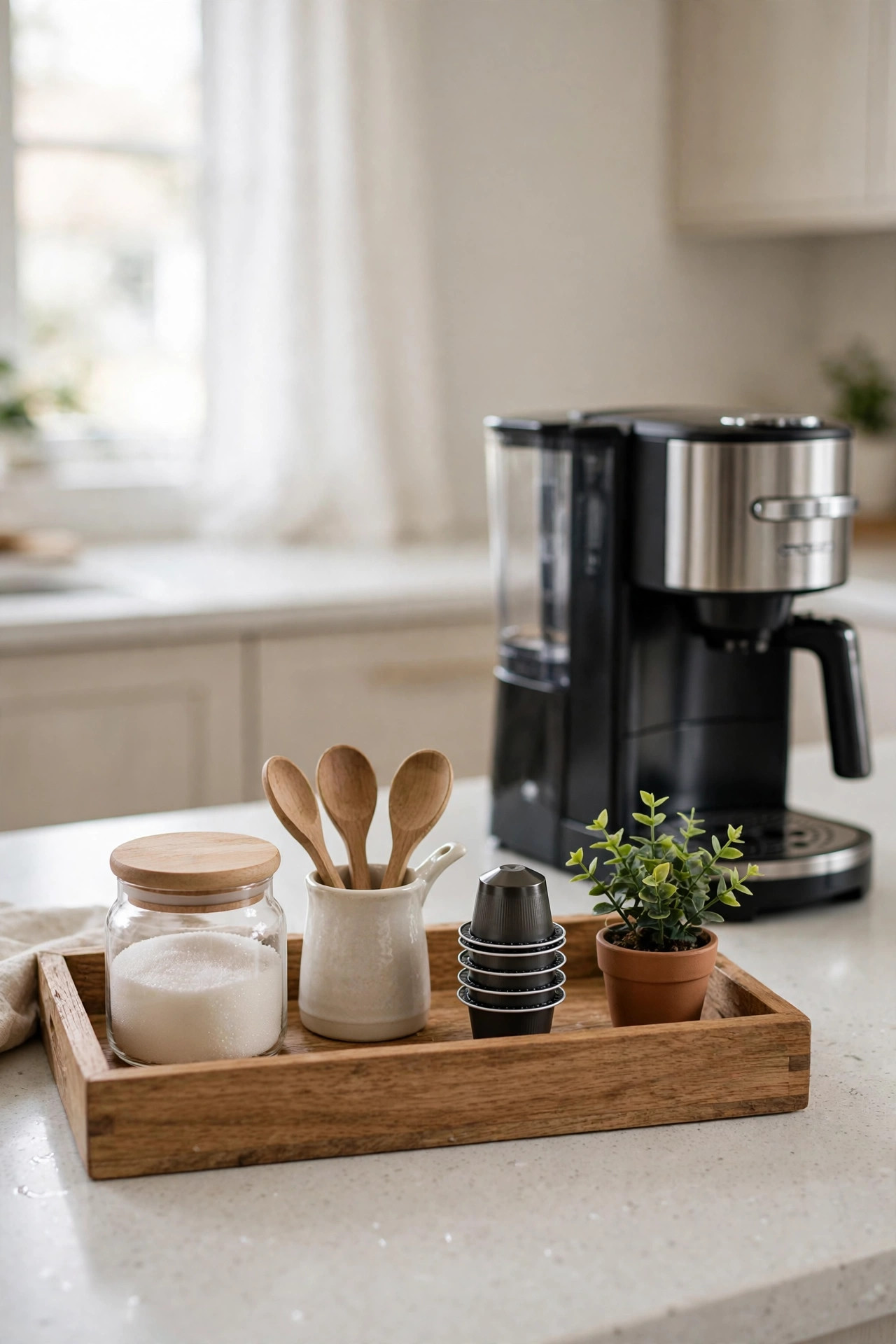
The problem is the messy look. Even when every item has a purpose, a coffee maker plus a sugar jar plus a spoon holder plus a stack of pods looks like clutter on an open counter. Your eye reads it as mess, and the whole corner feels chaotic instead of cozy.
The fix is a single tray that holds all the small pieces together. Put the sugar jar, the spoons, the pods, and a small plant or candle on the tray, and set the coffee maker right beside it. The tray draws a clear border around the group, so your brain reads it as one styled arrangement instead of five random objects. A wood tray warms up the corner, a marble one makes it feel fancy, and either one wipes clean in seconds.
4. Mount a Floating Shelf Above the Counter
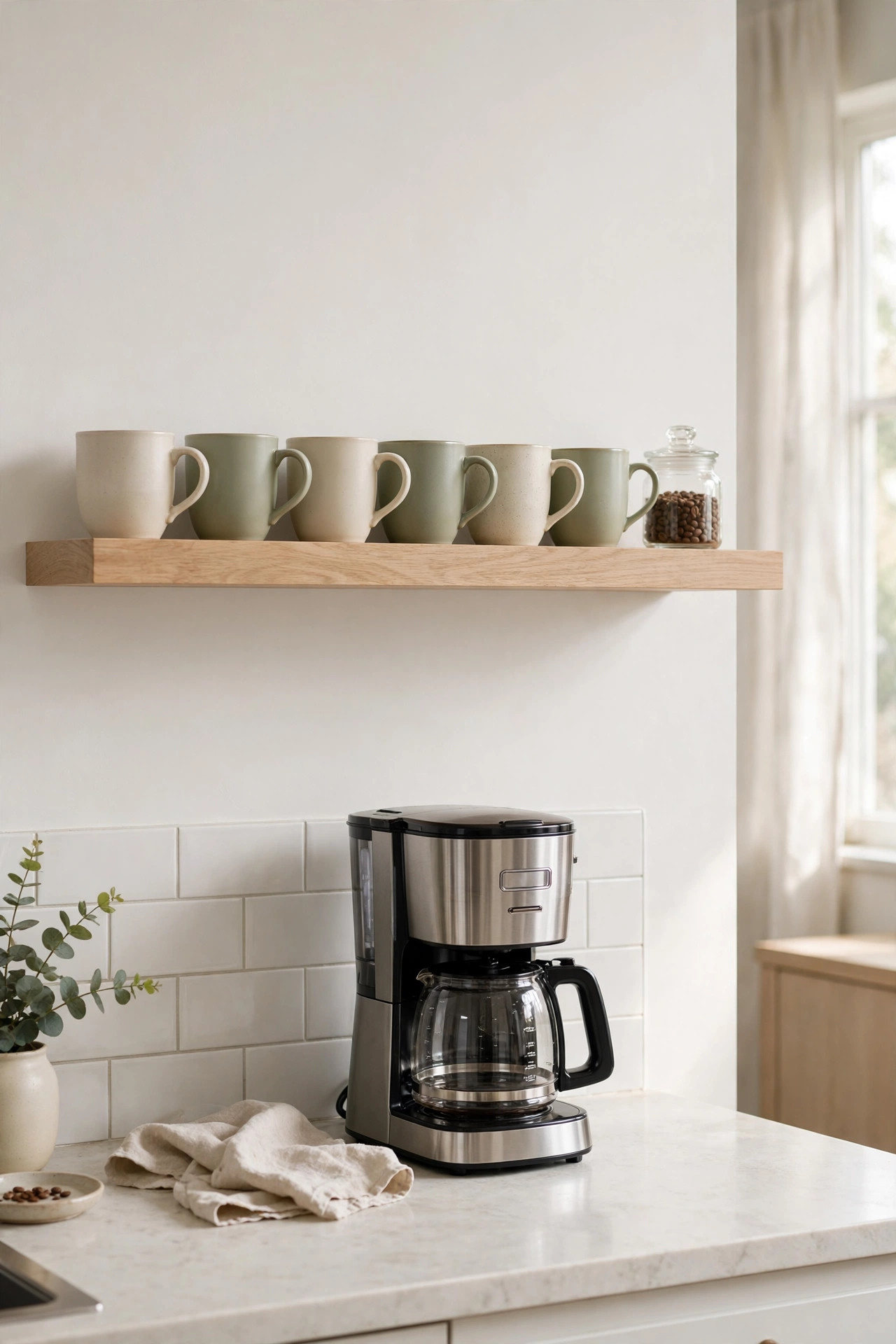
The problem is wasted wall space. The wall above your coffee maker is empty while the counter below it overflows. Mugs pile up, jars crowd together, and there is nowhere for the pretty things you actually want to look at.
The fix is one or two floating shelves mounted on that empty wall. You screw the brackets into a stud, slide the shelf on, and suddenly your mugs hang below on hooks or sit in a neat row above. The shelf lifts half the clutter off the counter and puts your nicest mugs on display at the same time. Keep the shelf within easy reach so grabbing a mug is still a one hand job, and leave a little breathing room between items so it looks styled instead of stuffed.
5. Repurpose a Nightstand as a Coffee Nook
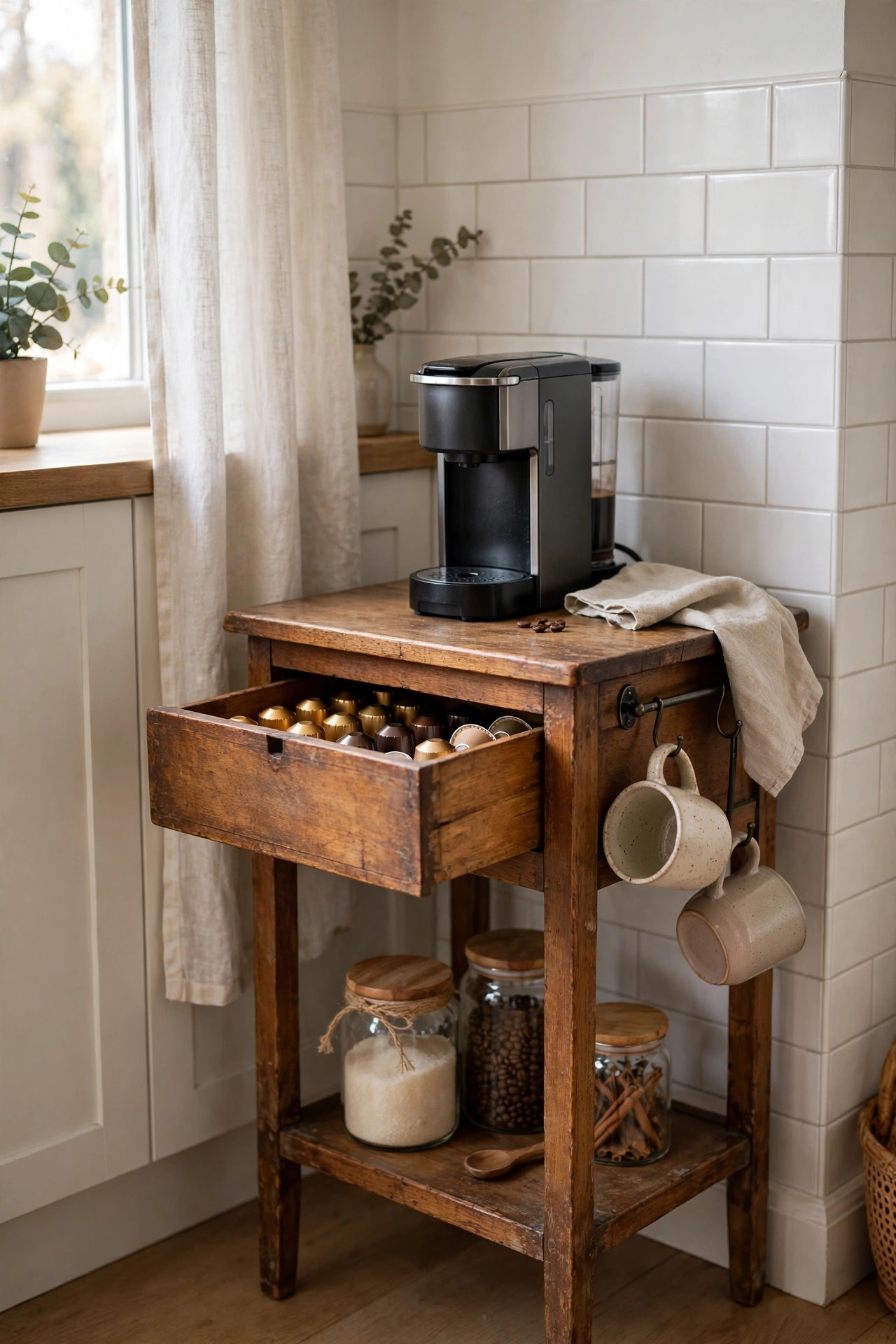
The problem is no free counter at all. Some kitchens are so small that every inch of counter is already claimed by cooking. There is simply nowhere to put a coffee maker without moving something else first, which means the coffee setup never gets a permanent home.
The fix is a small nightstand or side table pulled into a corner to serve as a dedicated coffee stand. A nightstand is the perfect size for a coffee maker on top and supplies in the drawer or on the lower shelf. Check thrift stores for a solid wood one, since they cost very little and look charming with a little polish. Push it into any corner with an outlet nearby, and you have a full coffee bar that does not touch your kitchen counter at all.
6. Hang Mugs on Hooks Under a Cabinet
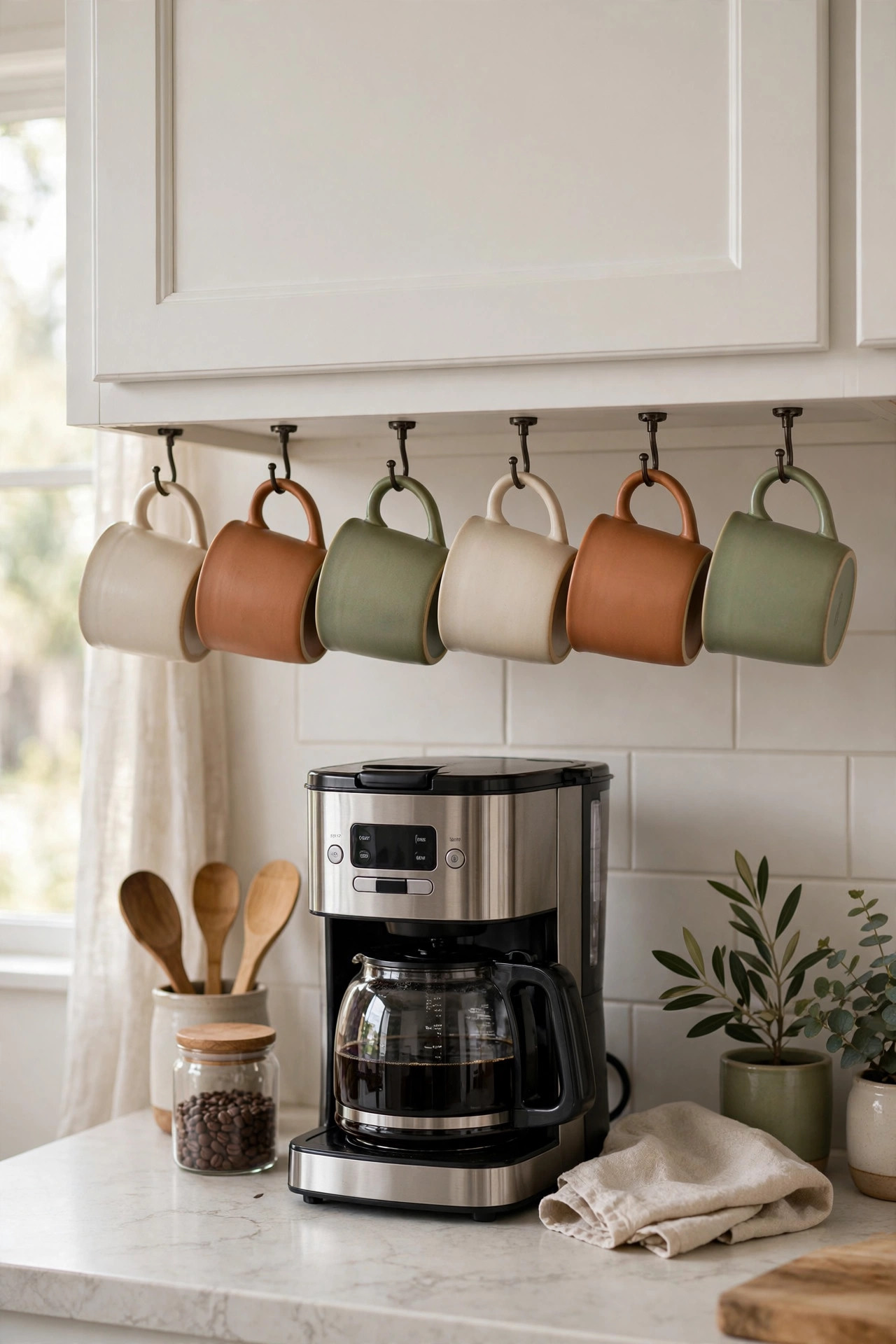
The problem is mug chaos. Mugs are bulky, they do not stack well, and they eat cabinet space fast. You end up with a leaning tower of mugs that threatens to fall every time you grab one, or mugs spread across three shelves where you can never find your favorite.
The fix is a row of small hooks screwed under an upper cabinet, right above your coffee station. Each mug gets its own hook, so they hang in a neat line where you can see every one at a glance. It frees a whole cabinet shelf for other things, and the hanging mugs actually look good, like a little display of your collection. Use sturdy cup hooks and screw them into the cabinet base, not just the thin bottom panel, so they hold the weight without pulling out.
7. Tuck the Station Into an Unused Closet
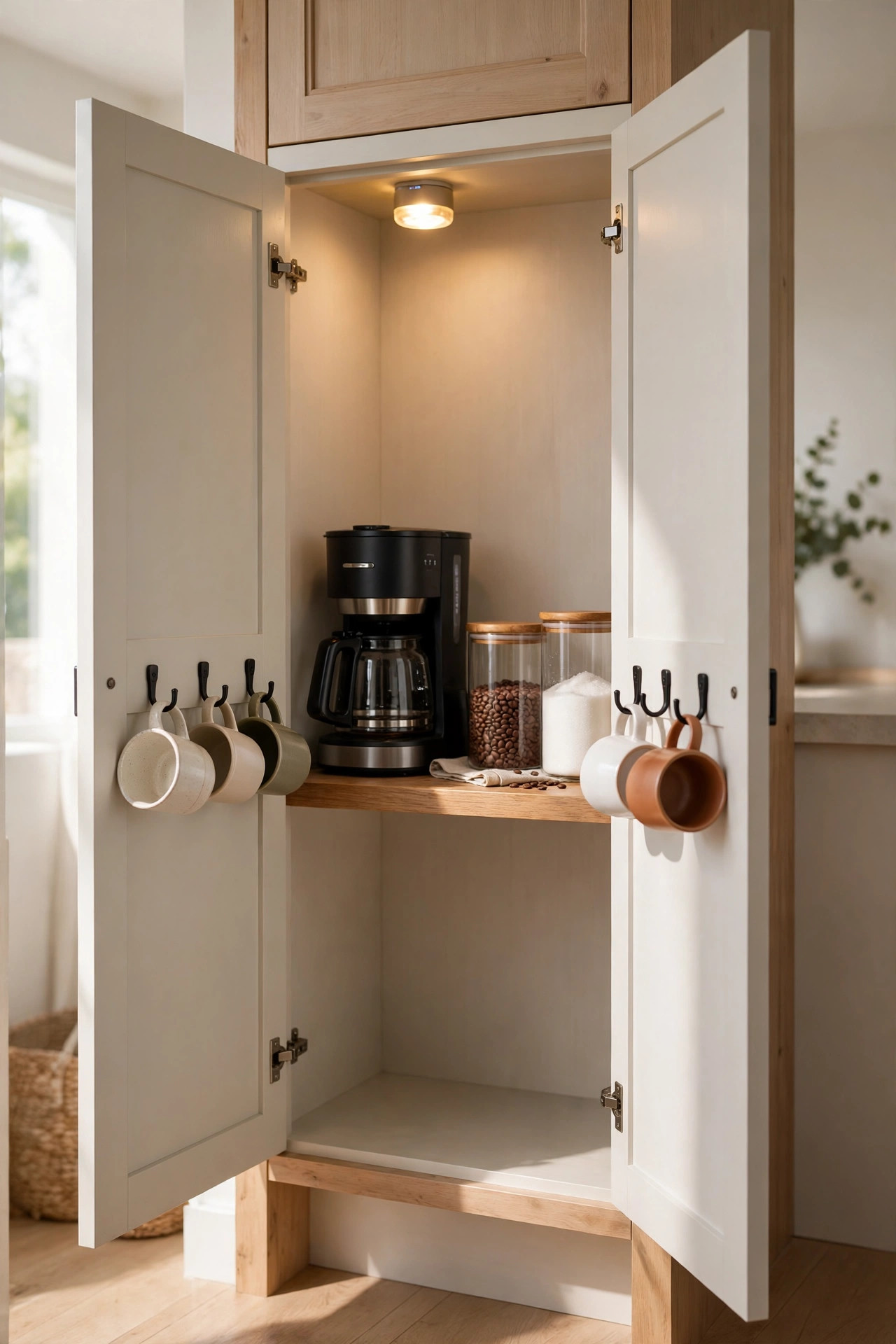
The problem is a kitchen with zero spare corners. Maybe your kitchen is a galley, or the only free wall is taken up by the fridge. There is nowhere to build a visible coffee bar, and giving up cooking space for coffee feels wrong.
The fix is a closet, pantry, or even a coat closet near the kitchen that becomes a hidden coffee station. Clear one shelf at counter height, set the coffee maker there, and add your supplies around it. You open the doors in the morning, make your coffee, and close them when you are done, which means the kitchen stays clean and the coffee gear stays out of sight. Add a small battery light inside if the closet is dark, and run a short extension cord to the nearest outlet so the coffee maker has power.
8. Use a Tiered Stand for Small Supplies
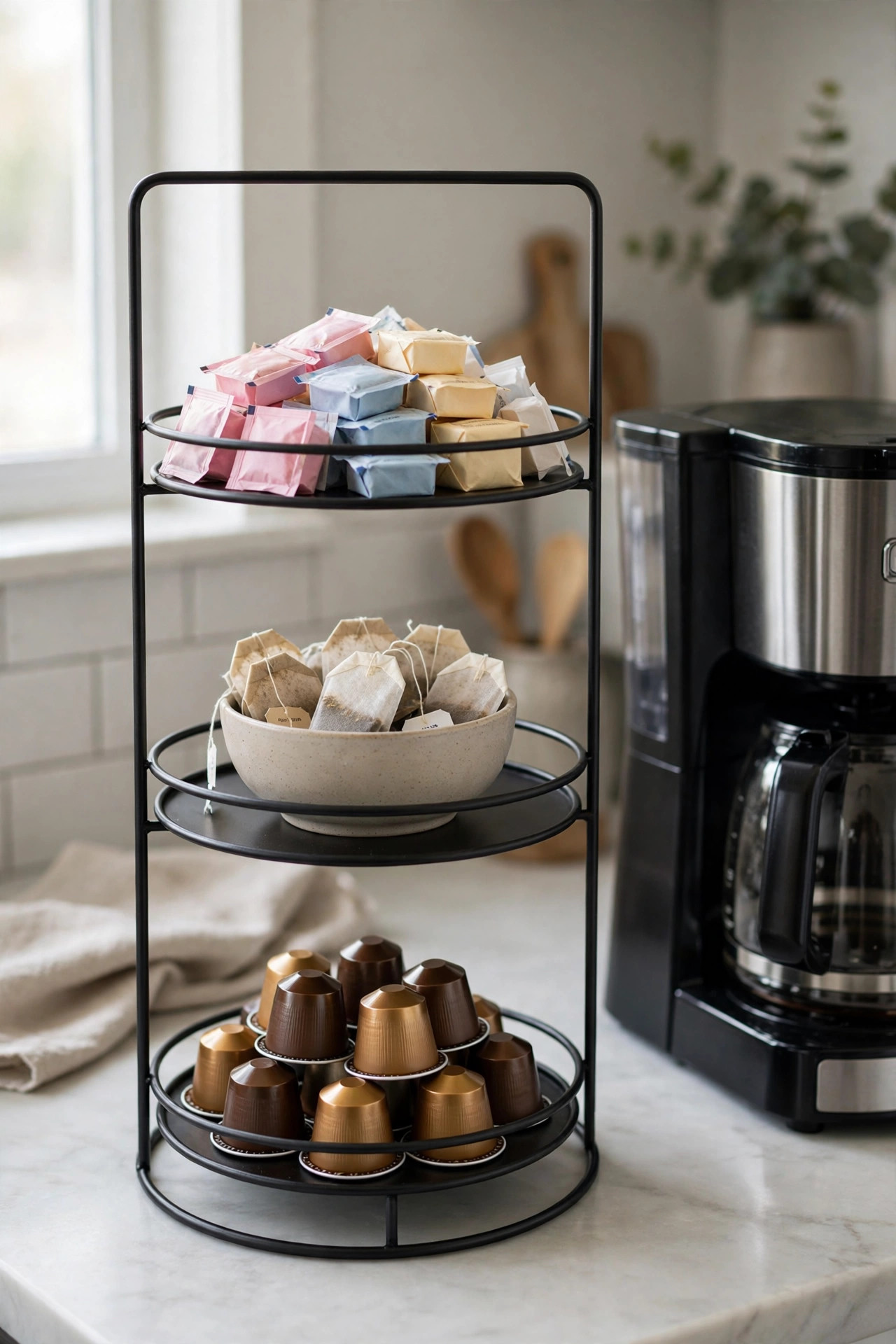
The problem is tiny items taking over. Pods, tea bags, sweetener packets, and stir sticks are all small, and small things spread. They slide behind the coffee maker, fall into drawers, and turn the corner into a mess of little bits that are hard to tidy.
The fix is a two or three tiered stand, the kind often used for cupcakes, that stacks small supplies vertically. Pods go on the bottom tier, tea bags in the middle, and sweeteners on top, all in one footprint about the size of a dinner plate. It works because it gives every tiny item a visible home, so nothing drifts. When guests come over, the stand looks intentional and pretty, like you styled it on purpose instead of just piling things up.
9. Add a Power Strip for Hidden Cords
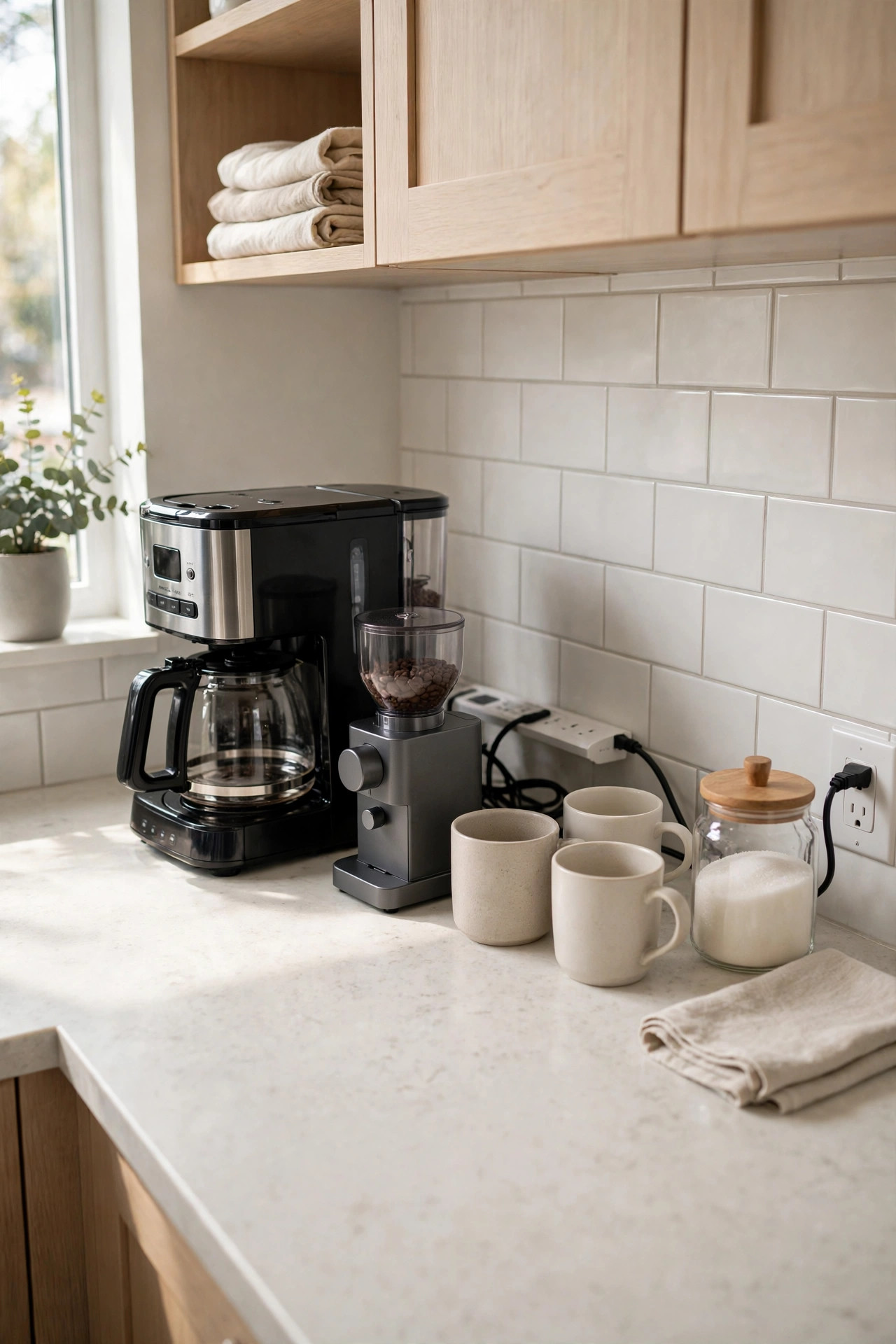
The problem is the tangle of cords. The coffee maker cord, the grinder cord, and the milk frother cord snake across the counter and behind everything. It looks messy, it collects dust, and it makes wiping the counter a chore because you have to lift every cord.
The fix is a small power strip mounted or tucked right behind the coffee station. Plug everything into the strip, then plug the strip into the wall with one cord. Coil the extra cord length with a twist tie and tuck it behind the coffee maker where nobody sees it. One cord to the wall instead of three changes the whole look of the corner. If your strip has a switch, you can even turn everything off with one click at night, which saves a little power too.
10. Style a Corner of the Dining Room Sideboard
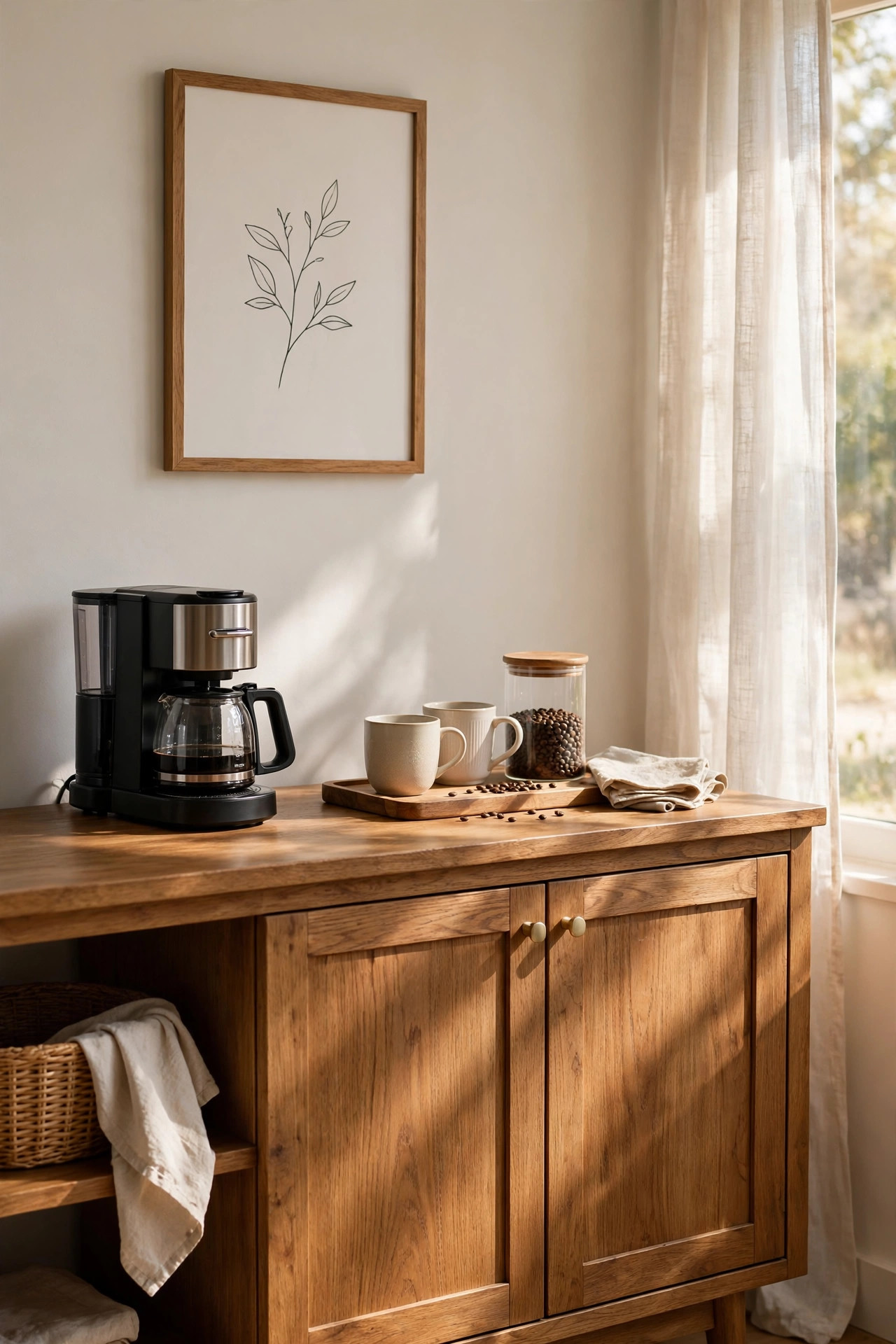
The problem is a kitchen too small for any coffee setup at all. When the kitchen truly has no room, most people give up on the idea of a coffee bar, and the coffee maker ends up on top of the fridge or in a cabinet where it is a pain to use.
The fix is the dining room sideboard, buffet, or console table, which often sits half empty. Clear one end of it, set up the coffee maker and a small tray of supplies, and hang a little sign or frame above it to mark the spot. It works because the dining room is usually steps from the kitchen, so the walk is short, and the sideboard gives you a wide, stable surface. Your guests will love it too, since they can pour a second cup without walking into your cooking zone.
11. Keep Cream and Sugar in Matching Jars
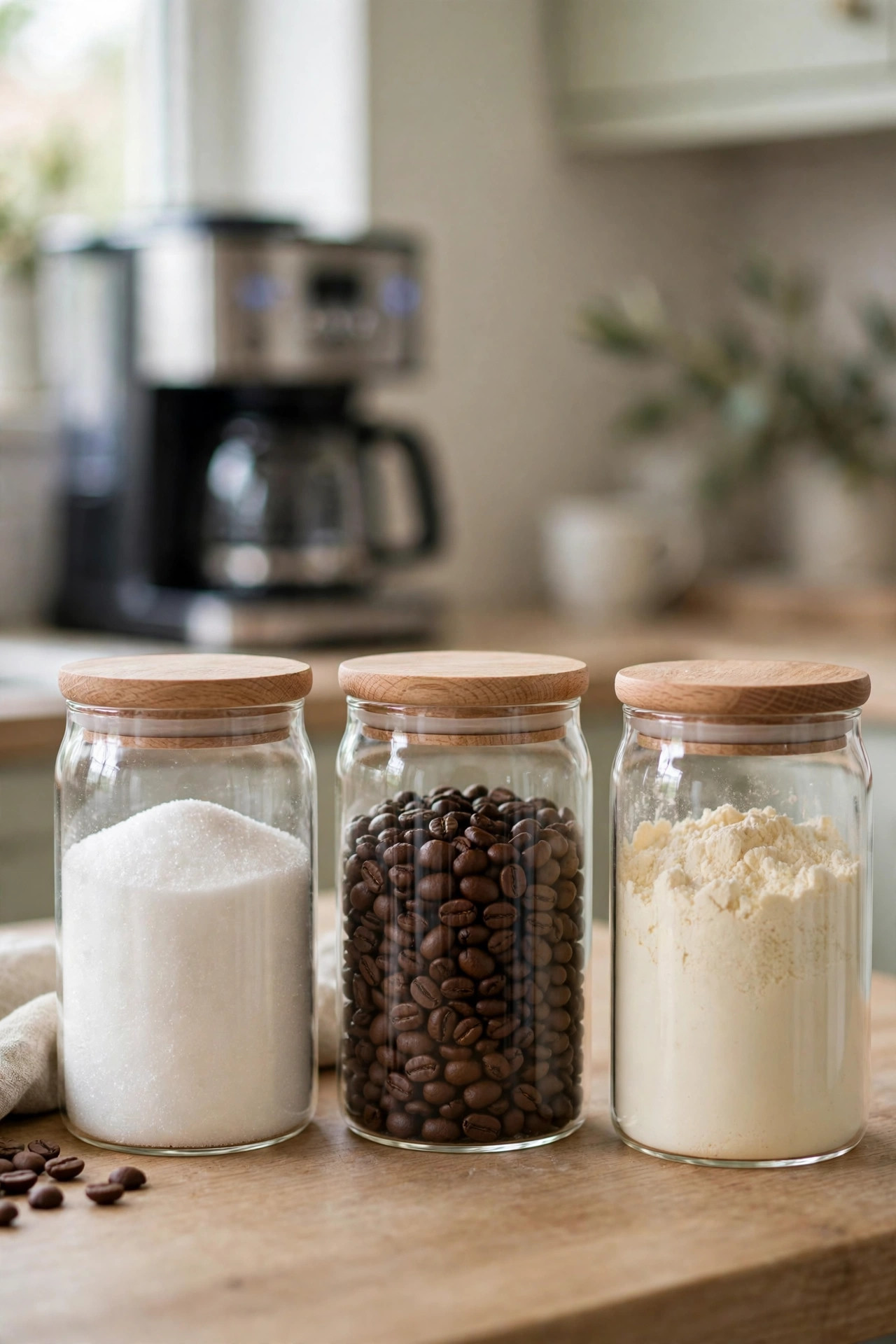
The problem is ugly packaging. The creamer comes in a plastic bottle, the sugar in a torn bag, and the whole station looks like a grocery shelf instead of a cozy corner. Packaging is designed to sell, not to look good in your home, and it drags the style down.
The fix is two or three matching jars with lids for sugar, creamer powder, and coffee beans. Pour the supplies in, label the jars if you like, and toss the original packaging. Matching jars turn a random pile of products into a set that looks like it was bought together. Glass jars let you see when you are running low, and a tight lid keeps everything fresh. This one small change makes the biggest visual difference for the least money.
12. Use a Small Bookshelf as a Coffee Tower
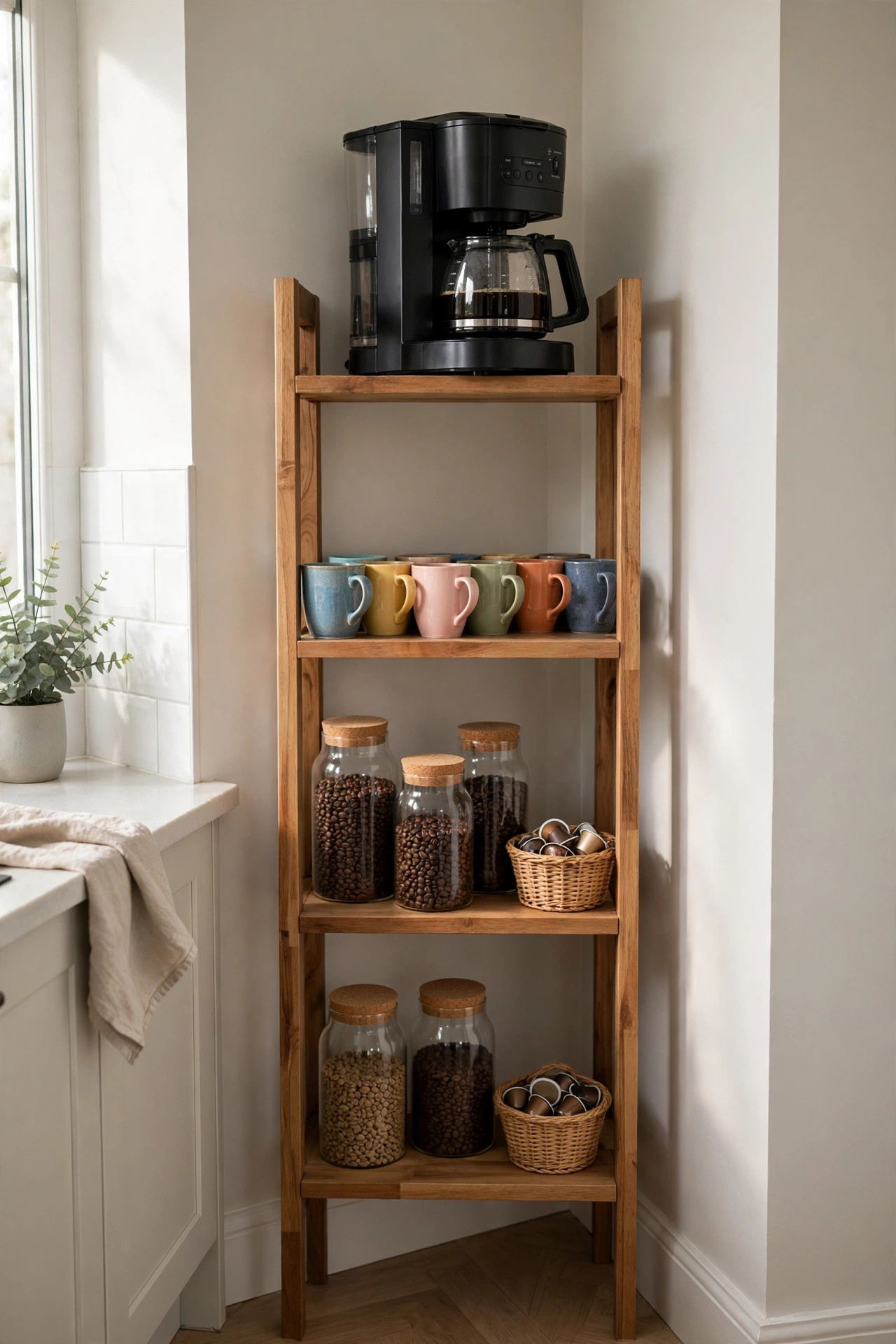
The problem is needing storage and surface in one tiny footprint. A coffee bar needs a place for the machine plus room for mugs, beans, and extras, and most small tables only give you the top surface. Everything else ends up back on the kitchen counter, which defeats the purpose.
The fix is a narrow bookshelf, about a foot wide, that acts as a coffee tower. The coffee maker sits on top, mugs line the middle shelves, and beans and supplies fill the bottom. A bookshelf gives you four or five levels of storage in the floor space of one chair. Look for a sturdy one that does not wobble, since a coffee maker vibrates a little when it brews. Paint it or leave it wood, and it becomes a real piece of furniture instead of a makeshift setup.
13. Add a Small Lamp for a Warm Glow
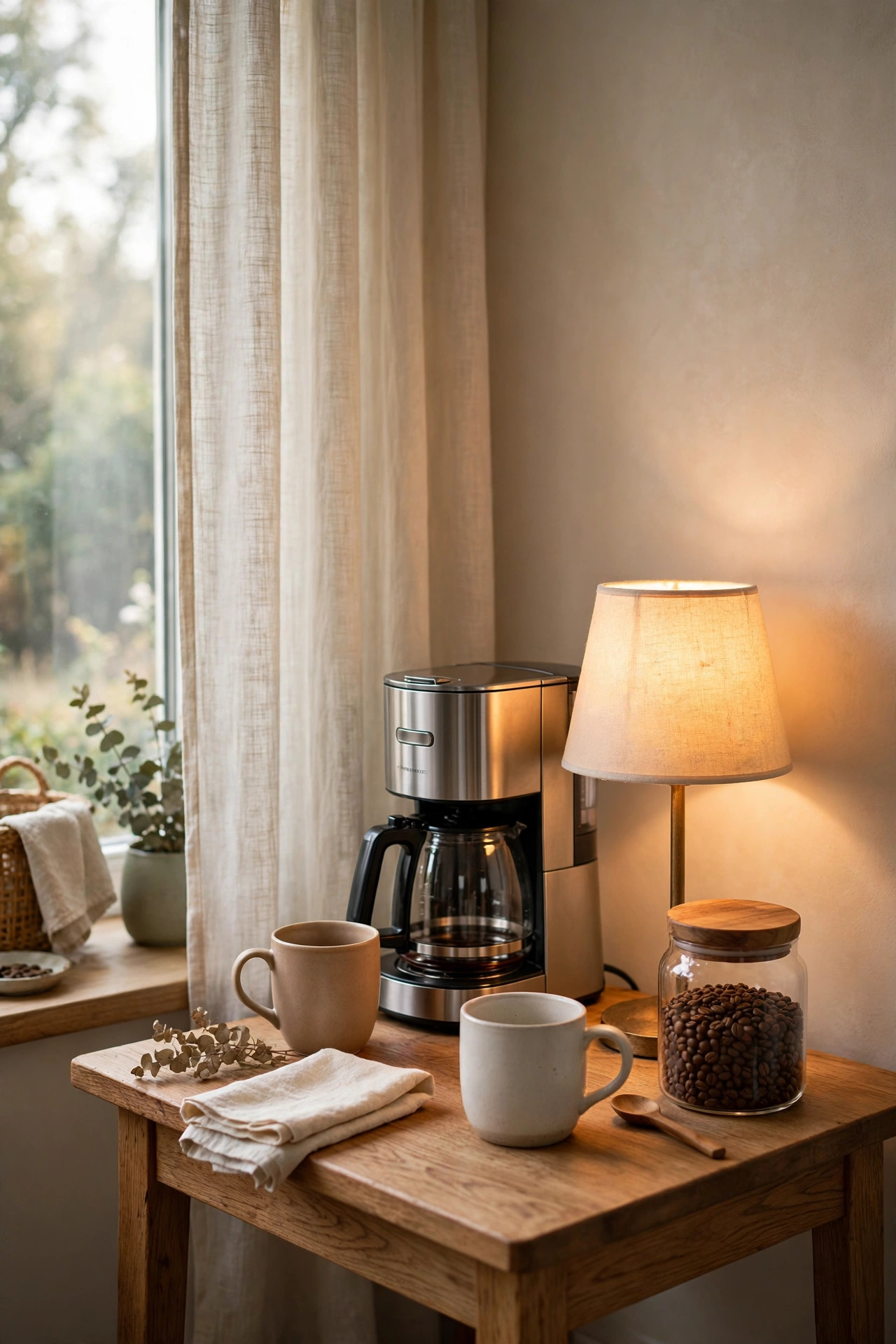
The problem is harsh kitchen lighting. Overhead kitchen lights are bright and cold, which is fine for cooking but terrible for a cozy corner. Your coffee bar sits under the same flat light as the sink, and it never feels like a special spot.
The fix is a small lamp placed right at the coffee station. A little table lamp with a warm bulb turns the corner into its own world, separate from the rest of the kitchen. Mornings feel calmer when you make coffee in soft light instead of the full overhead glare. Pick a lamp with a fabric shade for the softest glow, and use a warm white bulb. If there is no outlet nearby, a battery operated lamp works just as well and needs no cord at all.
14. Store Beans in Airtight Canisters
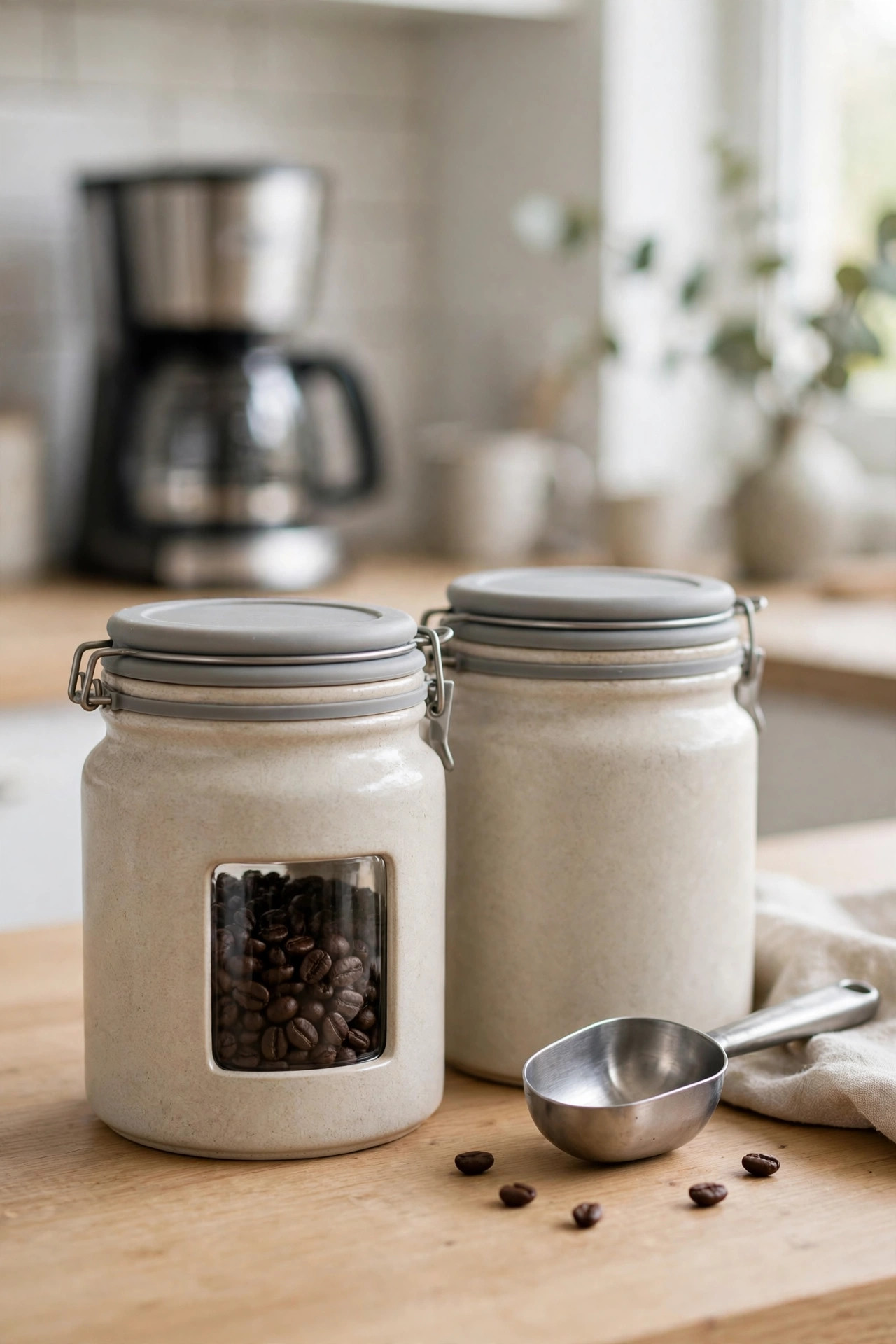
The problem is stale coffee. Beans left in the bag they came in go stale fast, especially once the bag is opened and rolled shut with a clip. You buy good beans and then wonder why the coffee tastes flat by the second week.
The fix is an airtight canister for your beans, preferably one that blocks light. Air and light are what age coffee, so a sealed, opaque canister keeps beans fresh for weeks instead of days. Scoop out what you need each morning and seal it right back up. As a bonus, a nice canister looks great on the coffee bar, so it does double duty as storage and decor. Ceramic canisters with silicone seals work well and come in every style.
15. Use a Fold Down Wall Table for Tiny Kitchens
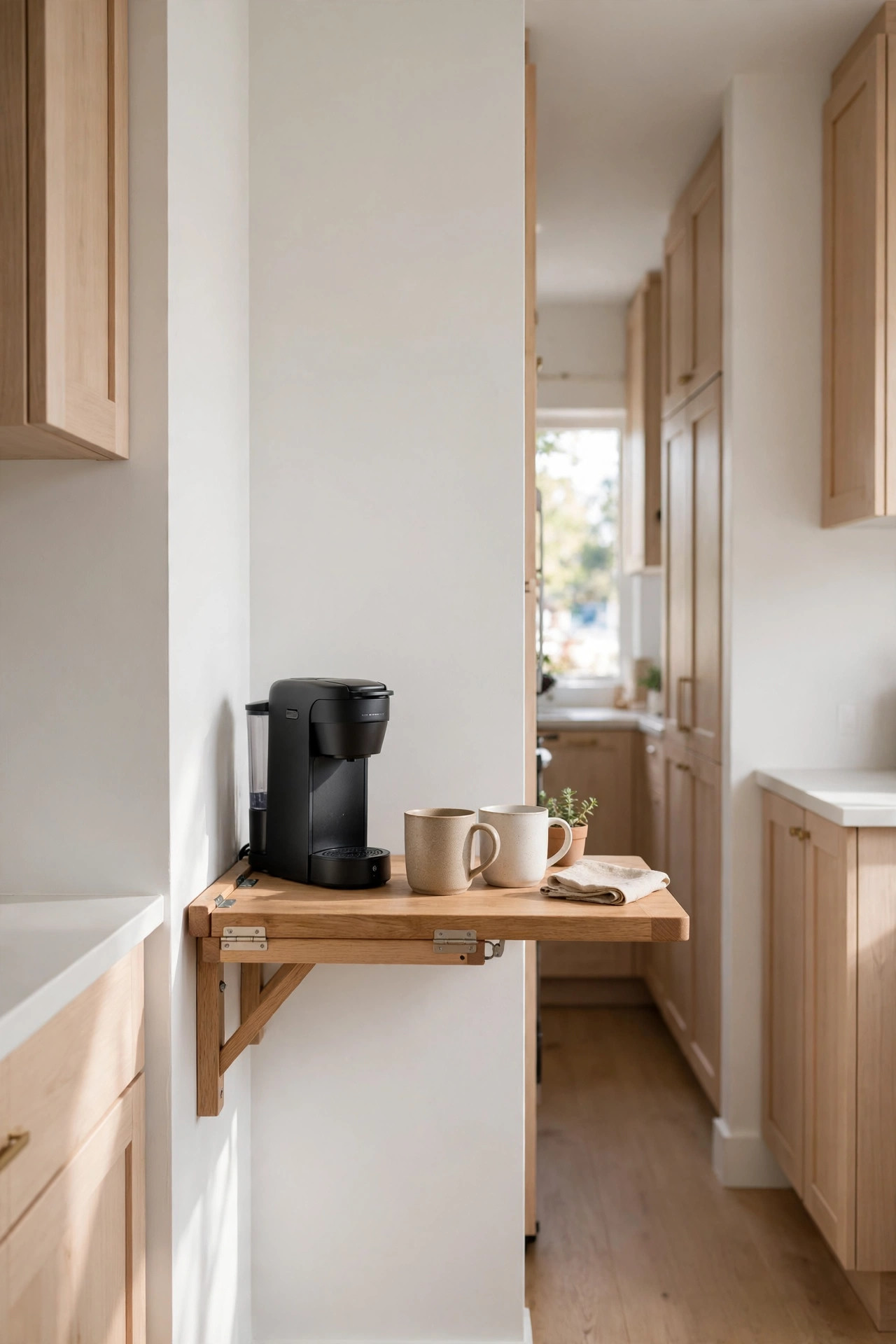
The problem is no floor space for furniture. In a truly tiny kitchen, there is no room for a cart, a nightstand, or a bookshelf. Every piece of furniture you add makes the room harder to move through, so the coffee bar feels impossible.
The fix is a fold down wall table that mounts to the wall and folds flat when you are not using it. You flip it down in the morning, set the coffee maker on it, and fold it back up when you are done. It gives you a full size coffee surface that disappears completely. Mount it at counter height on any free stretch of wall, and make sure it locks firmly in the down position so it holds the coffee maker safely. This is the smallest possible footprint a coffee bar can have.
16. Add a Small Rug to Define the Corner
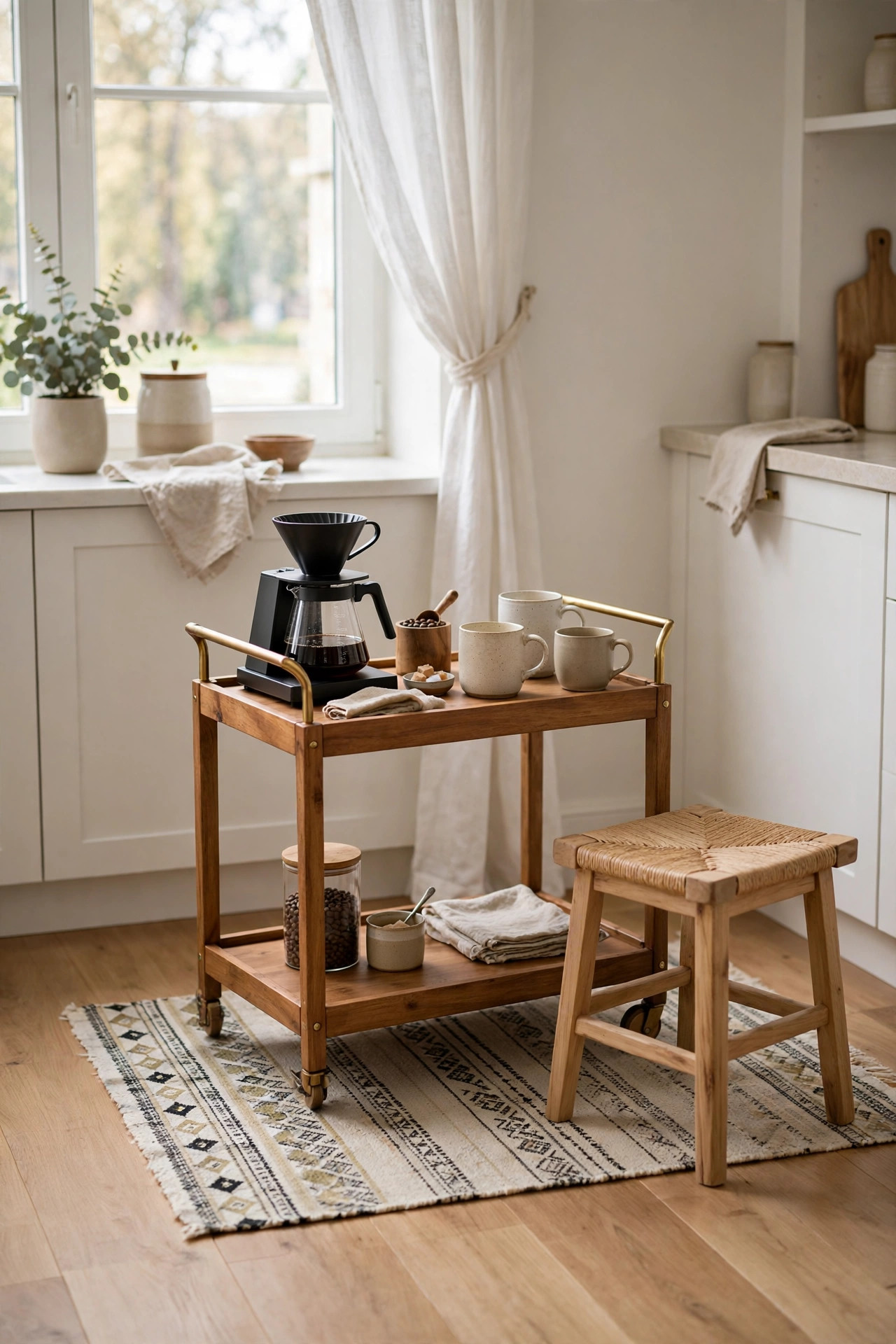
The problem is a coffee bar that blends into nowhere. When your station sits in a corner of a bigger room, it can look like random items that drifted together instead of a deliberate spot. There is no visual boundary, so the eye skips right past it.
The fix is a small rug placed under or in front of the coffee station. The rug draws a clear zone on the floor and tells your eye that this corner has a purpose. It also makes the spot feel warmer and more finished, like a little room within the room. Choose a flat weave rug that is easy to clean, since coffee splashes happen, and pick a pattern or color that ties into your kitchen. Even a two by three foot rug is enough to do the job.
17. Label Everything With Simple Tags
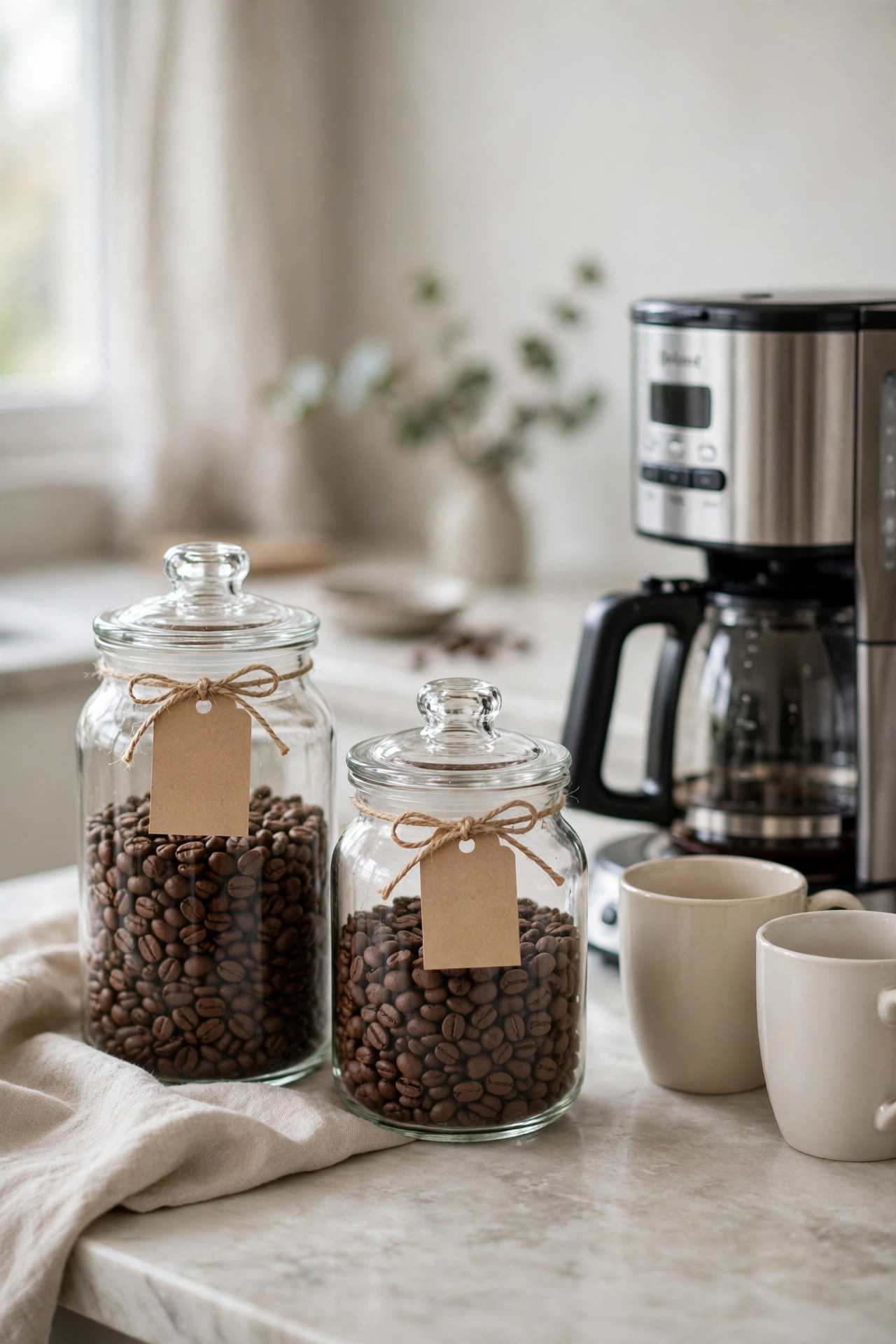
The problem is confusion, especially with guests or family. Nobody knows which jar holds decaf, which one holds sugar, and whether the pods are regular or flavored. People open every jar to check, which slows everything down and makes a mess.
The fix is simple labels on every jar, canister, and bin. A chalkboard tag tied with twine, a small sticker, or a tag slipped into a frame all work. Labels make the station usable for everyone in the house, not just the person who set it up. They also look charming and intentional, like a little cafe. Write clearly and keep the words short, decaf, sugar, pods, so anyone can read them at a glance.
You do not need a big kitchen to have a coffee bar worth loving. You need one corner, a few honest fixes, and the willingness to start small. Every idea in this list came from a real problem that real people hit in real kitchens, and every fix costs less than a month of coffee shop visits. Pick the one that solves your biggest headache first, and let the rest come later.
Your cozy corner is closer than you think. It might be a cart, a shelf, or just a tray on the counter you already have. What matters is that it is yours, it works for your mornings, and it makes you smile before the first sip. That is a problem worth fixing, and now you know exactly how.eed far less than you think. A coffee bar can live on a two foot stretch of counter, a small bar cart, or even a single cabinet shelf. The key is keeping everything in one zone so the routine stays simple. If you have a corner with an outlet nearby, you have enough space. Measure the spot, then choose a setup that fits it instead of trying to squeeze a big station into a small gap.Start with four things: your coffee maker, your mugs, your coffee or pods, and something for sugar and creamer. That is a complete coffee bar. Everything else, like trays, jars, and signs, is styling that you can add later. Do not buy a full set of accessories before you know your routine. Set up the basics, use them for a week, and then add what you actually miss.e everything a boundary. A tray under the small items, hooks for the mugs, and jars instead of original packaging will tame almost any mess. Follow the one in, one out rule too. When a new gadget arrives, something old leaves. Wipe the surface once a day, which takes less than a minute when everything has a home. A coffee bar looks cluttered when items have no place, not when it has too many items.Yes, and many people do. A French press, a pour over dripper, or even an electric kettle with instant coffee all work as the heart of a coffee bar. These take up less space than a machine and cost much less. The station still gets the tray, the mugs, and the jars, so it looks and feels like a real coffee corner. Choose the brewing method you will actually use every day, because the best setup is the one that fits your habit.everything into one small power strip tucked behind the coffee maker, so only a single cord runs to the wall outlet. Coil extra cord length with a twist tie and hide it behind the machine or inside a small cord box. Run the final cord flat along the wall or counter edge where it draws less attention. If your coffee bar is on a cart, keep the strip on the cart so the whole station moves as one unit.Start with what you already own. Use a tray or cutting board you have, jars from the pantry, and mugs from the cabinet. A thrift store bar cart or nightstand often costs less than a restaurant dinner. Buy only the pieces that solve a real problem, like hooks for the mugs or a jar for the sugar. Most cozy coffee bars in this list cost less than fifty dollars total when you shop your own home first.
FAQs
How much space do I need for a coffee bar?
You need far less than you think. A coffee bar can live on a two foot stretch of counter, a small bar cart, or even a single cabinet shelf. The key is keeping everything in one zone so the routine stays simple. If you have a corner with an outlet nearby, you have enough space. Measure the spot, then choose a setup that fits it instead of trying to squeeze a big station into a small gap.
What do I actually need to start a coffee bar?
Start with four things: your coffee maker, your mugs, your coffee or pods, and something for sugar and creamer. That is a complete coffee bar. Everything else, like trays, jars, and signs, is styling that you can add later. Do not buy a full set of accessories before you know your routine. Set up the basics, use them for a week, and then add what you actually miss.
How do I keep a coffee bar from looking cluttered?
Give everything a boundary. A tray under the small items, hooks for the mugs, and jars instead of original packaging will tame almost any mess. Follow the one in, one out rule too. When a new gadget arrives, something old leaves. Wipe the surface once a day, which takes less than a minute when everything has a home. A coffee bar looks cluttered when items have no place, not when it has too many items.
Can I make a coffee bar without a coffee maker?
Yes, and many people do. A French press, a pour over dripper, or even an electric kettle with instant coffee all work as the heart of a coffee bar. These take up less space than a machine and cost much less. The station still gets the tray, the mugs, and the jars, so it looks and feels like a real coffee corner. Choose the brewing method you will actually use every day, because the best setup is the one that fits your habit.
How do I hide the cords on my coffee bar?
Plug everything into one small power strip tucked behind the coffee maker, so only a single cord runs to the wall outlet. Coil extra cord length with a twist tie and hide it behind the machine or inside a small cord box. Run the final cord flat along the wall or counter edge where it draws less attention. If your coffee bar is on a cart, keep the strip on the cart so the whole station moves as one unit.
What is the cheapest way to set up a coffee bar?
Start with what you already own. Use a tray or cutting board you have, jars from the pantry, and mugs from the cabinet. A thrift store bar cart or nightstand often costs less than a restaurant dinner. Buy only the pieces that solve a real problem, like hooks for the mugs or a jar for the sugar. Most cozy coffee bars in this list cost less than fifty dollars total when you shop your own home first.