
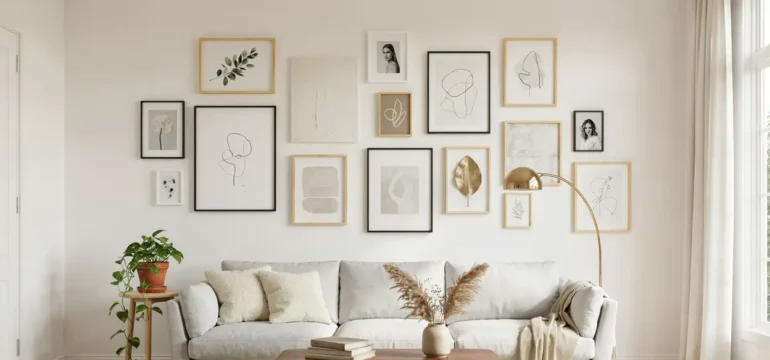
I used to stand in the middle of my living room staring at one big blank wall, coffee in hand, trying to picture what would actually work there. I bought three different frames before I found something I liked, and even then it took months to get the wall to feel finished. If you are in that same spot right now, staring at a wall that feels a little too empty and a little too plain, you are not alone. Most people freeze up when it comes to wall decor because there are so many options and no clear starting point. This list is meant to fix that. These are twenty one ideas that regular homeowners have actually used in their own living rooms, nothing fancy or expensive required, just practical ways to make your wall feel like it belongs to your home.
1. Gallery Wall Display
A gallery wall is one of the easiest ways to fill a large wall without spending a fortune on one big piece. Pick a mix of frame sizes and colors, then lay them out on the floor first so you can move things around before anything goes on the wall. Mixing photos, prints, and small art pieces gives the wall personality instead of looking like a matched set from a store.
Start with your biggest piece in the center or slightly off to one side, then build outward with smaller frames. Leave two to three inches of space between each frame so the whole thing does not feel cramped. This works especially well above a sofa or along a stairway wall, and you can always add more pieces later as you find things you love.
2. Oversized Statement Mirror
A big mirror does double duty on a living room wall. It bounces light around the room and gives you something to look at without needing a whole gallery of frames. Round mirrors soften a room full of straight lines, while an arched or rectangular mirror with a wood or brass frame adds a bit of warmth.
Hang it across from a window so it catches daylight and makes the room feel brighter and bigger than it actually is. A mirror over a console table or behind a sofa also works great if you want something simple that still makes a strong visual statement. Just make sure the size feels right for the wall, too small and it gets lost, too big and it can overwhelm the space.
3. Woven Wall Hanging
Woven wall hangings bring in texture without adding any extra color if your room already feels busy. Made from cotton, jute, or wool, these pieces hang from a wood dowel and usually have a soft, handmade look that fits almost any style of living room.
Hang one above a bookshelf, next to a window, or as the focal point above a smaller sofa. Because they come in so many shapes and sizes, you can find one that fits an awkward narrow wall just as easily as a wide open one. Pair it with a plant nearby for a natural, lived-in feel, and avoid hanging anything too heavy right next to it so the woven piece stays the star of that corner.
4. Floating Wood Shelves
Floating shelves give you decor and storage in one move. Instead of a flat piece of art, you get a spot to style books, small plants, candles, and framed photos that you can switch out whenever you feel like changing things up.
Install two or three shelves at slightly different heights on one wall, leaving enough room between them so nothing feels squeezed. Stick to a simple color palette when you style them, two or three colors is plenty, so the shelves look pulled together instead of cluttered. This idea works especially well in living rooms that need more personality but do not have room for extra furniture.
5. Large Abstract Art
One big abstract piece can carry an entire wall on its own. Look for a canvas with colors that already show up somewhere else in your room, your rug, your pillows, even your curtains, so the piece feels connected instead of randomly placed.
Hang it so the center sits at eye level when you are standing, which is usually around fifty seven inches from the floor. A single large piece works best on a wall that does not have a lot of other furniture competing for attention, like the wall behind your sofa or across from your main seating area. It gives the whole room an anchor point that everything else can build around.
6. Vintage Botanical Prints
Botanical prints have a quiet, old fashioned charm that works in almost any living room. Look for a set of three or four prints showing different plants or flowers, then frame them the same way so they read as a matching set even though the images are different.
Hang them in a straight row above a console table, sofa, or fireplace mantel. Thin black or wood frames keep the focus on the prints themselves rather than the frame. This idea works well if you want something that feels collected over time rather than bought all at once, and it pairs nicely with a room that already has plants or natural materials in it.
7. Bold Wall Clock
A large wall clock is decor that actually earns its keep every single day. Oversized clocks with a simple face and a wood, black, or brass frame have become a popular way to fill space above a sofa or on a wall near the entryway.
Choose a size that matches the scale of your wall, a small clock on a huge wall will look lost. Twenty four inches or larger usually works well for a standard living room. Keep the area around it fairly simple, maybe one or two smaller pieces nearby at most, so the clock stays the clear focal point instead of getting crowded out.
8. Framed Family Photos
Real photos of your own family or friends make a living room feel like yours in a way that store bought art cannot. Choose a handful of your favorite pictures, black and white photos tend to look more cohesive together than a mix of color and black and white, then frame them in matching frames for a clean look.
Arrange them in a grid pattern or a loose cluster depending on your style. This works beautifully on a hallway wall leading into the living room or on the main wall behind your seating area. Update the photos every year or two so the wall keeps growing along with your family.
9. Rattan Wall Panels
Rattan wall panels add warmth and texture to a living room without taking up any floor space. These woven panels come in circles, ovals, or fan shapes and have become popular for their natural, relaxed look.
Hang a single large rattan piece as a focal point, or group two or three smaller ones together for more visual interest. They pair especially well with wood furniture, linen curtains, and other natural materials already in the room. Because they are lightweight, they are easy to hang with just a nail or a small hook, making this one of the simpler ideas on this list to actually pull off in an afternoon.
10. Wall Sconce Pair
A pair of wall sconces adds both light and style to a living room wall. Flanking a piece of art, a mirror, or even a television with matching sconces gives the whole setup a finished, intentional look instead of one lonely light source in the corner.
Pick sconces with a warm bulb rather than a bright white one for a cozier feel in the evening. Mount them at eye level, roughly sixty to sixty five inches from the floor, and space them evenly on either side of whatever they are framing. This idea works well in living rooms that feel a little dim in the evening and need an extra layer of light beyond the overhead fixture.
11. Ceramic Plate Wall
Decorative plates arranged on a wall bring in pattern and color in a way that feels a little unexpected compared to standard framed art. Mix plates of different sizes and patterns, but keep a common color thread running through all of them so the display feels planned rather than random.
Use plate hangers to secure them safely, then arrange the largest plates first before filling in gaps with smaller ones. This idea works especially well in a living room with a cottage or vintage feel, and it looks great above a sideboard, a bookshelf, or in a dining nook that flows into the main living space.
12. Fabric Wall Panel
A stretched fabric panel is an easy way to bring in pattern or texture on a budget. Choose a fabric you love, stretch it over a wood frame or canvas stretcher bars, and you have a custom piece of wall art for a fraction of what a store bought version would cost.
This works great if you cannot find artwork in the exact colors your room needs, since you can pick any fabric that matches. Hang it as a single statement piece above the sofa, or make two smaller panels to flank a window. The soft texture also helps soften a room that has a lot of hard surfaces like leather furniture or wood floors.
13. Curated Ledge Shelves
Picture ledge shelves let you lean art instead of hammering it into place, which makes rearranging simple whenever the mood strikes. Install two or three ledges in a row, either stacked vertically or spread across a wall, then layer framed art, small photos, and little objects in front of each other.
This look feels more relaxed than a traditional gallery wall because nothing has to line up perfectly. Swap pieces in and out with the seasons, or as you find new art you like. It is a great option for renters since the ledges themselves only need a few small holes, and everything displayed on them can change without any extra work.
14. Black And White Prints
Black and white photography or line art gives a living room a clean, calm feeling that works with almost any color scheme already in the room. Choose prints with a similar subject, like city scenes, nature shots, or simple line drawings, so the set feels cohesive even in different frames.
Hang three or four in a horizontal row above the sofa, or stack two vertically in a narrower spot. Because there is no color to clash with your furniture, this is one of the safest choices if you are unsure what else in the room might change down the road. It also photographs beautifully, which matters if you like sharing pictures of your space.
15. Wall-Mounted Bookshelf
A wall mounted bookshelf turns your book collection into the decor itself. Rather than a bulky bookcase taking up floor space, thin shelves mounted directly to the wall hold books, small plants, and a few personal objects while keeping the room feeling open.
Arrange books both upright and stacked flat, mixing in a small frame or plant every foot or so to break up the visual line of spines. This works well on a wall near your reading chair or beside the television, giving the room a lived-in, personal feel. It is also a smart option if you have more books than shelf space elsewhere in the house.
16. Large Landscape Print
A large scale landscape photo or painting brings a sense of calm to a living room, almost like a window looking out somewhere else. Mountains, beaches, forests, and open fields are popular choices because they work with nearly any color palette already in the room.
Choose one with tones that echo something else nearby, blues that match a throw pillow or greens that pick up a plant in the corner. Hang it as the main piece on your largest wall, giving it plenty of open space around it rather than crowding it with smaller frames. This is a simple way to add a strong focal point without needing to coordinate a whole gallery arrangement.
17. Metal Wall Sculpture
A metal wall sculpture adds a sculptural, three dimensional element that flat art cannot offer. Look for pieces in brass, copper, or matte black, shaped as anything from abstract lines to leaf and branch patterns.
These pieces catch light differently throughout the day, which gives the wall a bit of movement even though nothing is actually moving. Hang one as a focal point on its own, since the shadows and texture usually provide enough visual interest without needing anything else nearby. This idea works especially well in living rooms with a modern or industrial feel, where the metal ties in with other finishes already in the space.
18. Mirror Cluster Wall
Instead of one large mirror, group several smaller mirrors of different shapes and sizes together for a more playful look. Round, oval, and arched shapes mixed together create visual interest while still giving you all the light bouncing benefits of a single big mirror.
Lay the mirrors out on the floor first to plan your spacing before drilling anything into the wall. Keep some breathing room between each one so the cluster does not feel too busy. This idea works particularly well in a smaller living room where you want the light and space boosting effect of a mirror but a single oversized piece would feel like too much.
19. Wallpaper Accent Wall
A wallpapered accent wall turns your wall itself into the decor, no frames required. Choose a bold pattern for a statement look, or a subtle grasscloth or textured paper if you want something quieter that still adds depth.
Apply it to just one wall, usually the one behind your sofa or the first wall you see when entering the room, so it reads as an intentional accent rather than an overwhelming choice. Peel and stick versions make this an easy weekend project even if you have never wallpapered before. Once the wall itself has pattern or texture, you can keep everything else in the room simple and let that wall do the talking.
20. Hanging Plant Shelf
A wall mounted shelf built for plants brings green life up off the floor and onto the wall itself. Use a simple wood shelf with a lip to hold pots in place, then fill it with trailing plants like pothos or string of hearts that can spill over the edge naturally.
Position it near a window so the plants actually get enough light to thrive. This idea works well in living rooms that feel a little stiff or too neutral, since the greenery softens hard edges and adds natural movement to an otherwise still wall. Water on a regular schedule and rotate the plants occasionally so they grow evenly on all sides.
21. Woven Tapestry Statement
A large woven tapestry brings in pattern, texture, and color all at once, without needing any frames or hardware beyond a simple rod. Choose one with colors that already exist somewhere in your room so it feels connected rather than randomly dropped in.
Hang it from a wood or metal rod using fabric loops sewn into the top, then let it hang naturally rather than pulling it too tight. This works beautifully as the main feature above a sofa or daybed, especially in a living room with a relaxed or global inspired style. Because tapestries are soft, they also help absorb sound in a room with a lot of hard flooring.
FAQs
How high should I hang art in my living room?
Center most pieces around fifty seven inches from the floor, which is standard eye level for most adults, then adjust slightly if the piece hangs above a sofa or console table.
What is a good rule for gallery wall spacing?
Keep two to three inches between each frame so the grouping feels connected but not cramped, and always lay the arrangement out on the floor first.
Can I mix different styles of wall decor on the same wall?
Yes, mixing textures like a mirror, a woven piece, and a small shelf together often looks more interesting than matching everything perfectly.
What if my living room wall is very large?
Go with one oversized piece, a gallery wall with several frames, or a combination of shelves and art to fill the space without it feeling sparse.
Filling a blank living room wall does not have to be complicated. Pick one idea from this list that fits your style and your budget, and give it a try this weekend. You can always add more later as your room grows and changes.