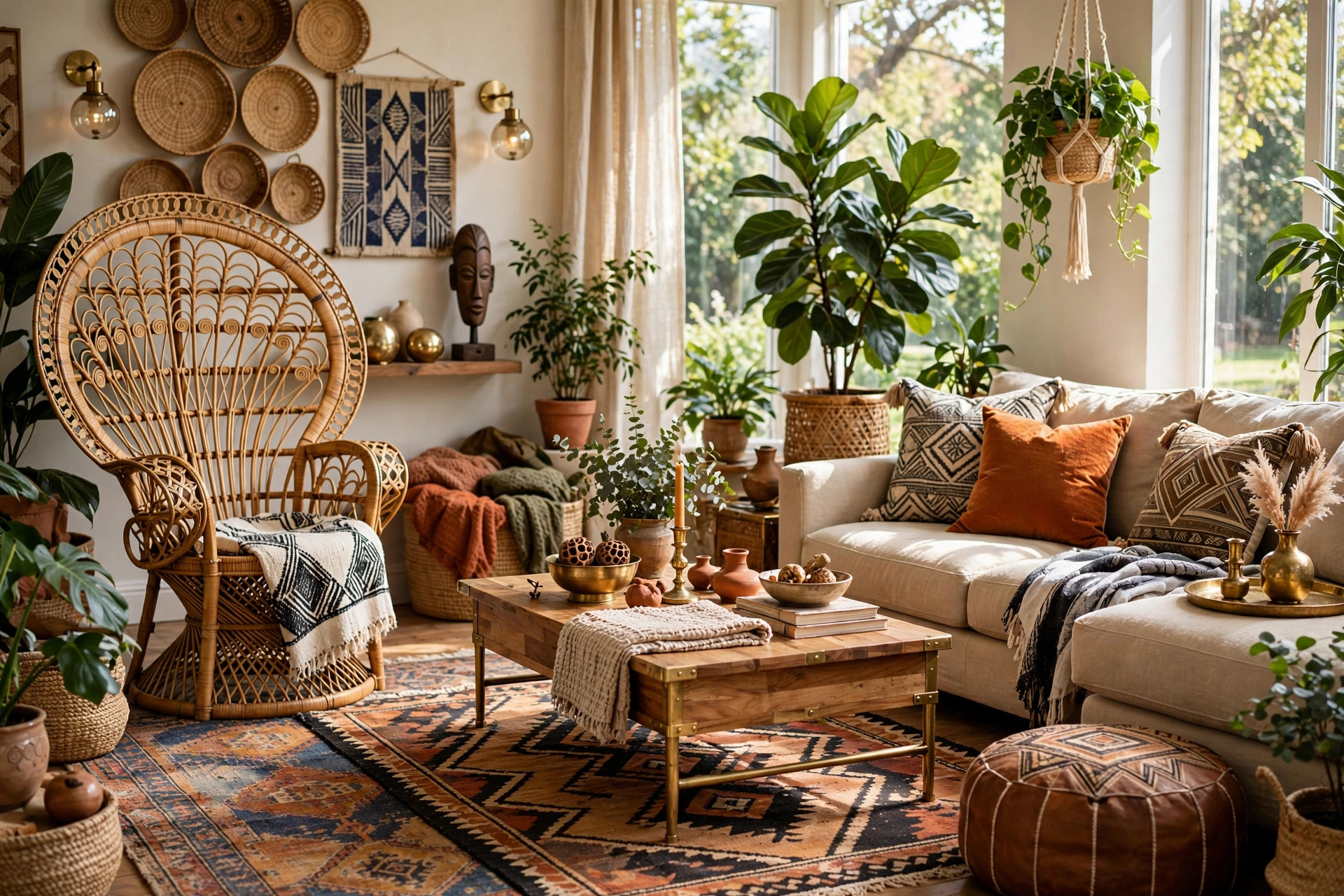

I’ll be honest, I used to think luxury meant price tags. About five years ago I walked into a high end furniture showroom just to look around, and I left convinced that a beautiful home was something other people had. People with bigger paychecks and interior designers on speed dial. So I did what a lot of us do. I saved for months and bought one “designer look” piece, a mirrored side table with shiny gold legs that I had seen in a magazine. I was so proud when it arrived. I placed it right next to my sofa and stepped back to admire my fancy new living room. And you know what? It looked terrible. It was loud and cold and shiny in all the wrong ways. My cozy little room suddenly felt like a hotel lobby. That mirrored table was the most expensive lesson I ever bought, because it taught me that luxury has almost nothing to do with what things cost.
I started paying attention to the homes that actually felt luxurious instead. My friend Maria has a tiny apartment with secondhand furniture, and walking into her place always felt like a deep breath. Everything was cream and wood and soft light. Nothing in her home was expensive, but everything felt calm and considered. Later I learned there was a name for that feeling. Quiet luxury. It is the opposite of flashy. No big logos, no trendy neon colors, no furniture that screams for attention. It is natural materials, a calm palette, and the discipline to leave empty space alone. And here is the part nobody tells you. Quiet luxury is the cheapest kind of luxury there is, because it asks you to buy less, not more. Restraint costs nothing.
So I sold the mirrored table at a loss and started over with a tight budget and an open mind. I painted, I thrifted, I swapped out small things one weekend at a time. Within a few months people started asking if I had hired a decorator. I had not. I had just learned the quiet luxury playbook, and almost every move cost less than a dinner out. These are the twenty ideas that changed my home, grouped the way I learned them. First we fix the base of the room, then we add texture you can touch, then we bring in collected pieces with history, and finally we finish with the small rituals that make a house feel like a sanctuary.
1. Warm White Paint Refresh
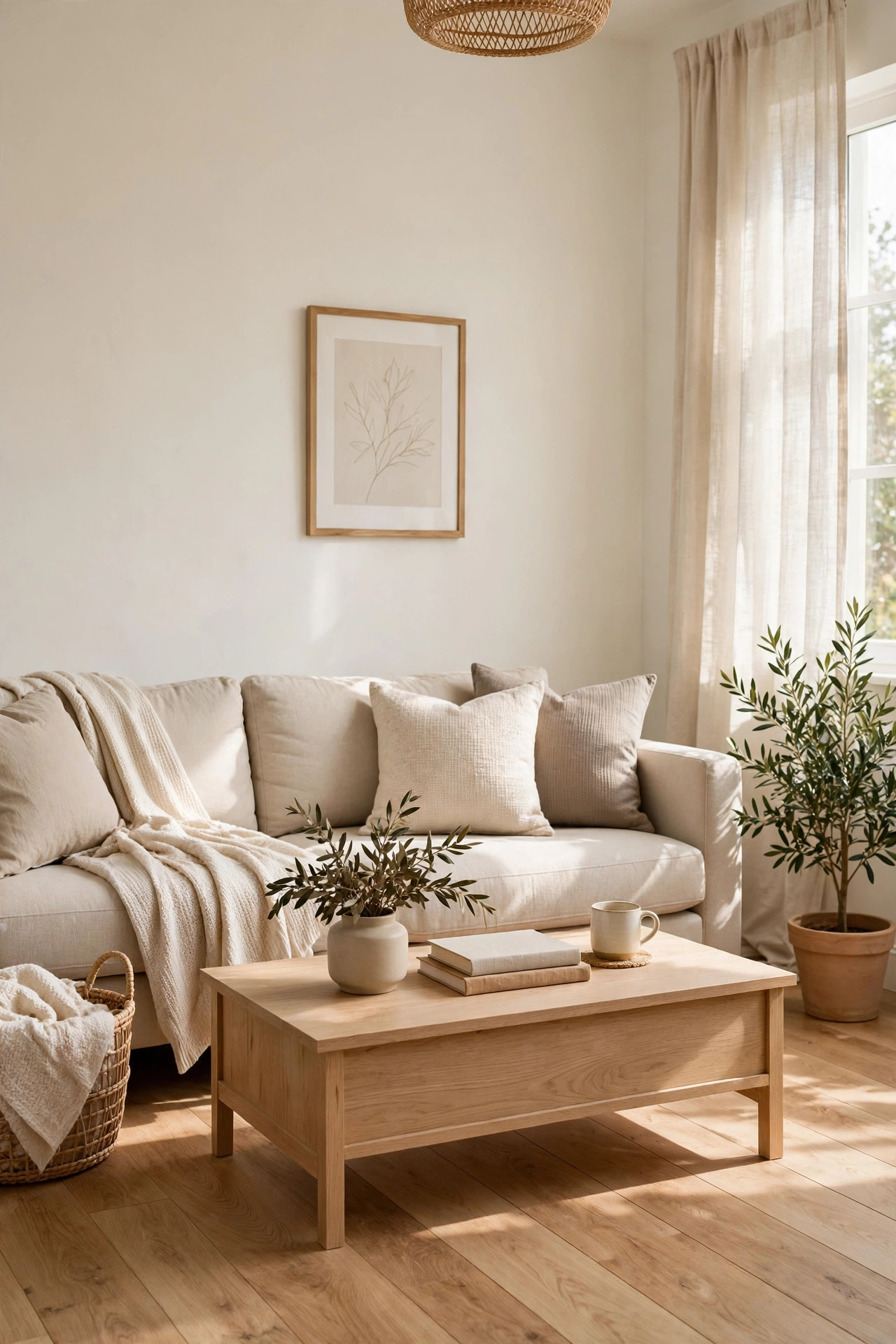
The single biggest change I ever made to my living room cost me one can of paint and a Saturday. My walls used to be a cool rental gray that made everything look flat and a little sad. I had lived with it for two years because painting felt like a big commitment. Then one spring weekend I finally bought a gallon of warm white paint, the creamy kind with a hint of yellow, not the stark blue white that looks like a hospital. I moved the sofa, I taped the trim while listening to music, and I rolled on two coats. When I pulled the tape off the next morning and the sunlight hit those walls, I actually gasped. The whole room glowed. My same old sofa looked richer. My cheap rug looked intentional. Warm white paint is the quiet luxury secret nobody talks about because it is too simple to seem impressive. It bounces soft light around the room, it makes wood tones look deeper, and it gives every single thing you own a calmer background to sit against. Stark white can feel cold and unfinished, but warm white feels like candlelight frozen on the wall. It is the difference between a room that looks painted and a room that looks finished. I also noticed that my artwork suddenly looked better, because the warm background made the colors in my prints feel richer and more alive. Even my houseplants seemed happier against the creamy walls, their green leaves popping in a way they never did against the old gray. It is funny how one simple change can make you fall in love with a room all over again, and I found myself spending more evenings in the living room just enjoying how it felt.
If you try this, and I really think you should, take the color choice seriously because not all whites are equal. I learned this the hard way when I first grabbed a white that looked perfect on the tiny card and turned pinkish on my wall at sunset. Buy three small sample pots and paint big squares right on the wall, then look at them in morning light, afternoon light, and lamplight before you commit. Look for names with words like warm, creamy, linen, or bone, and run away from anything described as bright, crisp, or pure. You do not need expensive paint either. The mid priced store brand covered beautifully in two coats for me. Do the cutting in with a good angled brush, roll the big areas in a W pattern, and give it a full day to cure before you judge the color. One weekend, one gallon, and your room gets the expensive looking base that every quiet luxury home starts with. Everything you add after this will look twice as good. If your ceiling is still stark white, consider painting it the same warm white so the whole room feels like one connected space. I did mine the following weekend and it made a bigger difference than I expected. And do not rush the prep work, because careful taping along the trim is what separates a professional looking job from a messy one. Good tape and a steady hand are worth more than expensive paint.
2. Floor-to-Ceiling Linen Curtains
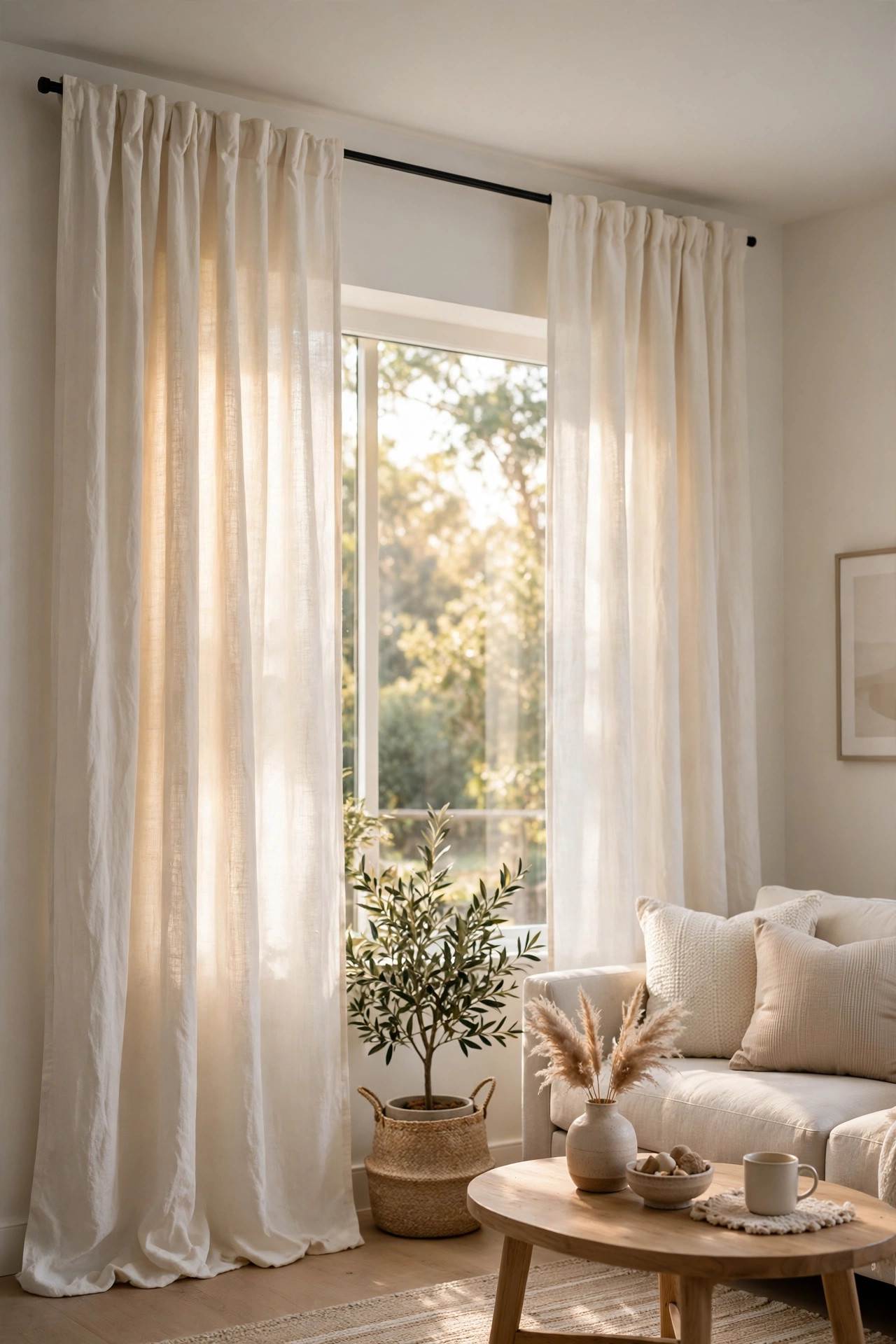
Here is a confession. For years my windows wore the sad little curtains that came with the apartment, short panels that stopped halfway down the wall and made my ceilings feel low. I thought curtains were just background, the kind of thing nobody notices. Then I visited a friend whose living room felt oddly grand despite being the same size as mine, and I realized her secret was hanging above my head. Her curtains started an inch below the ceiling and kissed the floor. That one change made her eight foot ceilings feel like ten. I went home and measured my own windows that same evening. Inexpensive linen look curtains, hung high and wide, are one of the fastest ways to fake the architecture of a much more expensive home. The long vertical lines draw your eye up, the soft fabric filters daylight into something golden, and the whole wall looks finished instead of forgotten. Linen has that slightly rumpled, natural texture that reads as expensive even when the price tag says otherwise. It does not try too hard, which is the entire point of quiet luxury. Guests started commenting on my windows within days, which had never happened before, and I realized curtains are one of those things people feel more than they notice. They also gave me privacy without blocking light, because the linen filters the view from outside while still letting sunshine pour in. My living room finally felt finished, like someone had thought about every wall instead of just the furniture.
You do not need custom drapes to pull this off, and I am proof. I bought four ready made linen blend panels on sale and two simple black rods, and the total was less than a nice dinner for two. Hang the rod four to six inches above the window frame, and extend it six to eight inches past the frame on each side so the panels frame the glass instead of covering it. Let the curtains just barely touch the floor, what designers call kissing the floor, because puddling fabric collects dust and looks messy in a small room. If your panels are too long, a ten dollar hemming tape from the craft store fixes it in an afternoon with just an iron. I chose a warm ivory color that matched my new wall paint, and suddenly my windows looked like they belonged in a magazine. The light in my living room changed completely. Mornings feel softer now, and in the evening the lamps glow against that fabric in the prettiest way. It is a two hour project with a ten year payoff. One more tip that made a real difference. Take ten minutes to steam or iron the panels before you hang them, because crisp fabric hangs in much prettier folds than wrinkled fabric straight from the package. I also added simple tiebacks for daytime, which let me pull the curtains to the sides and show off the full window when I want maximum light. Small details, big payoff, and the whole project still cost less than one custom panel.
3. Layered Neutral Rugs
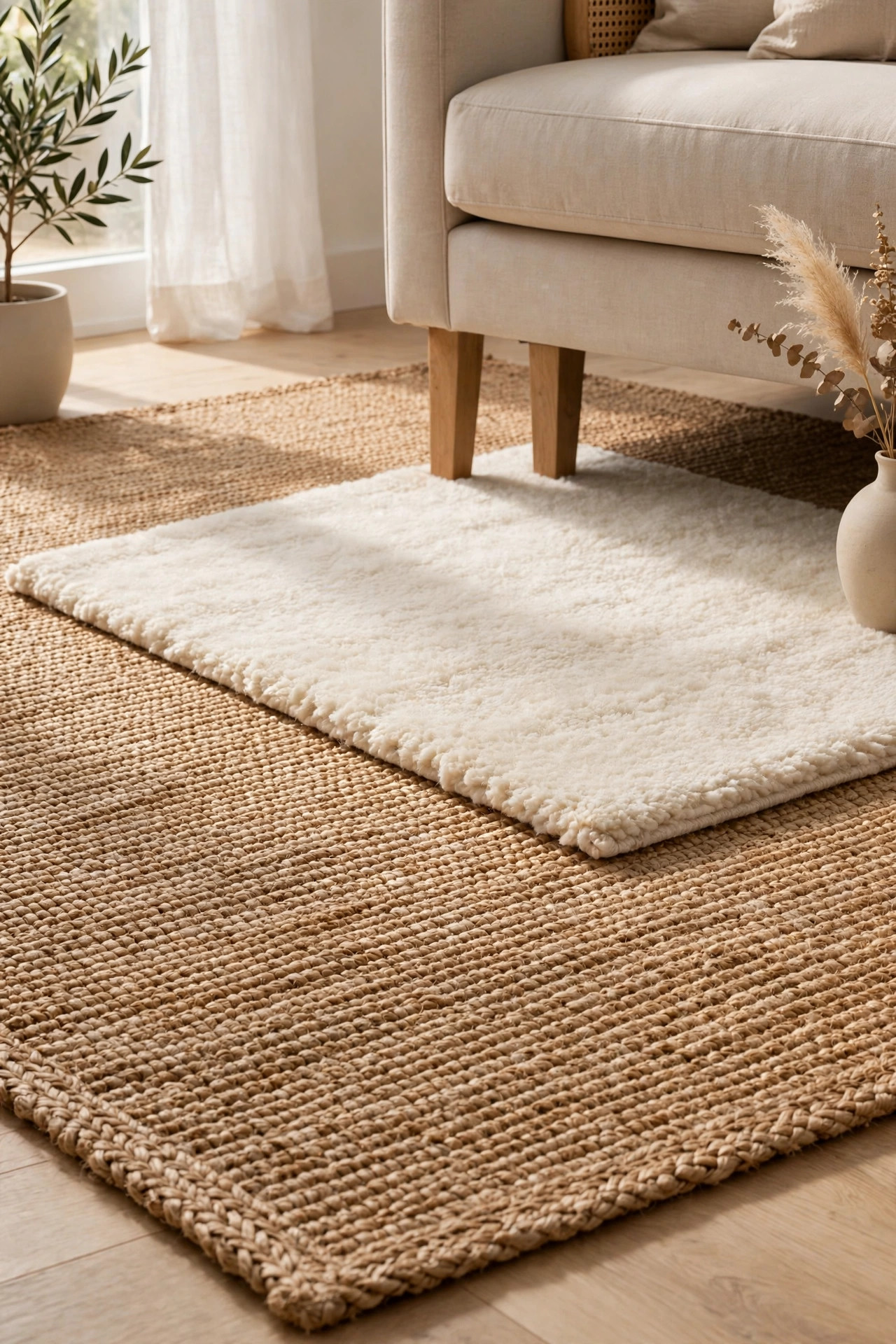
My living room floor used to be bare wood with one small rug floating in the middle like a lonely island. It looked unfinished, but a big rug felt like a huge expense I could not justify. Then I learned the layering trick from a designer friend, and it changed everything I thought I knew about rugs. Instead of buying one giant expensive rug, you layer two affordable ones. I put down a large, inexpensive jute rug as the base, the kind you can find at any home store for very little money, and then I layered a smaller, softer wool look rug on top at a slight angle. The result looked like something from a styled catalog. The jute brings that natural, nubby texture that instantly says quality, while the softer top rug adds the comfort your feet actually want. Layering also lets you play with tone, a darker natural fiber underneath and a cream or ivory rug on top creates depth without any pattern fighting for attention. My room finally felt anchored, like the furniture had a reason to sit where it sat. Something I did not expect was how much quieter the room became. Bare wood floors bounce sound around, and the layered rugs soaked up the echo so conversations felt warmer and the whole space felt calmer. In winter I sometimes swap the top rug for a slightly darker one, which takes five minutes and makes the room feel cozier instantly. It is like giving your floor a change of clothes with the seasons.
The practical side is just as good as the look. A jute base rug is one of the cheapest large rugs you can buy, and it hides dirt and wear better than almost anything. I vacuum mine once a week and it still looks new after two years. The top rug is where you put your comfort money, and even there you can stay budget friendly with a cotton or wool blend from a discount store. Make sure the base rug is big enough that the front legs of your sofa and chairs sit on it, because a rug that is too small is the fastest way to make layering look like a mistake. I also put a thin rug pad underneath, which cost me very little and stopped everything from sliding around. When I want a change, I just swap the top rug instead of replacing the whole setup. Two rugs, one pad, and my floor went from bare and echoey to warm and pulled together. Guests always ask where I got my “designer rug,” and I just smile. When you shop, look for jute rugs with a tight, even weave, because loose weaves shed and snag. I found mine at a big home store during a sale, and the top rug came from a discount site a month later when I spotted the perfect cream color. If you have pets, choose a low pile top rug, because it is much easier to vacuum fur from than a shaggy one. My dog has tested this thoroughly and the rug still looks great.
4. Warm Glow Table Lamps
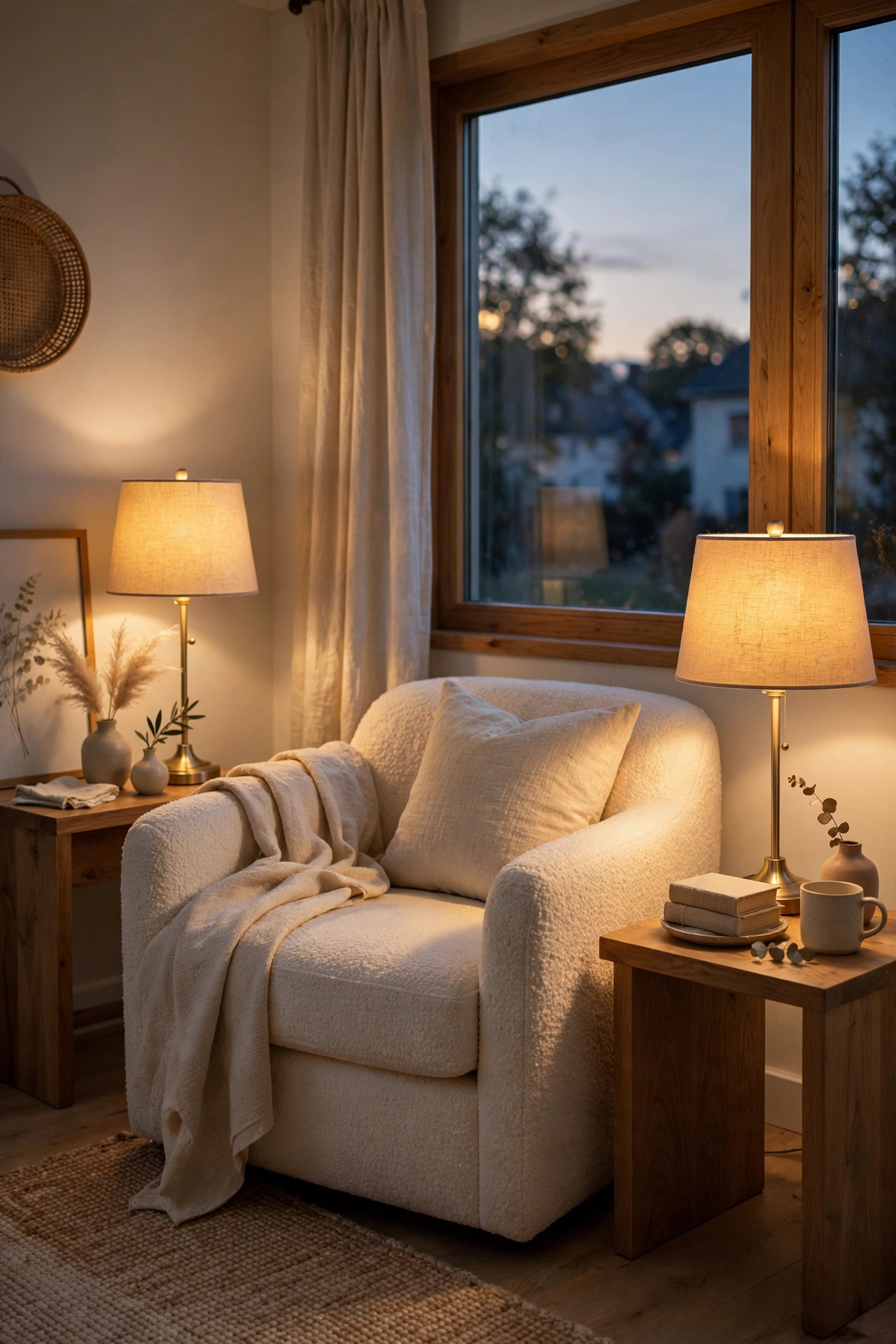
I will tell you exactly when I learned about lighting. It was a Tuesday night, I was sitting in my living room under the bright ceiling light, and I felt like I was in a dentist’s office. Everything in the room was technically fine, but nothing felt good. On a whim I turned off the overhead light and switched on the one sad floor lamp I owned, and the whole room exhaled. That was the night I understood that quiet luxury is mostly about light. Expensive looking rooms are never lit from above like an interrogation room. They glow from the sides, low and warm, from lamps at the height where people actually sit and talk. I went to the thrift store the next weekend and bought two mismatched table lamps for almost nothing. I put warm bulbs in them, the soft yellow kind, and placed one on each side of the room. That evening my apartment felt like a different home. The walls looked warmer, the wood looked richer, and I felt calmer just sitting there. These days I light a few candles alongside the lamps, and the combination of lamplight and candlelight is pure magic. Mornings are different, of course, and I still open the curtains wide for daylight while I work. But the moment the sun goes down, the overheads stay off and the lamps take over. My electricity bill even dropped a little, because two efficient bulbs use far less power than a big ceiling fixture blazing away.
You can do this for very little money, and it is the highest impact change on this whole list after paint. Look for lamps with fabric shades, because fabric softens the light in a way that bare bulbs never will. Thrift stores are full of solid, heavy lamps with ugly shades, and a new simple drum shade costs less than a pizza. The bulb matters more than the lamp itself. Buy warm white bulbs, and if you can find dimmable ones with a cheap plug in dimmer, even better. I keep my overhead light off almost every evening now. The two lamps give me all the light I need, and the room feels like a restaurant at golden hour. One more tip I learned the hard way. Match the warmth of all your bulbs so the room glows in one tone. A cool white bulb sneaking in among warm ones will ruin the effect instantly. Two lamps, two warm bulbs, and suddenly your evenings feel expensive. I put both of my lamps on inexpensive plug in timers, so they glow on every evening at sunset without me touching a switch. It feels wonderfully luxurious to walk into a lit room after a long day. Every few months I wipe down the shades with a dry cloth, because dust on a shade dims the light more than you would think. Clean shades, warm bulbs, and well placed lamps are the whole formula.
5. The Ruthless Declutter
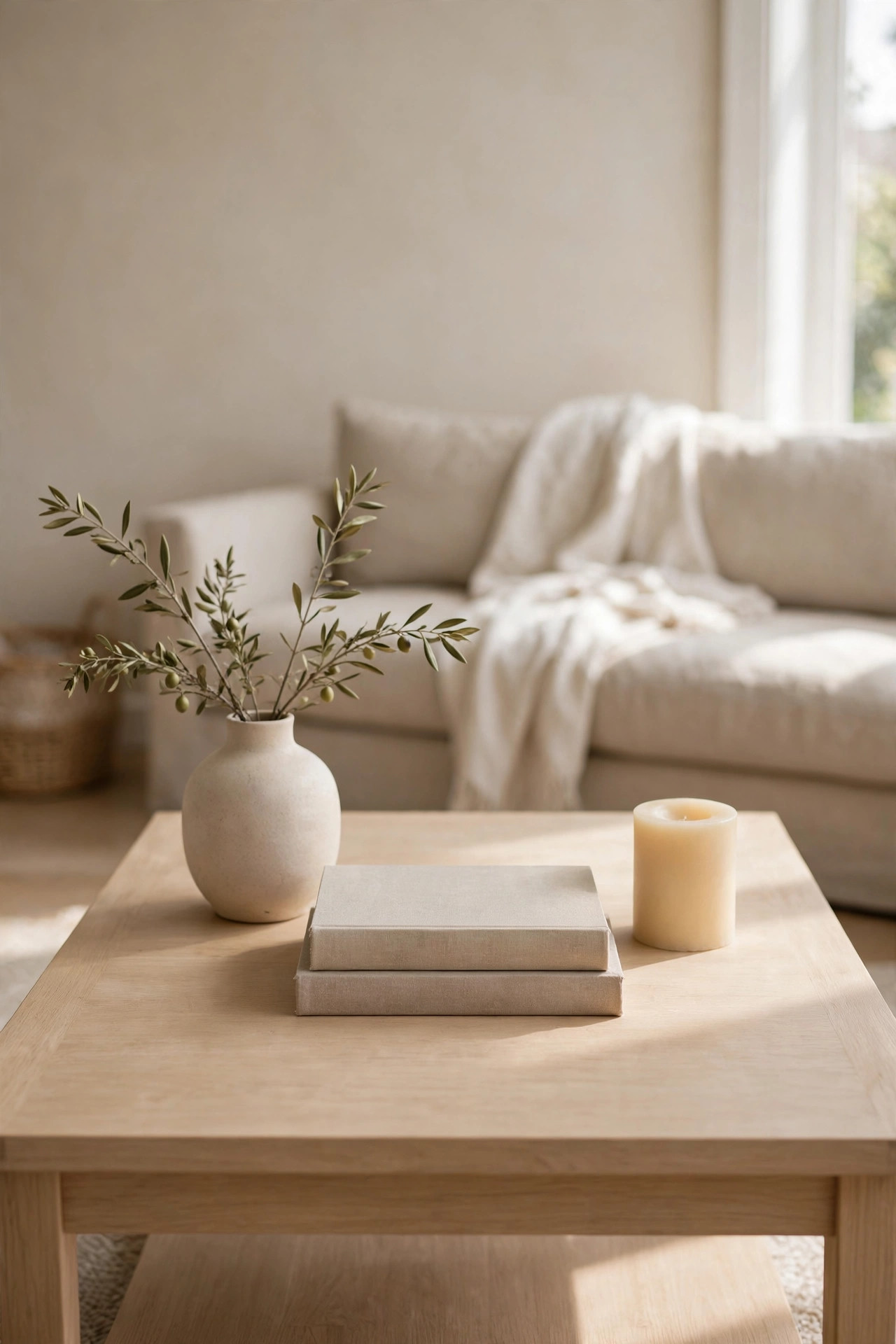
This one costs absolutely nothing, and it might be the most luxurious change of all. A few years ago my shelves and tables were crowded with little things I had collected without thinking. Candles I never lit, frames with old photos, a bowl of decorative balls, stacks of magazines. I thought a full shelf looked cozy. Then I helped a friend move, and I saw her new place before she unpacked a single box. Just clean surfaces, a sofa, a lamp. It looked like a spa. That empty apartment taught me more than any decor book. Quiet luxury needs empty space the way good cooking needs salt. Every surface that is clear makes the few things left on it look more important and more beautiful. I went home and took everything off my coffee table, my mantel, and my bookshelves. I put it all in boxes in the hallway and lived with the emptiness for a week. By day three I never wanted the clutter back. I also adopted a one in, one out rule that has kept the clutter from creeping back. Every time something new comes into the house, something old has to leave. It sounds strict, but it takes ten seconds and it works. My surfaces have stayed calm for over a year now. And the weekly dusting takes half the time it used to, which is a luxury I did not expect but deeply appreciate.
Here is the method that worked for me, and I still use it every spring. Take everything off one surface at a time and clean the surface itself, because dust is the enemy of luxury. Then put back only three things you truly love, and make them different heights, something tall like a vase, something medium like a stack of books, something small like a candle. That is it. Three things. If you want to keep the rest, box it up and store it, because you can rotate pieces with the seasons and everything feels new again. I donated two full bags that first weekend and I have never missed a single item. My rooms feel bigger, cleaning takes half the time, and the few beautiful things I own finally get the attention they deserve. Before you buy one new thing for your home, try taking ten things away. I promise the room will feel more expensive with less in it, not more. I also adopted a one in, one out rule that has kept the clutter from creeping back. Every time something new comes into the house, something old has to leave. It sounds strict, but it takes ten seconds and it works. My surfaces have stayed calm for over a year now. And the weekly dusting takes half the time it used to, which is a luxury I did not expect but deeply appreciate. And that brings me to the next group of ideas, because once your surfaces are calm, it is time to add back texture you can actually touch.
6. Cream Boucle Throw Pillows
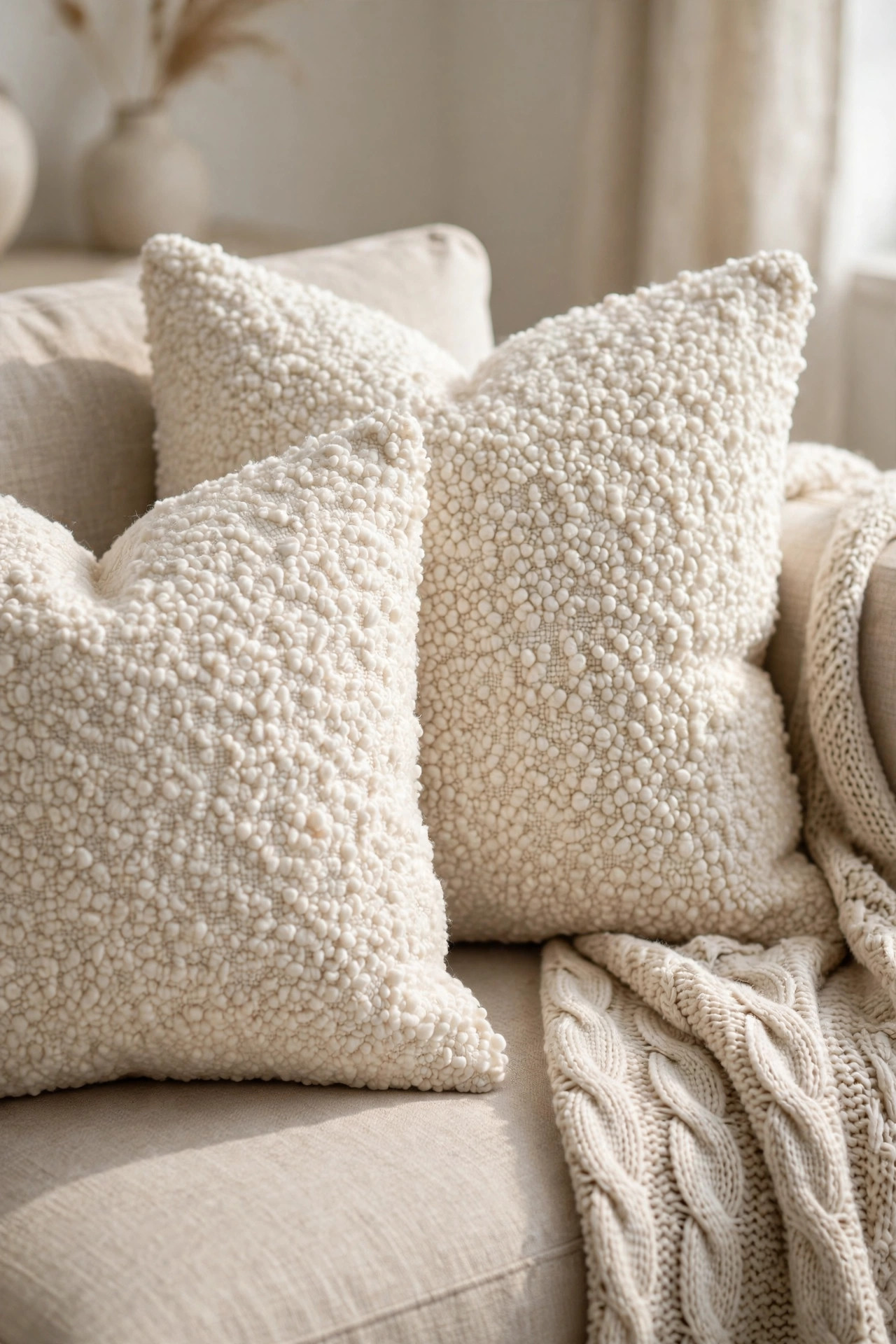
If quiet luxury had an official fabric, it would be boucle. That nubby, looped wool that looks like tiny clouds stitched together. I first touched it on a very expensive armchair in a furniture store, and I remember thinking that texture alone was worth the price. Then I found boucle throw pillow covers at a discount home store for the price of a sandwich each, and I nearly bought the whole shelf. Two of those pillows on my plain sofa changed the entire feeling of my living room. Boucle catches the light in a way flat cotton never does. Every little loop creates a tiny shadow, so the pillow looks deep and soft and touchable from across the room. In cream or ivory, it is the perfect quiet luxury accent, because it adds richness without adding color or pattern. It does not shout. It just sits there looking expensive and inviting you to lean back. My sofa went from ordinary to interesting with literally two pillow covers, and I did not even need new inserts because I just slipped them over the flat pillows I already had. The texture is even better in person than in photos, because those little loops catch light and shadow as you move around the room. I sometimes catch myself running my hand over them when I walk past, which tells you everything about how inviting they are. I also added one small boucle lumbar pillow to my reading chair, and that corner instantly became the most fought over seat in the house.
The trick is restraint, which I learned after briefly going overboard. My first instinct was to cover every pillow in the house with boucle, and for about a week my sofa looked like a sheep. Two is the magic number on a standard sofa, or three if your sofa is very long. Mix them with one smooth linen pillow so the textures play off each other instead of competing. Cream, ivory, or warm white are the safest colors, because they blend with everything and never look trendy. I wash mine inside out on gentle and air dry them, and they have held up beautifully for over a year. When friends ask about them, nobody believes what I paid. That is the whole game of quiet luxury on a budget. Find the one texture that reads as expensive, use it sparingly, and let it do all the talking while everything else stays calm. Do not skimp on the inserts if you can help it, because a full, plump insert makes even a budget cover look expensive. I replaced my flat old inserts with inexpensive feather blend ones, and the difference was night and day. In summer I store the boucle covers in a cotton bag to keep them fresh, and bringing them back out in fall feels like getting new pillows for free.
7. Chunky Knit Wool Throw
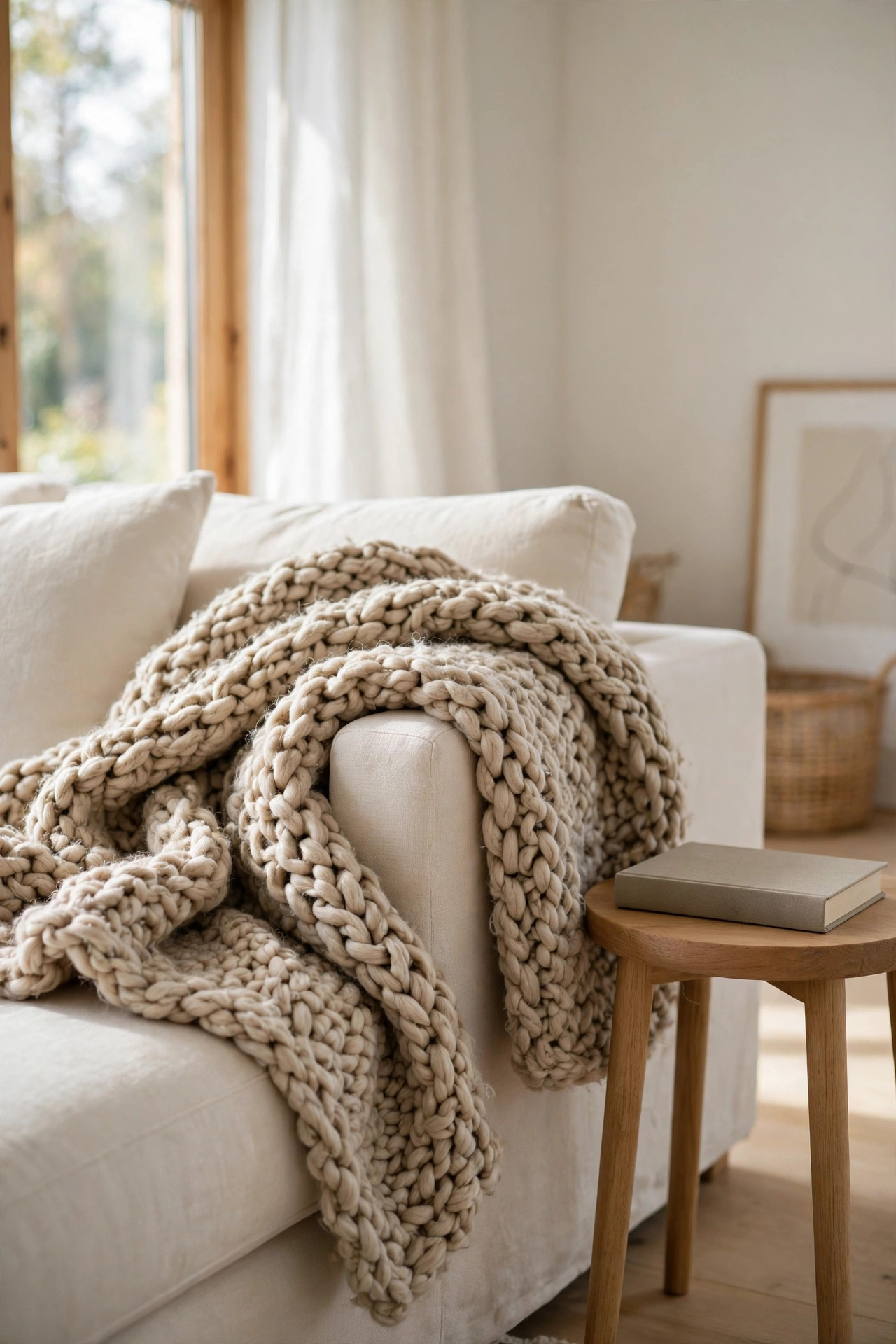
There is a throw blanket on the arm of my sofa that gets more compliments than anything else I own, and it cost me less than a movie ticket. It is a chunky knit throw in undyed wool, the kind with big soft stitches you can see from across the room. I found it folded on a clearance shelf, slightly imperfect, marked down because the color was not quite white and not quite beige. That in between oatmeal color turned out to be perfect. Draped over the arm of my sofa, it adds the one thing my living room was missing, which was softness you could see. Quiet luxury is deeply physical. It is about rooms that look like they would feel good, and nothing signals comfort like a thick knit throw waiting to be pulled over your legs. Mine has survived two winters of daily use, countless naps, and one memorable spaghetti incident, and it still looks better than the day I bought it because wool gets softer with age. That throw has also become my most given gift, because everyone who naps under it wants one. I have bought the same one three times now for birthdays, always on sale. There is something about giving comfort that feels more personal than giving decor. And mine has a small mend where I stitched up a pulled stitch, which I actually love, because it makes it feel even more like mine.
Placement matters more than price here, and I played around for a while before I found what worked. Do not fold your throw into a perfect rectangle and lay it flat like a tablecloth. That looks stiff and staged. Instead, drape it loosely over one arm of the sofa or the back of a chair, letting it fall naturally with a little puddle on the seat. The casual drape is what makes it look collected rather than decorated. I keep mine on the left arm of the sofa where the evening sun hits it, and the texture glows. In summer I swap it for a lighter cotton throw and store the wool one in a basket, which keeps it fresh and makes its return in fall feel like an event. If you can only buy one textile this year, make it this one. A beautiful throw does the work of three decorative objects, and unlike a vase, you will actually use it every single day. Wool throws need less washing than you think, which is good news. I air mine outside on a breezy day twice a year, and spot clean any marks with a damp cloth. Wool naturally resists odors, so it stays fresh far longer than cotton. When I do wash it, I use cold water and lay it flat to dry. Treated gently, a good wool throw will outlast most of your furniture.
8. Crisp White Linen Bedding
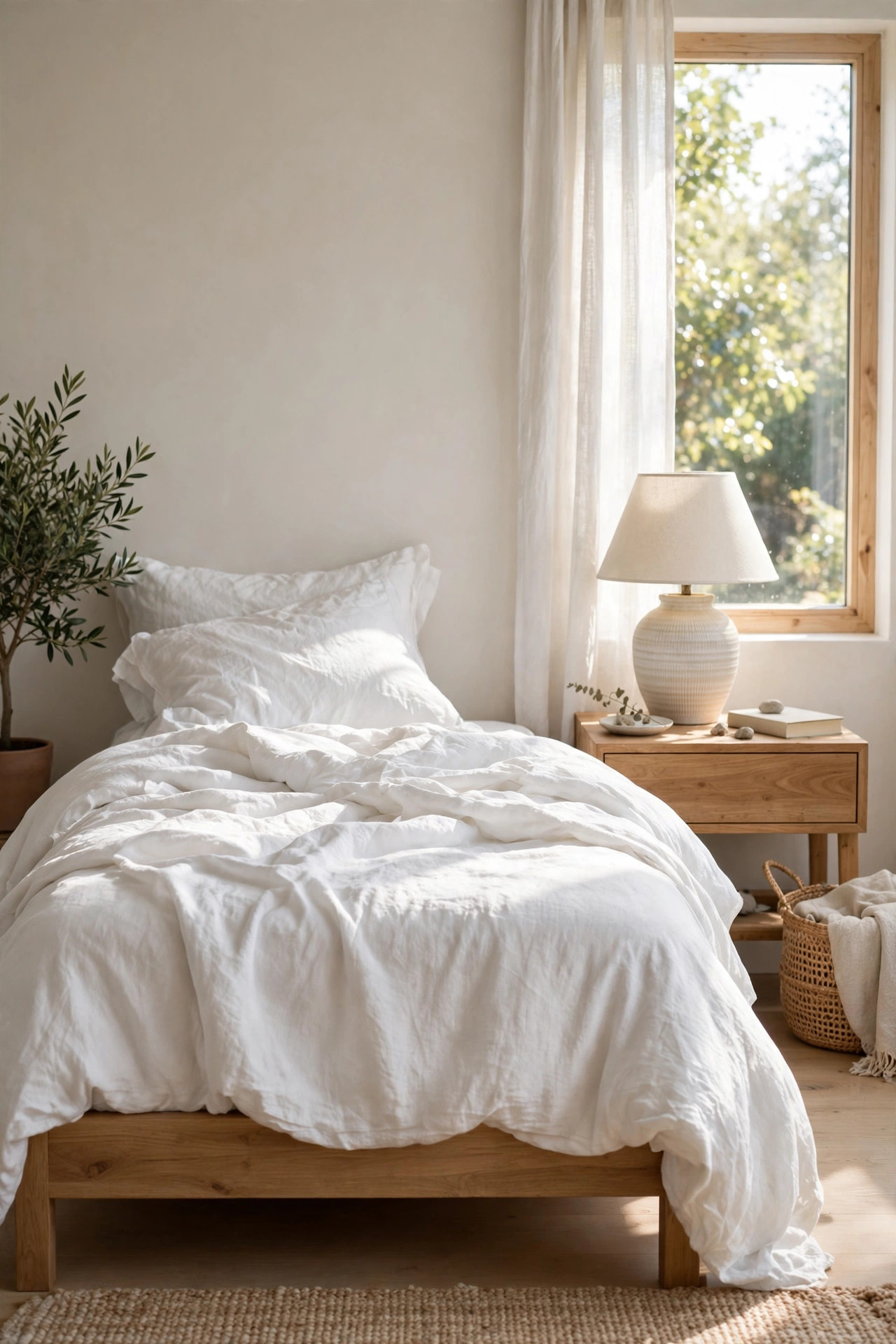
I know this list is mostly about the living room, but I have to include the bedroom for one reason. You spend a third of your life in bed, and nothing says quiet luxury like climbing into crisp, beautiful bedding every night. I used to buy colorful patterned sheet sets because they seemed like a good deal, three patterns for the price of one. My bed always looked busy and a little cheap, like a hotel trying too hard. Then I stayed at a small inn where the bed was dressed in nothing but white linen, slightly wrinkled, with a simple duvet folded back. I slept better than I had in months, and I am convinced the bedding was half the reason. White linen looks clean without being cold. The wrinkles are the point, because they say this is real fabric, lived in and loved, not plastic perfection. I came home and replaced my patterned sets with one good white linen duvet cover, and my bedroom instantly felt calmer and more grown up. I kept the pillows simple too, just two sleeping pillows and one long lumbar in the same white linen. No decorative shams, no fussy arrangements to rebuild every morning. Making the bed takes me about ninety seconds now, and it always looks effortlessly beautiful. That inn taught me that true luxury is ease, not effort, and my bedroom finally feels that way.
You do not need the thousand dollar kind, and I will die on this hill. I bought a linen blend duvet cover on sale, which gives you the look and feel of linen at half the price, and washed it three times before judging it because linen softens with every wash. White is the move because it never clashes, never fades into the wrong color, and always looks fresh against any wall color. I skip the top sheet like the Europeans do and just use the duvet, which means less laundry and a bed that looks effortlessly rumpled in the best way. One tip that took me too long to learn. Buy the duvet cover one size up from your insert so it looks full and plush instead of flat. My bed is now my favorite place in the house. Every night feels a little bit like a boutique hotel, and the whole upgrade cost less than one night in an actual hotel. Forget everything you have heard about thread count, because with linen it barely matters. What matters is the weight and the wash. Look for stonewashed or garment washed linen, which starts soft instead of stiff. I wash mine in warm water with mild detergent and skip the fabric softener, which can coat the fibers. Line drying in the sun keeps whites bright without any bleach.
9. Woven Seagrass Storage Baskets
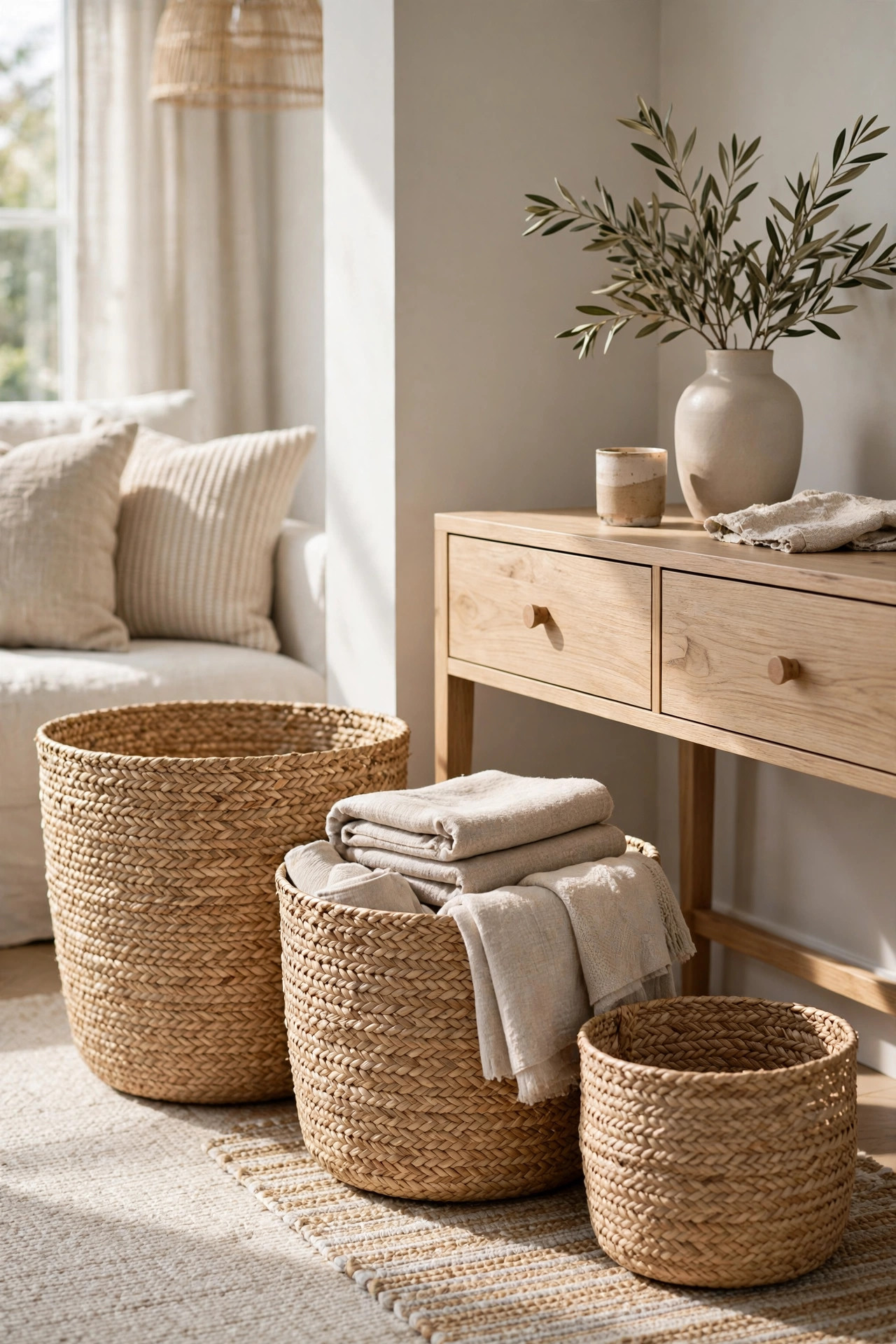
Every beautiful room has a secret, which is where all the ugly stuff hides. Mine used to hide in a hall closet that barely closed. Remote controls, chargers, dog toys, the blanket nobody admits to owning, it all lived in visible piles that quietly ruined the calm I was trying to build. Then I bought three large seagrass baskets, and my living room finally grew up. Woven baskets are the quiet luxury storage solution because they do two jobs at once. They swallow clutter completely, and while doing it they add natural texture that makes the room look warmer and more collected. Seagrass has that golden, sun baked color and a weave you can see from across the room. It looks like something from a coastal villa, not a storage bin. I keep one big basket by the sofa for throws and pillows, one medium one under the console for chargers and remotes, and one in the corner that holds absolutely nothing, just because it looks beautiful there. The dog has claimed the big basket as his toy box, and honestly it is the tidiest his toys have ever been. Kids love them too, because tossing toys into a basket feels like a game instead of a chore. I have watched my nephew clean an entire living room in three minutes flat when the baskets were involved. Beautiful storage that actually gets used is the rarest kind.
The budget math on baskets is wonderful, and I say this as someone who once priced built in cabinets. Three good sized seagrass baskets cost me less than one cheap storage ottoman, and they do more work. Look for tight, even weaving and sturdy handles, and give them a sniff before you buy because good seagrass smells faintly sweet and grassy, not musty. I line mine with nothing at all, though a simple cloth napkin tucked inside the top edge looks intentional if the contents are messy. The trick to making baskets look luxurious instead of dorm room is giving them a real place to live. Tucked under a console table, flanking a fireplace, or stacked in a corner, they read as decor. Shoved randomly by the door, they read as clutter with handles. Mine have been in daily use for two years. The weave has darkened slightly where hands grab it, which only makes it look more loved and more expensive. If you are short on floor space, look for nesting baskets that stack inside each other when empty. Mine came as a set of three that fit together like Russian dolls, which made them easy to carry home. The handles are worth checking before you buy, because you will grab them daily. Sturdy wrapped handles feel good in the hand and last for years.
10. Stone Tray Styling
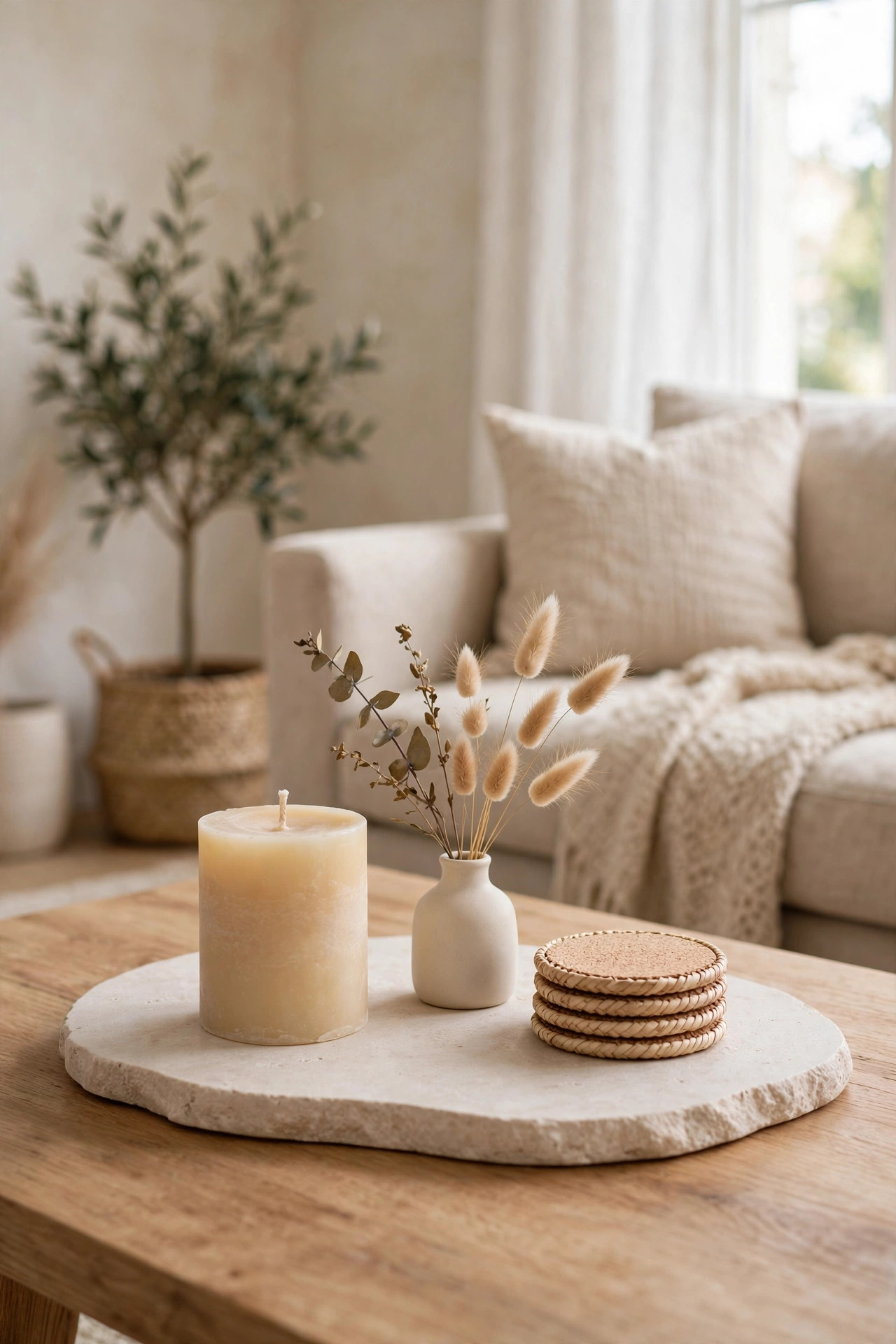
I want to tell you about the smallest, cheapest object that made the biggest difference on my coffee table. It is a simple rectangular tray made of pale stone, and I found it at a thrift store for the price of a coffee. Before the tray, my coffee table held a candle, a small plant, and a stack of coasters, all sitting directly on the wood in a sad little row. They looked like strangers waiting for a bus. The day I grouped them all on that tray, they became a family. That is the magic of a tray, and stone is the quiet luxury version. It has weight, which makes it feel substantial and real. It has a cool, smooth surface that contrasts beautifully with wood and fabric. And it tells the eye that everything on it belongs together, which is the entire secret of styling. A tray turns random objects into an arrangement, and an arrangement looks intentional, and intentional looks expensive. That marble tile hack has held up perfectly for two years, by the way. The felt pads keep it from scratching the table, and the stone has developed the faintest sheen where hands touch it. Real stone ages gracefully, which is exactly why quiet luxury loves it. Every tiny mark tells a story, and none of them look like damage.
You can find stone, marble, or concrete trays at thrift stores, discount home shops, and even the hardware store’s tile section if you are creative. Mine is actually a large marble tile sample I bought for almost nothing and put little felt pads under, which is my favorite kind of budget hack. The rule I follow is simple. Corral small things, and leave one beautiful thing alone. On my tray right now there is a candle, a tiny vase with dried stems, and a small stack of coasters. Three things, one tray, done. The tray also protects your table from rings and drips, which means your wood stays beautiful longer. When I want to change the mood, I just swap what is on the tray instead of redecorating the whole table. It takes thirty seconds and it always works. If your coffee table feels messy no matter how often you tidy it, you do not need fewer things. You need a tray. Round trays work beautifully on square ottomans, while rectangular trays suit long coffee tables best. I follow the rule of three for what goes on top, something tall, something flat, something living or flickering. A candle, a small plant, and a stack of coasters never fails. And when the seasons change, I just swap the contents. New look, zero cost, thirty seconds. And speaking of beautiful things with history, that is where the real treasure hunting begins.
11. Thrifted Brass Candlesticks
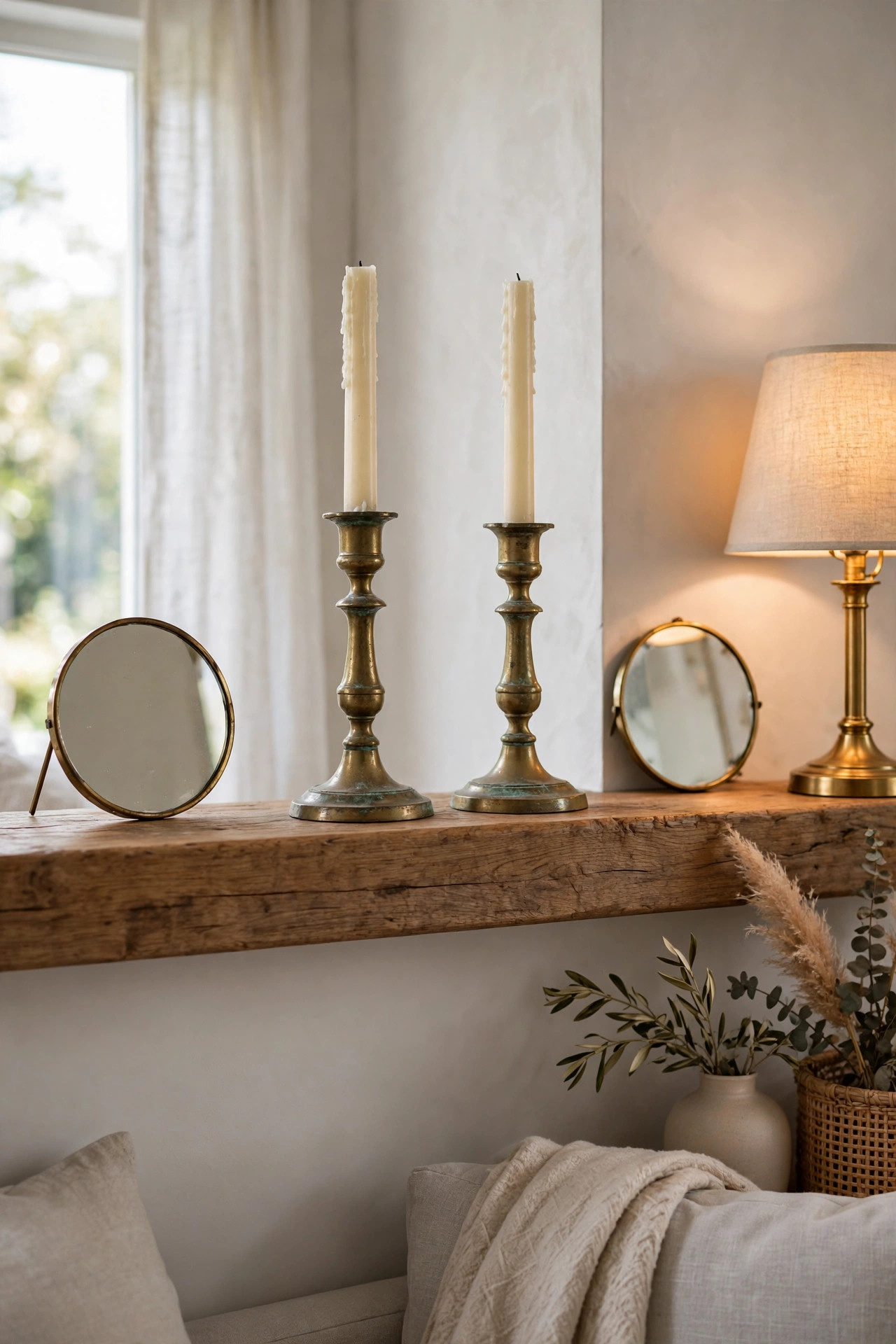
If I could only keep one decorative object from my entire home, it might be the pair of brass candlesticks I found at a flea market for less than lunch money. They are heavy, slightly tarnished, and completely unremarkable at first glance, which is exactly why I love them. Brass is the quiet luxury metal. It is warm where chrome is cold, and it glows where black metal just sits there. But here is what nobody tells beginners. New brass from a home store often looks too shiny and perfect, like costume jewelry. Old brass has a patina, that soft darkening in the crevices that only comes from years of being touched and polished and lived with. You cannot buy patina at full price. You can only find it secondhand, which means the most luxurious version is also the cheapest. My candlesticks sit on my mantel flanking a small mirror, and they catch the lamplight every evening in a way that makes the whole wall look richer. They have also become my favorite hostess gift, because a pair of vintage candlesticks feels personal in a way a bottle of wine never does. I keep an eye out for extras whenever I thrift, and I have a small stash ready for birthdays. Giving something with history feels more meaningful, and it always starts a conversation about where I found them.
Thrift stores, estate sales, and flea markets are full of brass waiting for a second life, and I have a whole routine now. I go early on weekends, I head straight for the housewares shelves, and I pick up anything heavy and golden. If a magnet sticks to it, it is not solid brass, so I put it back. If it is heavy and unmarked, it comes home with me. A little tarnish is good, heavy black crust is fine too because it polishes off. I clean mine with lemon and baking soda, which costs pennies and works better than any store bought polish. I never polish them to a mirror shine, because that soft glow is the whole point. Two candlesticks, a pair of simple ivory taper candles, and suddenly my mantel looks like it belongs to someone with excellent taste and a long memory. They cost me almost nothing and they will outlive me, which is more than I can say for most things I have bought new. A quick safety note I learned from experience. Always use sturdy, drip free taper candles and never leave them burning unattended. I trim my wicks to about a quarter inch before lighting, which keeps the flame steady and small. And I place the candlesticks away from curtain edges, because beautiful should never mean careless.
12. Secondhand Solid Wood Side Table
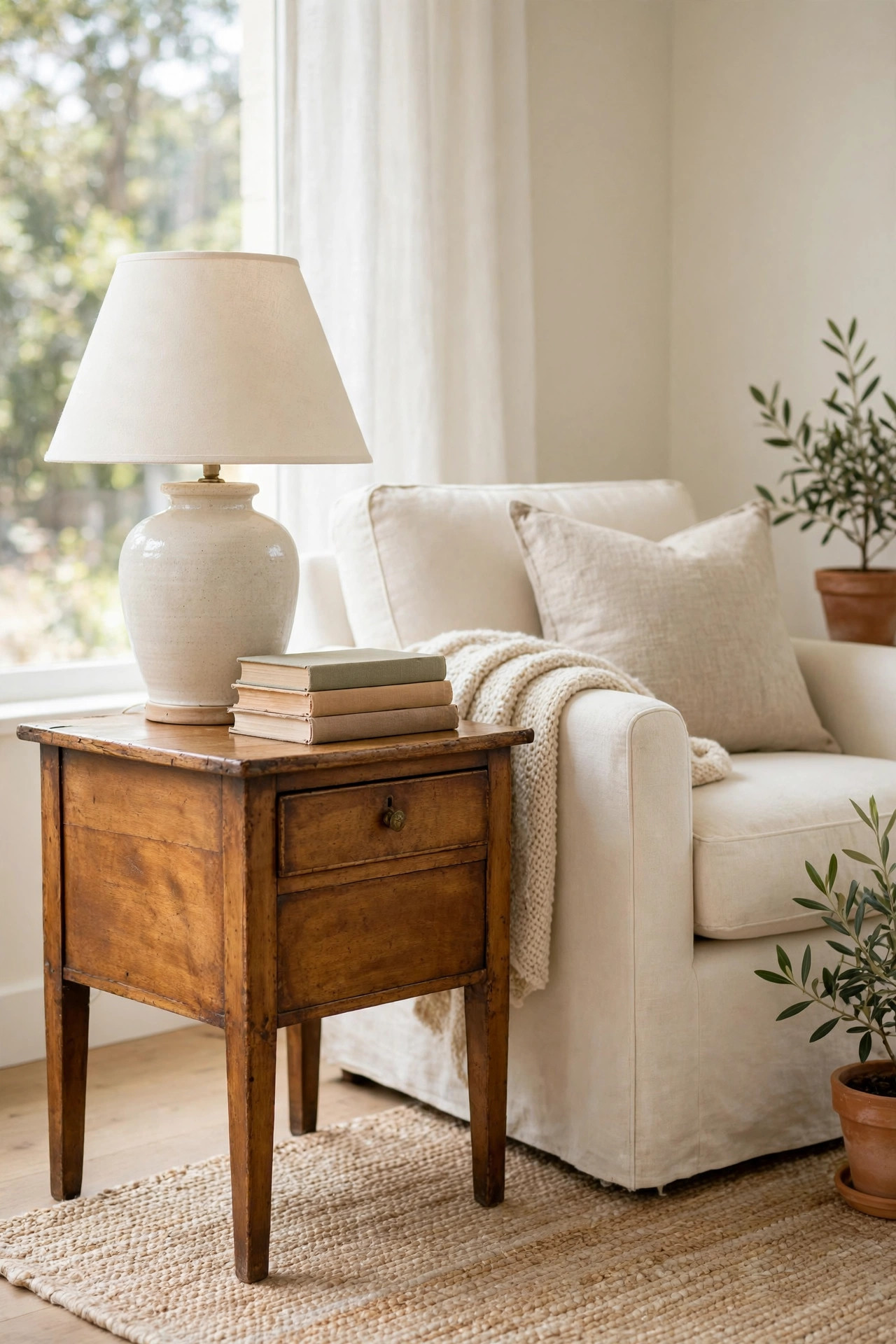
Let me tell you about the best forty dollars I ever spent on furniture. I found a small solid wood side table at a charity shop, scratched on top, wobbly leg, priced to move. Most people walked right past it. I saw past the scratches because I had learned the golden rule of secondhand furniture. Buy the bones, not the finish. Solid wood can be fixed, sanded, oiled, and loved back to life. Particle board cannot. That little table is now the hardest working piece in my living room. It holds my reading lamp, my tea, and the current book I am pretending to finish. The wood has a deep honey color that only comes from age, and the top has a soft sheen from years of hands and sunlight. New furniture tries to imitate this with distressing and glaze, but the real thing has a depth you can feel with your fingertips. Quiet luxury loves old wood because it has a story, and stories are the one thing money cannot buy. The oil finish has deepened beautifully over the past year, going from honey to a rich amber that looks more expensive every month. I reapply a thin coat of oil each spring, which takes twenty minutes and keeps the wood fed and glowing. That little table gets more use than any other surface in my home, and it just keeps getting better.
If you go hunting, and I hope you do, bring this checklist in your head. Knock on it, because solid wood sounds deep and dull while hollow furniture sounds like a drum. Check the joints, because dovetails and real screws mean quality. Ignore the finish completely, because scratches, water rings, and dull varnish are all fixable in a weekend. I sanded my table with medium sandpaper, wiped it clean, and rubbed in two coats of simple furniture oil. The whole restoration took one afternoon and cost me less than the sandpaper multipack I bought. The wobbly leg just needed its screw tightened, which took me about ninety seconds. Now that table looks like it cost ten times what I paid, and honestly it looks better than most new tables because it has character. Every scratch it still carries is a conversation. Buy old wood, give it a weekend of love, and your room gets an heirloom instead of just furniture. I always keep a stack of felt coasters on mine now, because even oiled wood appreciates protection from hot mugs. Danish oil was my finish of choice, since it soaks in and hardens without looking plasticky. Avoid thick varnish on old wood, because it hides the grain you fell in love with. Let the wood breathe and it will reward you.
13. Vintage Coffee Table Books
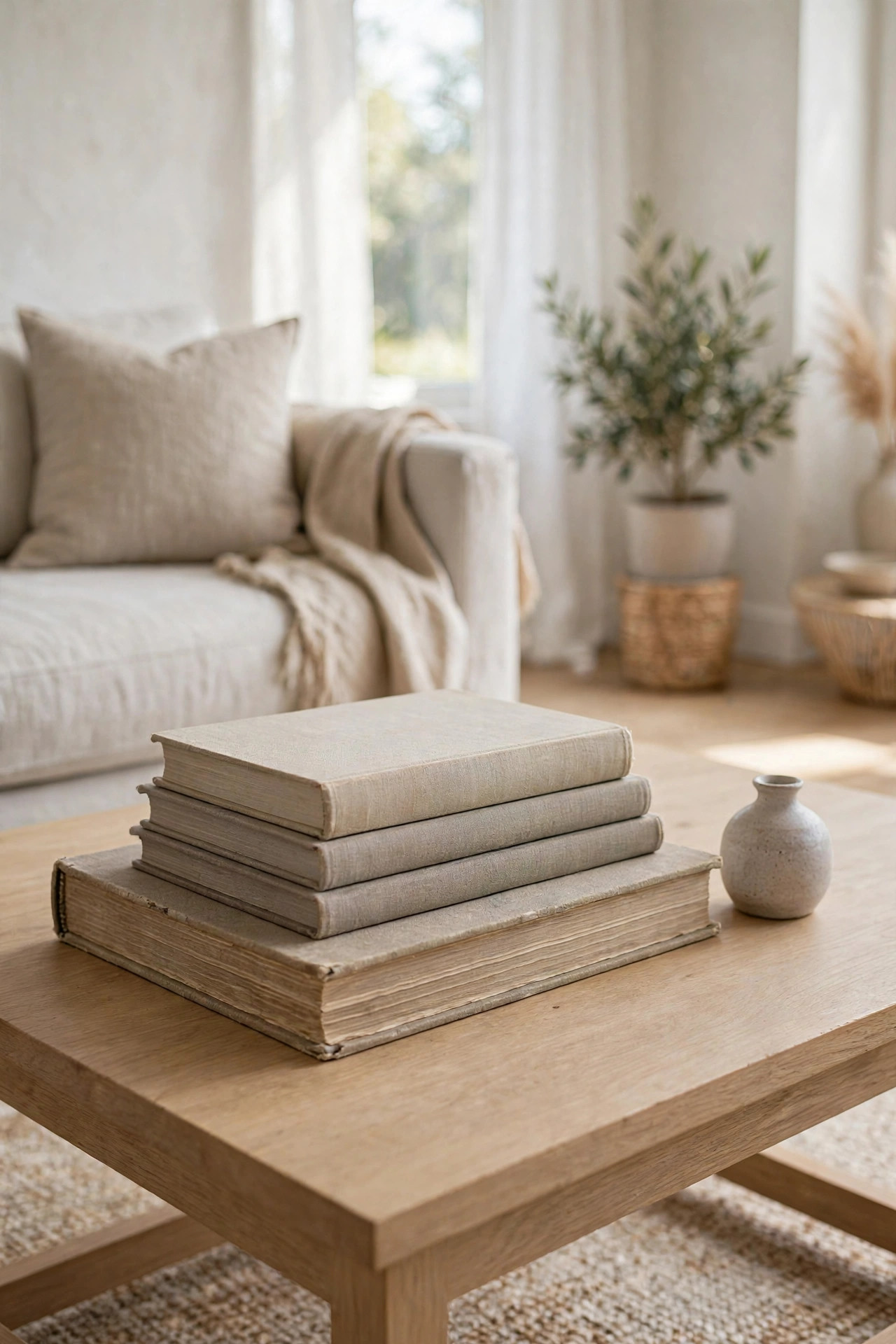
There is a special kind of book that was never really meant to be read cover to cover. Big, heavy, full of photographs, the kind about architecture or art or faraway places. I started collecting them from thrift stores, where they sell for a few dollars because nobody wants to carry them home. Stack two or three on a coffee table and something magical happens. The room instantly looks more cultured and more settled, like someone interesting lives there. It does not matter that I bought them for the pictures. What matters is the weight and the scale. A stack of large art books gives your coffee table the architecture it was missing. They add height, they add color in a controlled way, and they give guests something to flip through, which is the most welcoming thing a living room can offer. My favorite is a huge book of Italian villas I found for three dollars. I have never been to Italy, but that book makes my Tuesday evenings feel a little more romantic. That Italian villa book has started more conversations than anything else in my living room. Guests always pick it up, flip through the photographs, and ask where I found it. A three dollar thrift store book has given me more dinner party conversation than any small talk ever could. It turns out people love beautiful things with stories, even borrowed ones.
The styling part is simple, but there are rules I wish someone had told me sooner. Stack them largest to smallest, like a pyramid, and never more than three or four or it starts to look like a library sale. Turn the top book so its cover faces up and slightly angled, because that is the one people will notice first. Inside the frames I put a mix that cost me almost nothing. Free printable art from museum websites, a black and white photo I took myself, a postcard from a trip, and one small original sketch from a local market. The uniformity of the frames makes even a postcard look like it belongs in a museum. My hallway went from blank and forgotten to the most complimented spot in my home. Ten matching frames, one afternoon, and a wall that looks curated by a professional. I hung mine with a mix of small nails and removable strips, using strips on the rental friendly wall and nails where I owned the place. Keep about two inches between frames for a calm, even rhythm. Too tight feels crowded, too loose feels disconnected. Step back across the room after every three frames to check your lines, because walls are never as straight as you think.
14. Matching Frames Gallery Wall
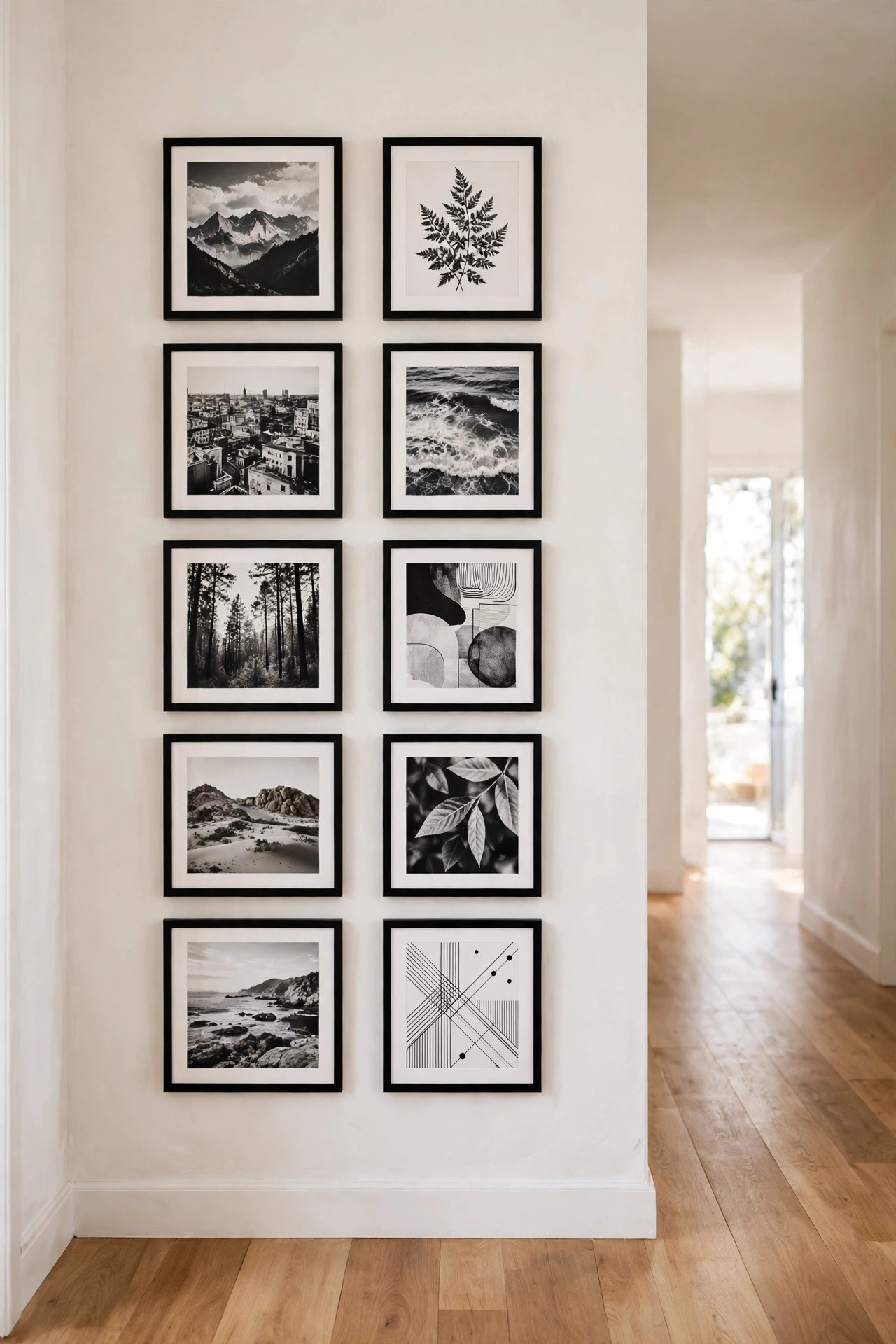
I made every gallery wall mistake before I learned this one, so let me save you the trouble. My first attempt was a cheerful chaos of different frames in different colors, different sizes, hung at slightly different heights. It looked like a craft fair exploded on my wall. I loved each piece individually, but together they shouted. Then I saw a gallery wall in a friend’s hallway that stopped me in my tracks. Ten pieces, all in identical thin black frames, hung in a perfect grid. The art inside was a wild mix, a sketch, a photograph, a pressed flower, a kid’s drawing. But because the frames matched, the whole thing looked calm and intentional and, yes, luxurious. That is the quiet luxury gallery wall formula. The frames do the unifying, so the art can be personal. Matching frames turn a collection of random things into a collection, period. It is the difference between a pile of photos and a gallery. The kid’s drawing in the grid gets the most comments of all, which delights me every time. It is a crayon drawing of our dog, framed exactly like the museum prints around it, and that contrast is pure joy. Treating something humble with the same respect as fine art is the quiet luxury mindset in a nutshell. Everything deserves a beautiful frame if you love it.
Here is exactly how I did mine for very little money. I bought ten identical frames from a discount store, all the same size, all simple black wood. Matching does not mean expensive, it means consistent. I laid them out on the living room floor first and played with arrangements until I found a grid I liked, then I took a photo of the layout so I would not forget. For hanging, I used paper templates taped to the wall, which sounds fussy but saved me from a wall full of extra nail holes. Inside the frames I put a mix that cost me almost nothing. Free printable art from museum websites, a black and white photo I took myself, a postcard from a trip, and one small original sketch from a local market. The uniformity of the frames makes even a postcard look like it belongs in a museum. My hallway went from blank and forgotten to the most complimented spot in my home. Ten matching frames, one afternoon, and a wall that looks curated by a professional. I hung mine with a mix of small nails and removable strips, using strips on the rental friendly wall and nails where I owned the place. Keep about two inches between frames for a calm, even rhythm. Too tight feels crowded, too loose feels disconnected. Step back across the room after every three frames to check your lines, because walls are never as straight as you think.
15. Aged Black Picture Frames
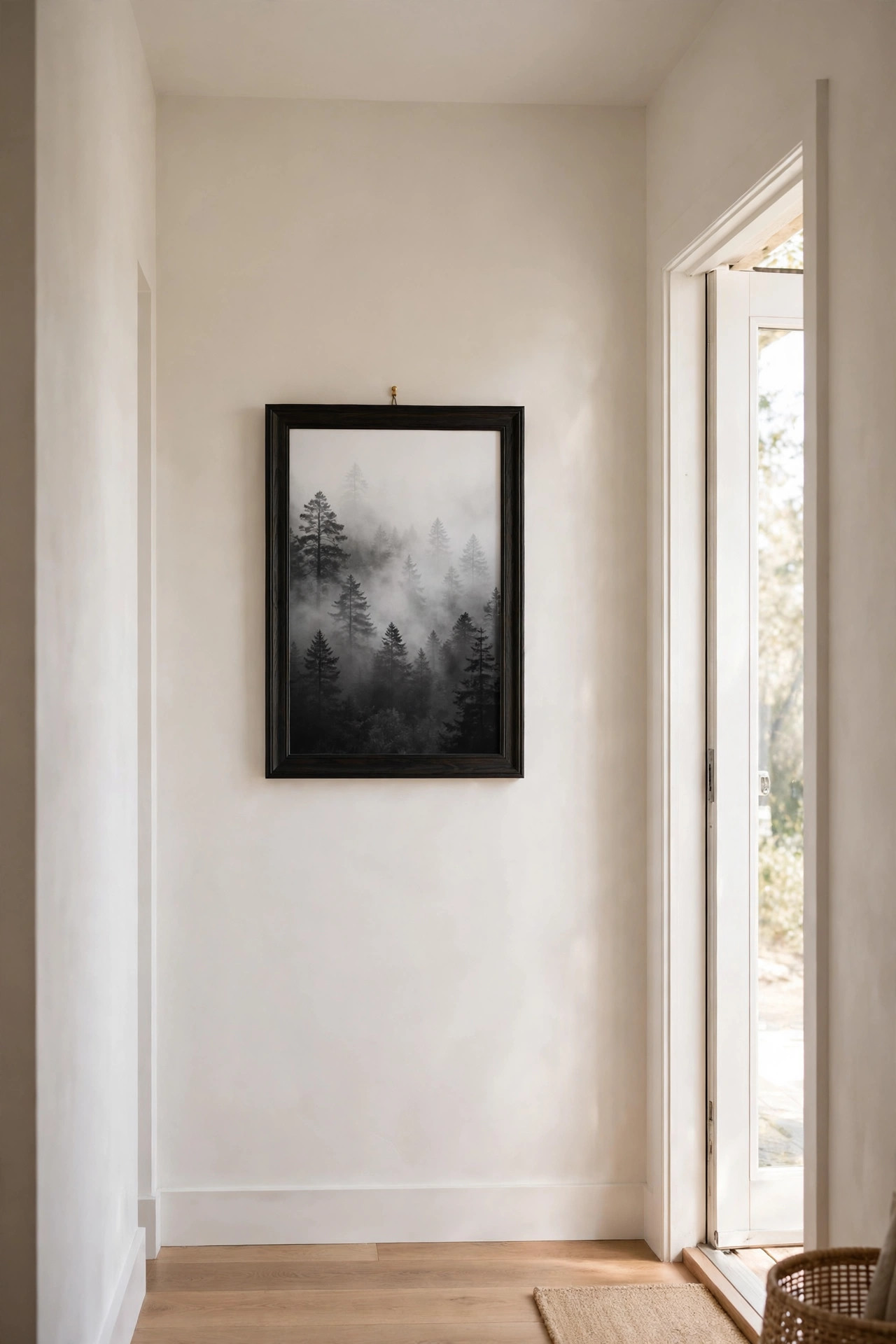
After the gallery wall, I had three frames left over, and they taught me a separate lesson about the power of a single well chosen frame. I had one photograph I loved, a misty black and white shot of trees I took on a morning walk, and it had been sitting in a cheap plastic frame for years looking sad. On a whim I put it in one of the leftover black wood frames and hung it alone on a narrow wall in my hallway. That single framed photograph changed the whole hallway. It became a destination instead of a passage. Black frames are the quiet luxury workhorse because they do something almost no other frame color does. They disappear and emphasize at the same time. The black border recedes so your eye goes straight to the image, but it also gives the image a crisp edge that makes even a phone photo look like fine art. It is the same reason museums use black frames. They are not decorating the art, they are presenting it. That misty tree photograph still stops me in the hallway sometimes, and I took it myself on an ordinary Tuesday. It reminds me that you do not need to travel far or spend much to find beauty worth framing. The black frame gave my little morning walk the dignity of a gallery piece. Some days that is all the art I need.
You do not need to buy expensive frames to get this effect, and the thrift store is your best friend here. I look for real wood frames with glass, because the weight and the slight imperfections in old wood read as quality. If the frame is the wrong color, a small can of matte black paint transforms it in an afternoon. I painted two wooden thrift frames last spring, and nobody has ever guessed they were not always black. For the art inside, think beyond store bought prints. Your own black and white photographs, printed at the drugstore for very little, look stunning in a black frame. Dried flowers pressed between glass, a handwritten quote, even a beautiful piece of fabric, all of it looks intentional in black. Hang a single large one as a focal point, or a pair flanking a mirror. One black frame, one image you love, and suddenly you have a gallery moment. It is the smallest change on this list and somehow one of the most powerful. Clean the glass with a microfiber cloth and a spritz of vinegar water, never paper towels, which can scratch over time. If your print is valuable to you, use a simple paper mat to keep the photo from touching the glass. Mats also make small images look grander, which is a lovely trick for phone photos. A two dollar mat can make a free print look like a hundred dollar piece.
16. Eucalyptus Stems in Ceramic Vases
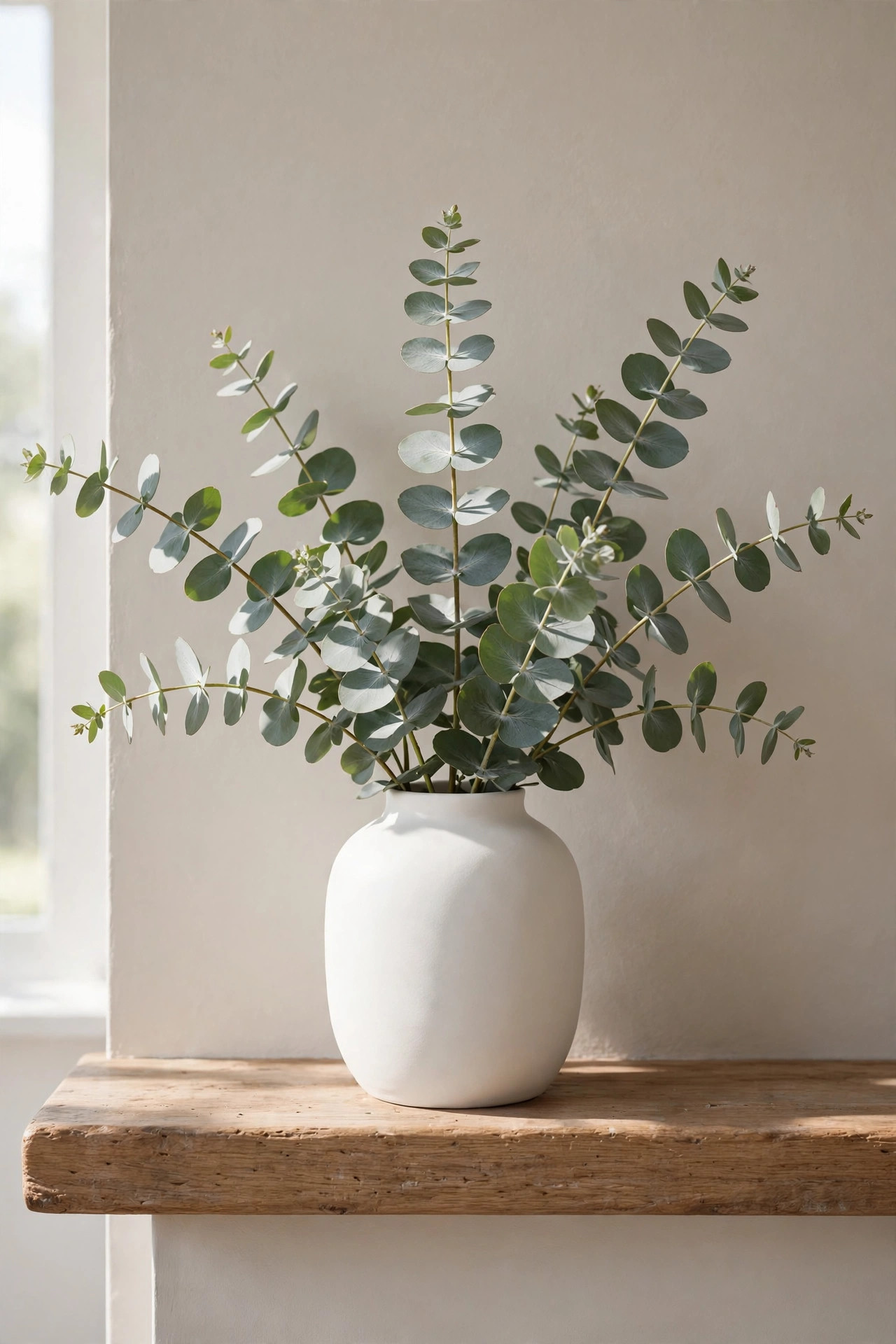
With the walls, shelves, and frames finally settled, I turned my attention to the finishing touches, the small living things that make a room feel alive. And the first one I tried was almost embarrassingly simple. A bunch of eucalyptus stems in a ceramic vase. I had seen them in every beautiful home photo for years and assumed they were some expensive designer trick. Then I found a big bunch at the grocery store for the price of a fancy coffee, brought it home, and stuck it in a plain white vase I already owned. The effect was instant and honestly a little shocking. Those silvery green stems added height, color, and life to my mantel in about ten seconds. Eucalyptus is the quiet luxury plant because it looks sculptural without trying. The round leaves catch the light beautifully, the muted green gray color goes with literally everything, and it smells faintly clean and fresh, like a spa that does not charge you two hundred dollars. It made my room feel styled in a way no object ever had, because it was alive. I also hang a small bunch in my shower sometimes, tied to the showerhead away from the direct spray. The steam releases the eucalyptus oils and turns an ordinary shower into a spa experience. It sounds extravagant, but it is literally the same grocery store bunch, just multitasking. That is my favorite kind of luxury, one purchase doing double duty.
The economics of eucalyptus are almost unfair, and that is why I love it. A fresh bunch lasts two to three weeks in water, and then, and this is the best part, you just let it dry. Dried eucalyptus keeps its shape and color for months, slowly fading to a softer sage that looks even more beautiful in my opinion. I have stems in my living room right now that I bought in the fall, and they still look intentional. If you want them to last even longer, hang a bunch upside down in a dark closet for a week when they are fresh, and they will dry perfectly straight. I keep one tall bunch on the mantel and a smaller one in the bathroom, because that little touch of green makes even a tiny room feel considered. No watering schedule, no plant parent guilt, no expensive pots. Just a grocery store bunch and a vase you already own. It is the lowest effort, highest reward idea on this entire list, and I refill mine whenever I do my weekly shopping without even thinking about it. Change the water every few days and trim a half inch off the stems each time, because fresh cuts drink better. Keep the vase out of direct afternoon sun, which fades the color faster. If a few leaves drop, do not worry, just pick them up and enjoy the faint scent they leave behind. Easy care is the whole point.
17. Stone Vessel Candle
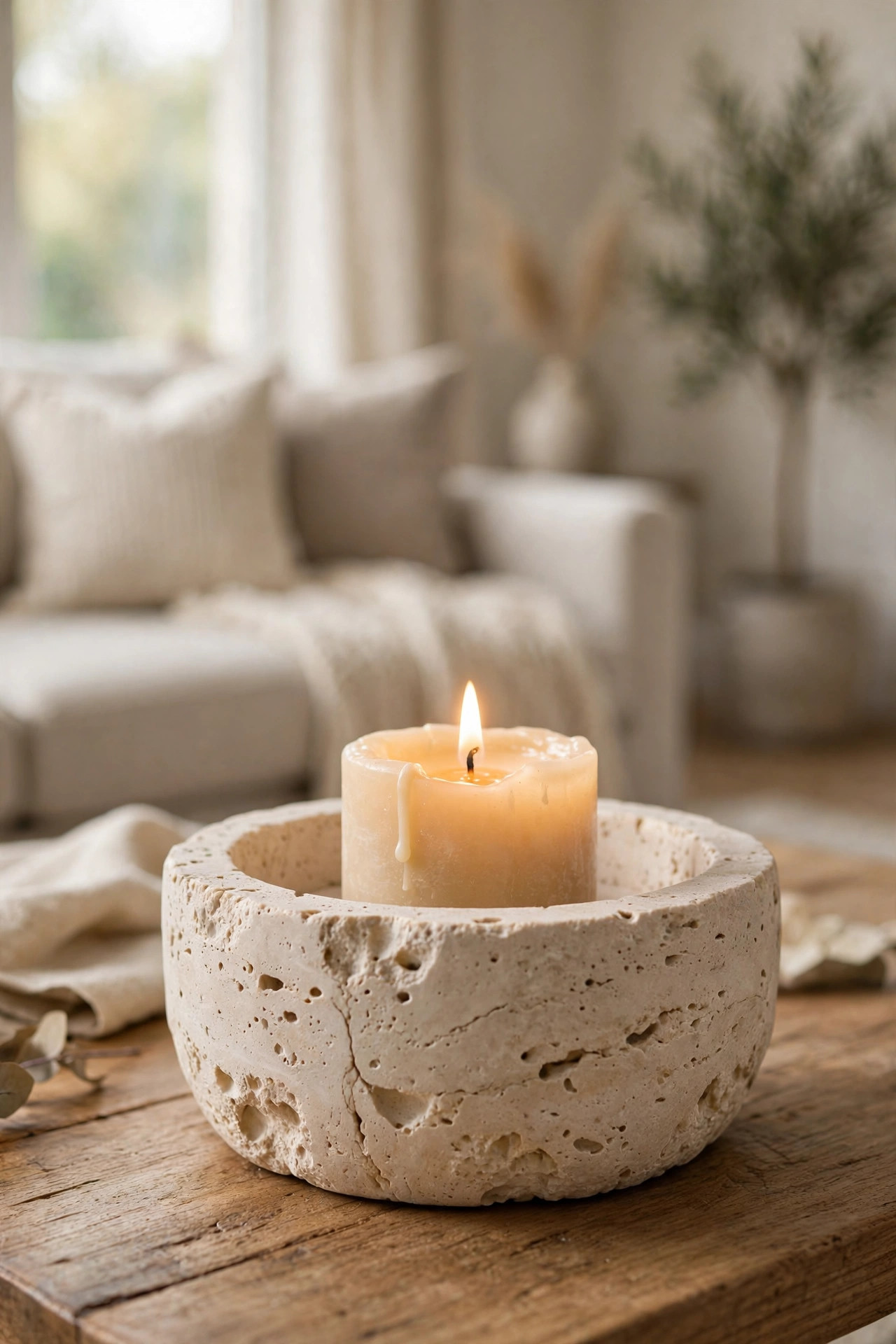
I used to buy whatever candle was on sale, usually in a glass jar with a loud label and a scent named something like tropical explosion. They did the job, but they never looked like anything. Then a friend gave me a candle poured into a small travertine stone vessel, and I finally understood what a candle could be. The vessel itself was the decoration. Cool, heavy, with natural pits and veins in the cream colored stone, it looked like something carved from a cliffside. When the candle burned down, I kept the vessel and used it to hold cotton balls in the bathroom, which tells you everything about how beautiful the container was. A stone vessel candle is quiet luxury in its purest form, because it appeals to three senses at once. You see the beautiful object, you feel its weight when you pick it up, and you smell whatever lovely scent fills the room. It is a tiny daily ritual of beauty, and rituals are what make a house feel like a sanctuary instead of just a place you sleep. I now keep a little rotation going, one beautiful candle burning, one waiting in the cupboard for when it finishes. Buying them on post holiday clearance means I never pay full price. There is something deeply satisfying about having a small stockpile of beautiful things. It feels like planning ahead for joy, which is a very quiet luxury habit.
Here is the budget reality, because stone vessels sound expensive. Mine was a gift, but I have since found beautiful ones at discount home stores for the price of two fancy coffees, especially after the holidays when seasonal scents go on clearance. The trick is to choose your scent the way you choose your paint, warm and natural. Look for cedar, amber, fig, or plain beeswax, and avoid anything with glitter, bright colors, or a name that sounds like a candy store. I burn mine in the evening while I read, just one candle on the coffee table, and the whole living room feels calmer. When it burns down, do not throw the vessel away. Pour out the last bit of wax with hot water, wipe it clean, and you have a permanent little stone cup for matches, rings, or cotton pads. One beautiful candle beats five cheap ones every time. Buy the nice one, burn it slowly, and enjoy the feeling of a small everyday luxury. Let the candle burn long enough on the first light to melt the wax across the whole surface, which prevents that tunneled look later. I trim the wick before every single burn, a habit that took two weeks to build and now feels automatic. And I always burn it on the stone tray, because the tray catches any drips and looks intentional doing it.
18. Oversized Leaning Floor Mirror
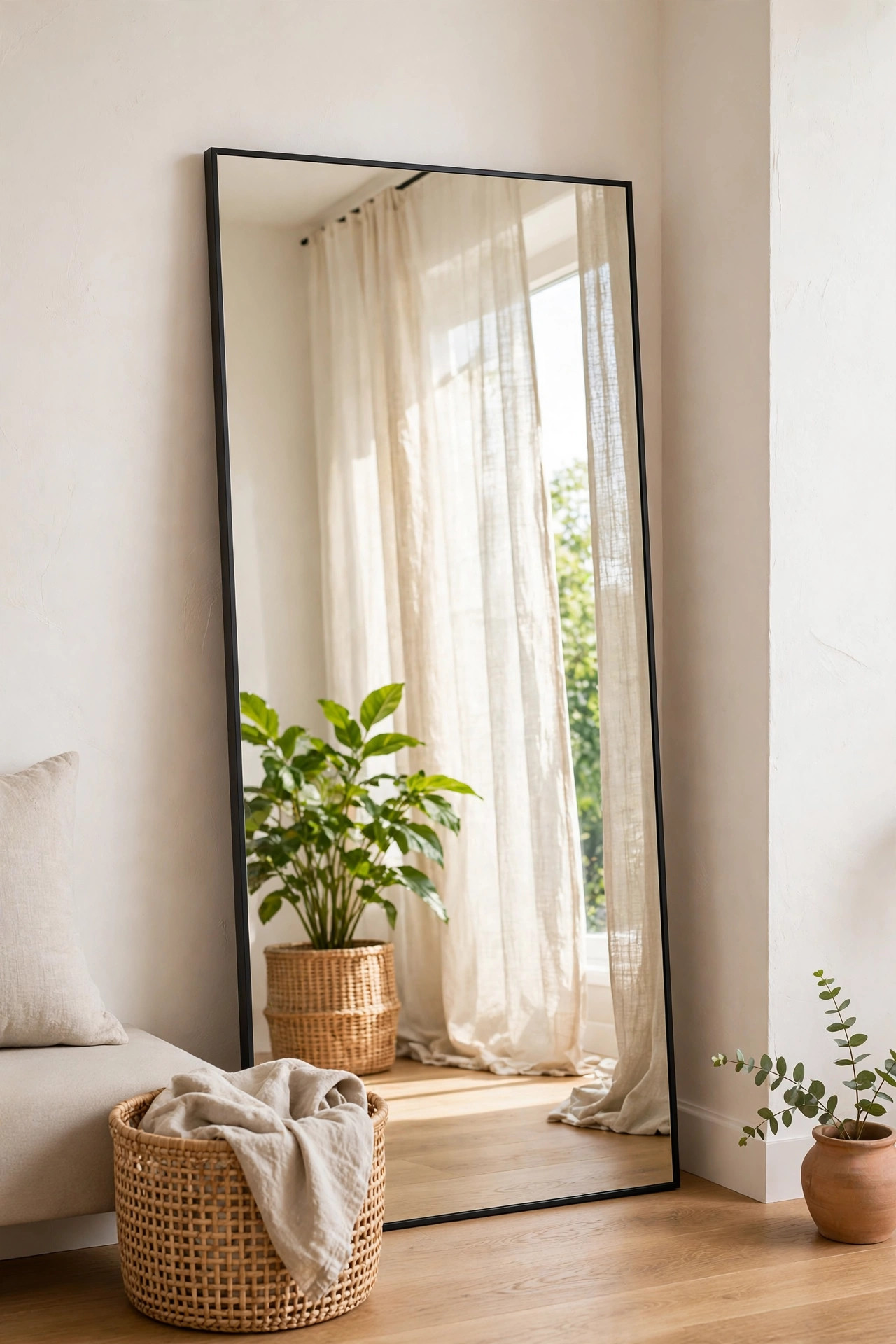
My living room has one awkward corner that defeated me for years. Too small for furniture, too big to ignore, it just sat there looking unfinished. I tried a plant there, but it died. I tried a floor lamp, but it crowded the walkway. Then I leaned a tall mirror against the wall in that corner, and the whole room changed in a way I did not expect. An oversized leaning mirror does three luxurious things at once. It bounces light deep into the room, which makes everything brighter and more alive. It doubles whatever is beautiful across from it, in my case my linen curtains and a plant, so the room feels fuller. And it adds a sense of scale and drama that makes the ceilings feel higher and the space feel grander. There is a reason every expensive hotel lobby has a giant mirror. It is instant architecture. Mine makes my modest living room feel twice as big, and every guest comments on how bright the room feels without knowing why. What the mirror reflects matters more than the mirror itself, and I learned this by experiment. At first it faced my bookshelf, which just doubled the visual clutter. Moving it to reflect the window and curtains changed everything. Now it throws daylight deep into the room and doubles the prettiest corner I have. Aim your mirror like a camera, at beauty.
The leaning part is key, and it is also what makes this budget friendly. A leaning mirror does not need professional hanging, no drilling into studs, no expensive hardware, no fear. You just lean it at a slight angle against the wall, making sure the bottom sits firmly on the floor. I found mine at a discount furniture outlet, a simple tall rectangle with a thin black frame, for less than a pair of nice shoes. Thrift stores get them too, though you have to check the glass carefully for desilvering, those dark spots around the edges. A little wear on a vintage mirror is actually charming, but big black spots will bother you forever. Place it where it reflects something pretty, a window, your curtains, a plant, never a blank wall or clutter. And please anchor the top to the wall with a small strap if you have kids or pets, because safety is the one thing you never skip. One mirror, one corner, and suddenly your room has depth it never had before. I anchored mine with a discreet anti tip strap screwed into a stud, which took ten minutes and lets me sleep at night. For cleaning, I use a microfiber cloth and plain water, because harsh cleaners can damage old mirror backing. Clean it monthly and it will keep throwing that beautiful light around your room for years.
19. Upholstered Linen Bench
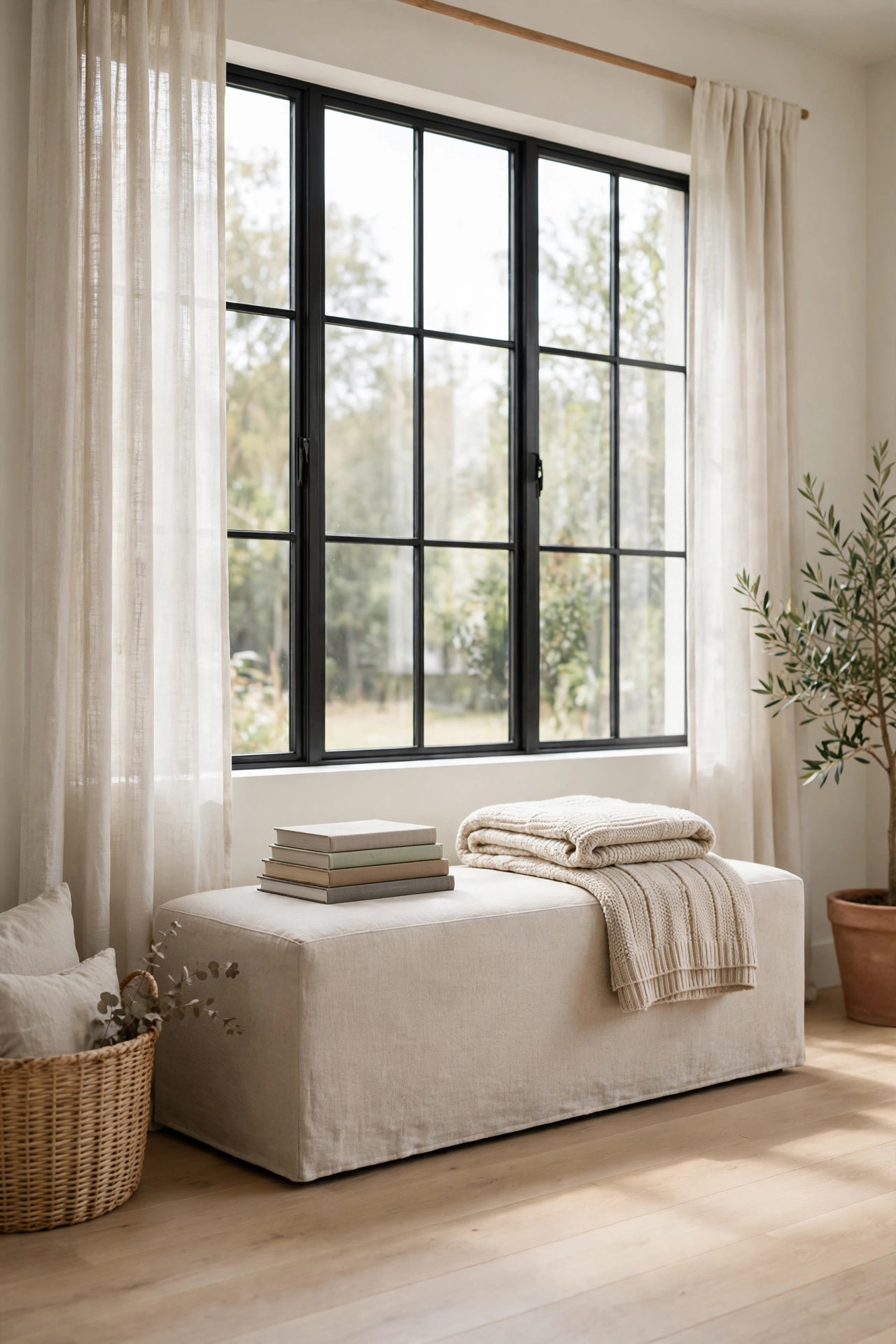
Every well dressed room needs one piece that is purely about comfort and invitation, and in my living room that piece is a simple upholstered bench. I found mine at an estate sale, a plain wooden bench with tired fabric, and I almost left it behind. But the shape was perfect, low, long, sturdy, the kind of bench that could sit at the foot of a bed or against a living room wall. I bought it for next to nothing and recovered it myself one weekend with natural linen fabric and a staple gun, following a video tutorial. It took me an afternoon, and I will not pretend my corners are perfect, but from normal viewing distance it looks like a custom piece. Now it sits under my front window holding a folded throw and a stack of books, and it is everyone’s favorite seat in the house. An upholstered bench is quiet luxury because it is useful without showing off. It offers a place to sit, to set a tray, to rest your feet, all while looking soft and tailored. The best part is how often it gets used compared to how little it cost. My morning coffee tastes better sitting on that bench in the window light. When friends visit, someone always ends up there, usually with a book. Furniture that invites you to sit down and stay awhile is doing its job, and this humble bench does it better than pieces costing ten times more.
If reupholstering sounds scary, and it did to me too, you have easier options. Discount stores sell simple linen covered benches and ottomans ready to go for very reasonable prices, especially in neutral colors. Look for clean lines and sturdy legs, because shape matters more than fabric when the color is neutral. I chose a warm oatmeal linen that hides dust and pet hair, which was a very practical decision I am proud of. The bench also solved a real problem in my room, which was the dead space under the window. Now that spot has a purpose. In a small living room, a bench can even replace a coffee table, giving you footrest, extra seating, and surface space in one piece. Mine gets used every single day, by me with my morning coffee, by the dog who has claimed the sunny end, by guests who need a perch. Beautiful, useful, and cheap. That is the quiet luxury trifecta, and this bench nails all three. I chose performance linen in that oatmeal shade specifically because it resists stains and wipes clean with a damp cloth. With a dog and a coffee habit, that was not optional. The neutral color means I never have to match it to anything, it simply belongs. If the fabric ever wears out, I already know I can recover it again in another afternoon.
20. Grocery Store Flower Ritual
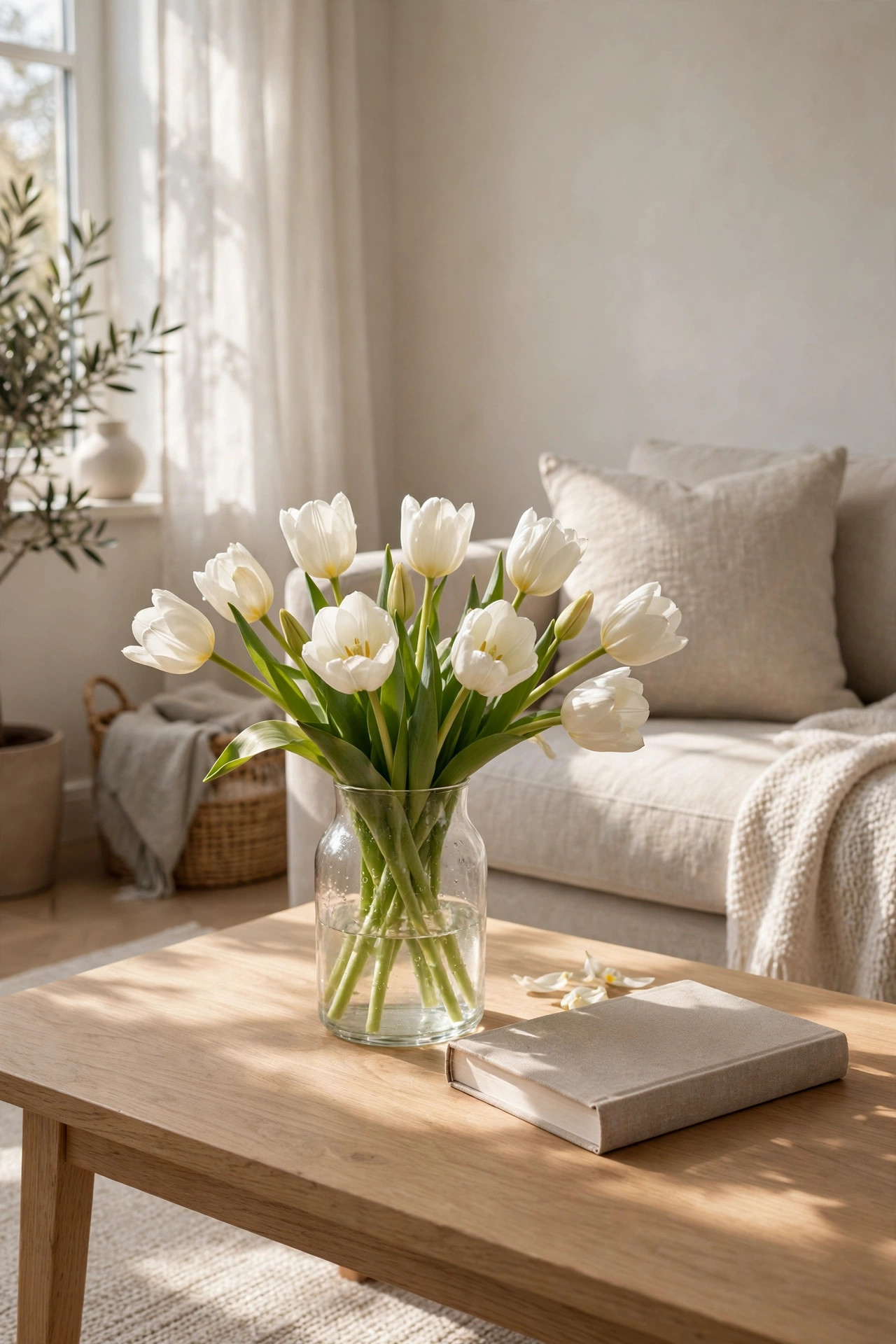
I saved my favorite idea for last, because it is not really about an object at all. It is about a habit. Every Sunday morning, I buy one bunch of fresh flowers from the grocery store. Not the big fancy arrangement, just the simple ten dollar bunch, whatever looks freshest. White tulips in spring, sunflowers in summer, simple mums in fall. I bring them home, trim the stems at an angle, and put them in a plain glass vase on my coffee table. That is it. That is the whole ritual. And I am telling you, it changes the feeling of my home more than any furniture I own. Fresh flowers are the ultimate quiet luxury because they are beautiful for no practical reason at all. They do not store anything, they do not provide light, they just sit there being gorgeous for a week. Having something purely beautiful in your home, replaced regularly, is a quiet way of telling yourself that you are worth nice things. It is self respect in flower form. I have also started bringing a small bunch to friends when I visit, instead of wine. It costs less, it is unexpected, and it always makes people happy. A ten dollar bunch of flowers says I was thinking of you in a way that feels personal. The ritual has spread a little joy beyond my own walls, which might be its best feature.
The budget math is what makes this a ritual instead of a splurge. One bunch a week costs less than most people’s daily coffee habit, and it pays you back every time you walk through the room. I have learned a few tricks to make them last. Trim the stems every two days and change the water, because clean water is the whole secret. Keep them away from direct sun and heating vents, which age them fast. Pull out any wilting stem immediately so it does not drag the rest down. And here is my favorite part. When the bunch starts to fade, I do not throw it all away. I keep the three best stems and move them to a tiny bud vase in the bathroom, which gives me a second week of beauty for free. Sunday flowers have become my favorite part of the week. The house smells faintly green, the coffee table always looks finished, and I start every Monday feeling like someone who has her life together. Try it for one month. I promise you will never go back. When the main bunch is truly done, I compost the stems and wash the vase with hot soapy water before the next Sunday. A clean vase makes the new flowers last longer, because bacteria is what kills them early. Some weeks I skip the flowers and put a big branch of greenery from the yard in the vase instead. The ritual bends, it never breaks.
Conclusion
Looking back at that mirrored side table I was once so proud of, I laugh a little now, but I am also grateful to it. It taught me the most valuable decorating lesson of my life, which is that luxury is a feeling, not a price. None of the twenty ideas on this list required a big budget. Most of them cost less than a dinner out, and several cost nothing at all. What they required instead was patience, restraint, and the willingness to look at my home with fresh eyes. Warm white walls, thrifted brass, linen curtains hung high, fresh flowers every Sunday. None of it is flashy. All of it feels like a deep breath.
If I had to pick just three for my own home, and you asked me this at a dinner party I would not hesitate, I would choose the warm white paint, the linen curtains, and the Sunday flower ritual. Paint for the base, curtains for the light, flowers for the soul. Everything else is wonderful, but those three changed how my home feels every single day. Start with whichever one speaks to you, do it this weekend, and notice how different your rooms feel by Sunday night. Quiet luxury is not about having more. It is about needing less and loving what you have a little more fiercely. Your home is already closer to beautiful than you think.
FAQs
What is quiet luxury decor?
Quiet luxury decor is a style built on restraint, quality materials, and calm neutral colors instead of flashy trends or big brand names. Think natural linen, warm wood, soft wool, aged brass, and plenty of empty space. It looks expensive because everything is chosen with care, not because everything cost a fortune. The whole philosophy is buying less and choosing better.
Can I really get the quiet luxury look on a tight budget?
Yes, and honestly a tight budget helps, because quiet luxury is about restraint. Thrift stores are full of solid wood furniture, brass candlesticks, and real art frames for very little money. Paint, secondhand textiles, and grocery store flowers do most of the heavy lifting. The style rewards patience and editing, both of which are free.
What colors work best for quiet luxury decor?
Stick to warm neutrals. Warm white, cream, ivory, oatmeal, soft beige, warm gray, and natural wood tones form the base. Add depth with muted accents like sage, charcoal, or aged brass. Avoid bright trendy colors and cold blue grays, which fight the calm feeling. When in doubt, choose the softer, warmer version of any color.
Where should I shop for quiet luxury pieces on a budget?
Thrift stores, estate sales, flea markets, and charity shops are the best sources for solid wood furniture, brass, art frames, and vintage books. For new items, discount home stores carry linen curtains, boucle pillows, seagrass baskets, and stone trays at very fair prices. Always buy the best bones you can afford secondhand and save your new purchases for textiles.
How do I keep quiet luxury from looking boring?
The secret is texture, not color. Mix nubby boucle with smooth linen, rough jute with soft wool, cool stone with warm wood. Vary the heights of your objects and leave breathing room between them. One sculptural plant or a single piece of moody art adds personality without noise. Boring comes from everything being the same flat finish, so layer textures generously.
Is quiet luxury just a trend that will look dated soon?
Quiet luxury is really just classic design with a new name. Neutral colors, natural materials, and simple shapes have looked good for a hundred years and will look good for a hundred more. Because it avoids trendy colors and fast fashion furniture, it actually ages better than most styles. Buy timeless pieces and your home will never need a full redo.