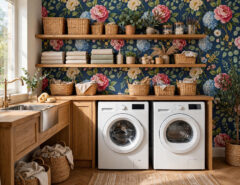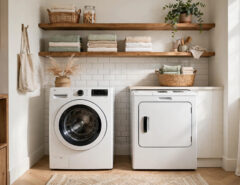
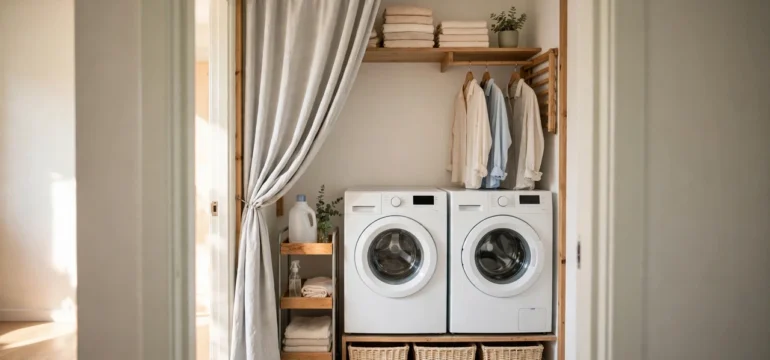
The closet door sticks, the washer hums against the wall, and the basket on the floor blocks the way in.
Most first apartments give laundry a closet, not a room. There is space for the machines and almost nothing else, no counter, no drying line, and no spot for detergent that does not fall over.
These first apartment laundry closet ideas on a budget work with the closet you already have. Each one costs little, needs no drilling or only a few removable hooks, and comes off clean when you move out. Together they give a tiny closet a place for sorting, drying, folding, and storing, without a renovation or a lost deposit.
Start with the curtain, the pads, and the cart, because those three quiet the room and hide the mess first. Then pick the drying and storage fixes that fit your own closet, and skip the rest without guilt.
1. A Curtain on a Tension Rod That Hides the Machines
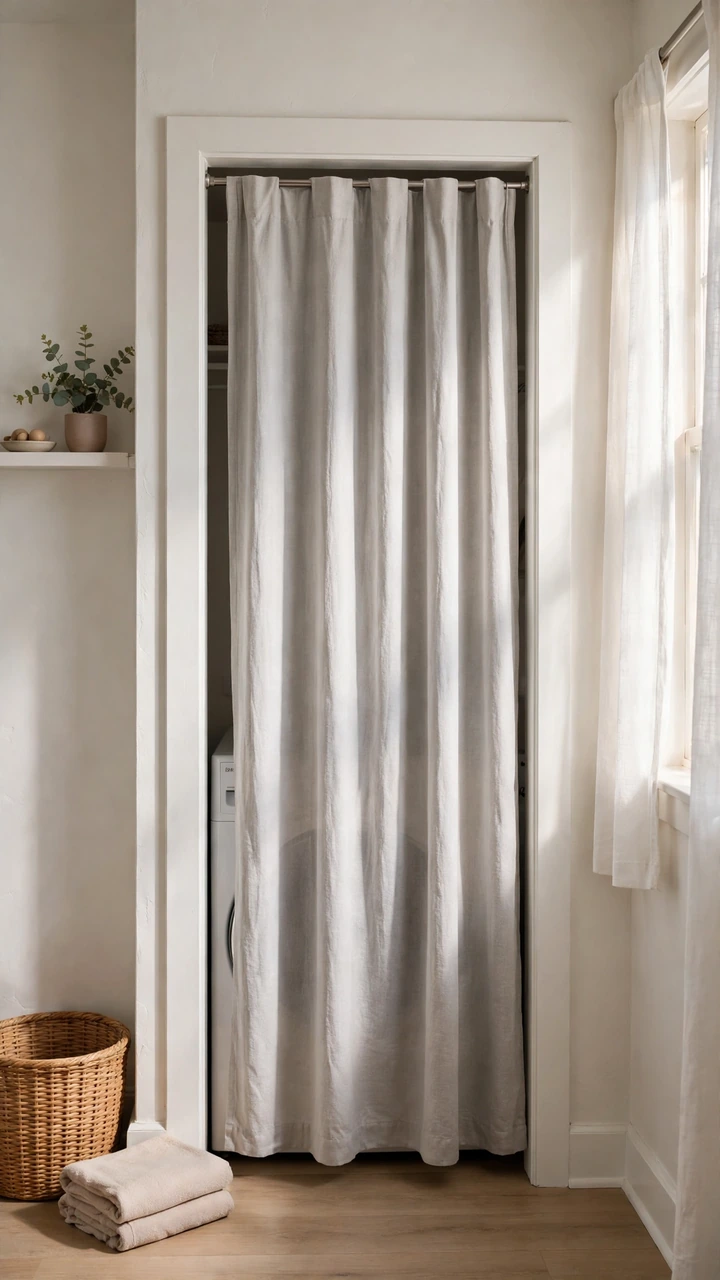
The machines are the first thing anyone sees when the closet door opens.
A curtain on a tension rod hides them in seconds, with no drilling and no new door. Choose a plain fabric curtain that reaches the floor, hang the rod high inside the frame, and let the curtain fall straight. The fabric softens the hard edges of the machines, it hides detergent and baskets behind it, and it comes down in one pull on moving day. Wash it with the towels when dust builds up.
- Rod that fits the frame width.
- Curtain that reaches the floor.
- Fabric that washes in a machine.
At about ten to twenty dollars, it is the cheapest door the closet will ever have.
Machines, bottles, and baskets on show every time the door opens.
A plain curtain to the floor, with the machines and supplies hidden behind it.
2. Anti Vibration Pads Under Each Foot That Quiet the Spin Cycle
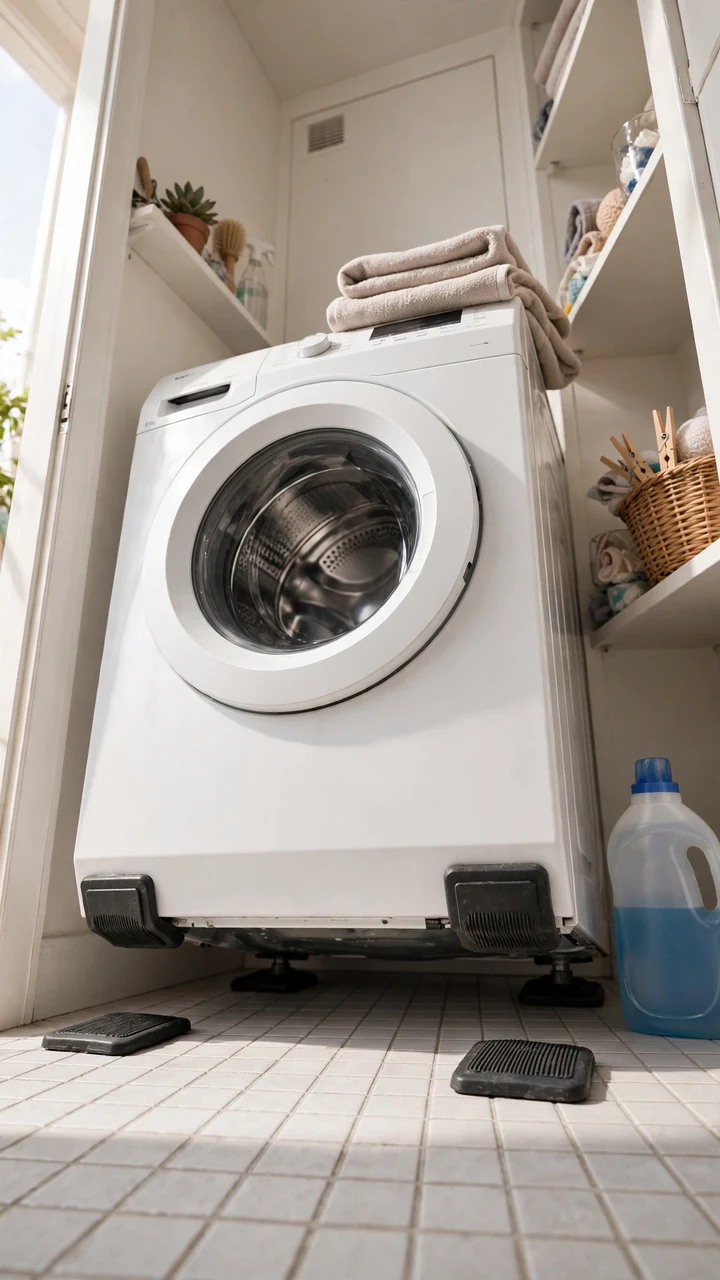
A quieter spin cycle starts under the feet of the machines.
Anti vibration pads sit under each foot and soak up the shake that travels through the floor. They help in an apartment where the laundry closet shares a wall with a bedroom, and they keep the machines from creeping forward load after load. Lift one corner at a time, slide a pad under each foot, and set the machine back down level. Check the feet again after the first wash, because a pad that sits crooked does no good.
- One pad under each foot.
- Machine level when it sits back down.
- Feet checked after the first wash.
Skip pads if the machine rocks on a broken foot. Fix the foot first, then add the pads.
Quick Tip
Put pads under a washer and a dryer that both sit on a hard floor. On carpet, a solid board under the pads works better.
3. A Slim Rolling Cart in the Gap Beside the Washer
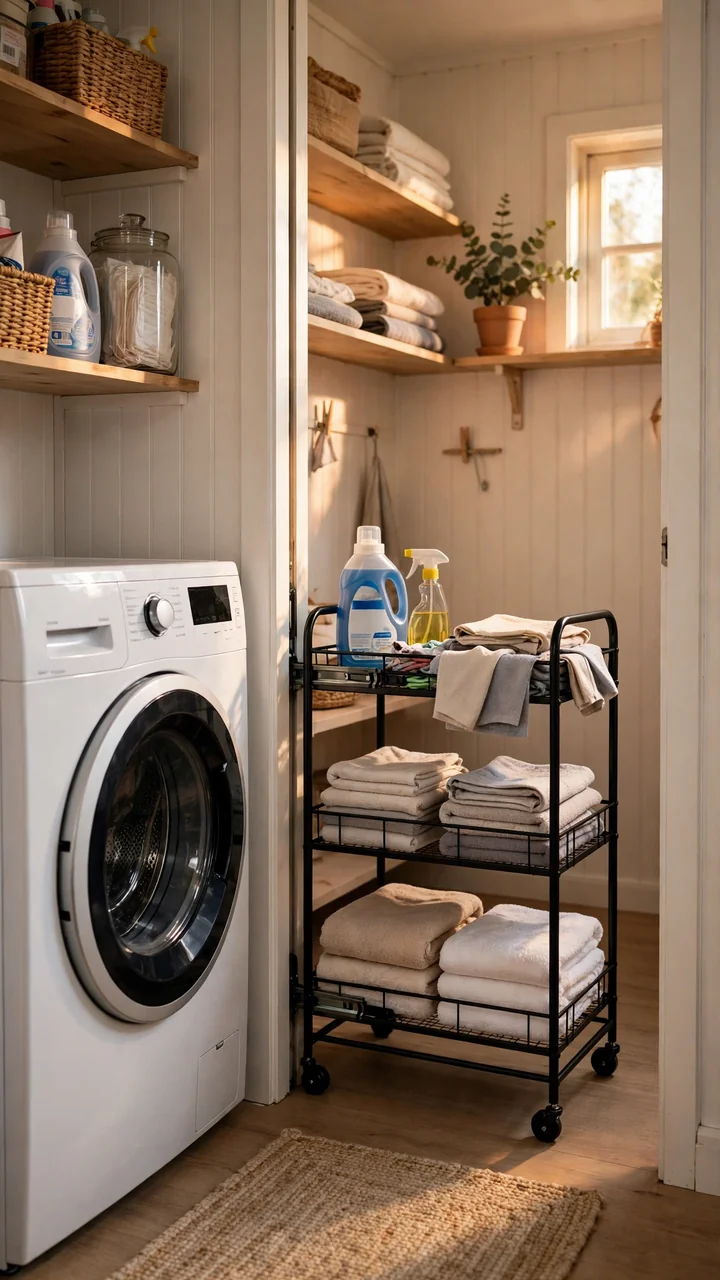
Measure the gap, then buy the cart.
A slim rolling cart slides into the narrow space beside the washer and turns dead space into storage. The top shelf holds detergent and stain spray where hands reach them, the middle shelf holds cloths and the lint roller, and the bottom shelf holds spare towels. Roll it out to clean behind it, roll it back when the wash starts, and keep nothing on top that blocks the washer door.
Pick sides high enough to stop bottles sliding off during the spin.
- Cart narrower than the gap.
- Wheels that lock when it parks.
- Shelves that wipe clean.
The gap you ignored becomes the shelf you reach for every wash day.
4. A Clear Shoe Organizer on the Closet Door for Detergent and Small Supplies
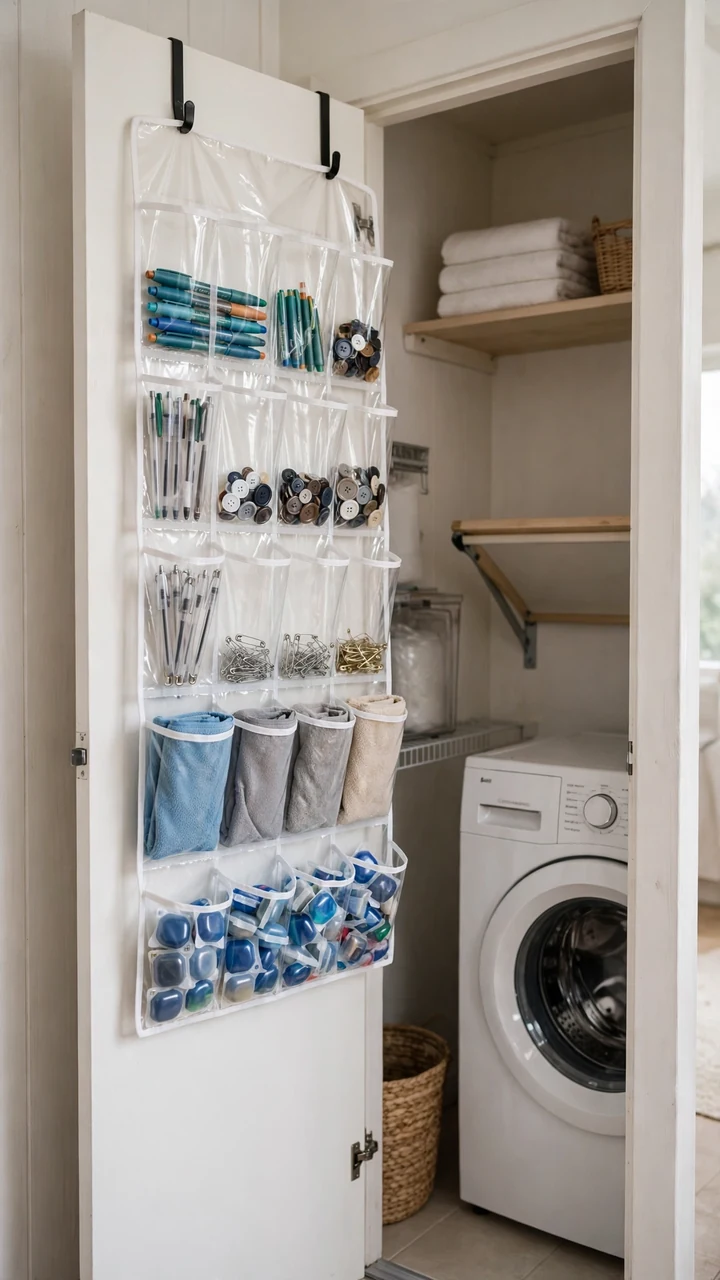
Open the closet door and everything small has a pocket of its own.
A clear shoe organizer hangs over the door with hooks, no drilling, and each pocket holds one small thing where eyes can find it. Detergent pods go in a high pocket, stain pens and cloths in the middle, and safety pins and spare buttons in a low pocket. The pockets keep small supplies off the top of the machines, where bottles tip over in the spin, and they free the one shelf for folding.
- High pockets for pods, out of reach.
- Middle pockets for pens and cloths.
- Low pocket for pins and buttons.
Keep pods in a high pocket, away from small hands and pets.
| Door Pockets | Top of Machines |
|---|---|
| Small things stay visible | Bottles tip in the spin |
| No drilling, hooks only | Needs a tray to stay put |
| Frees the shelf | Eats the folding space |
5. Three Labeled Bins for Lights, Darks, and Delicates
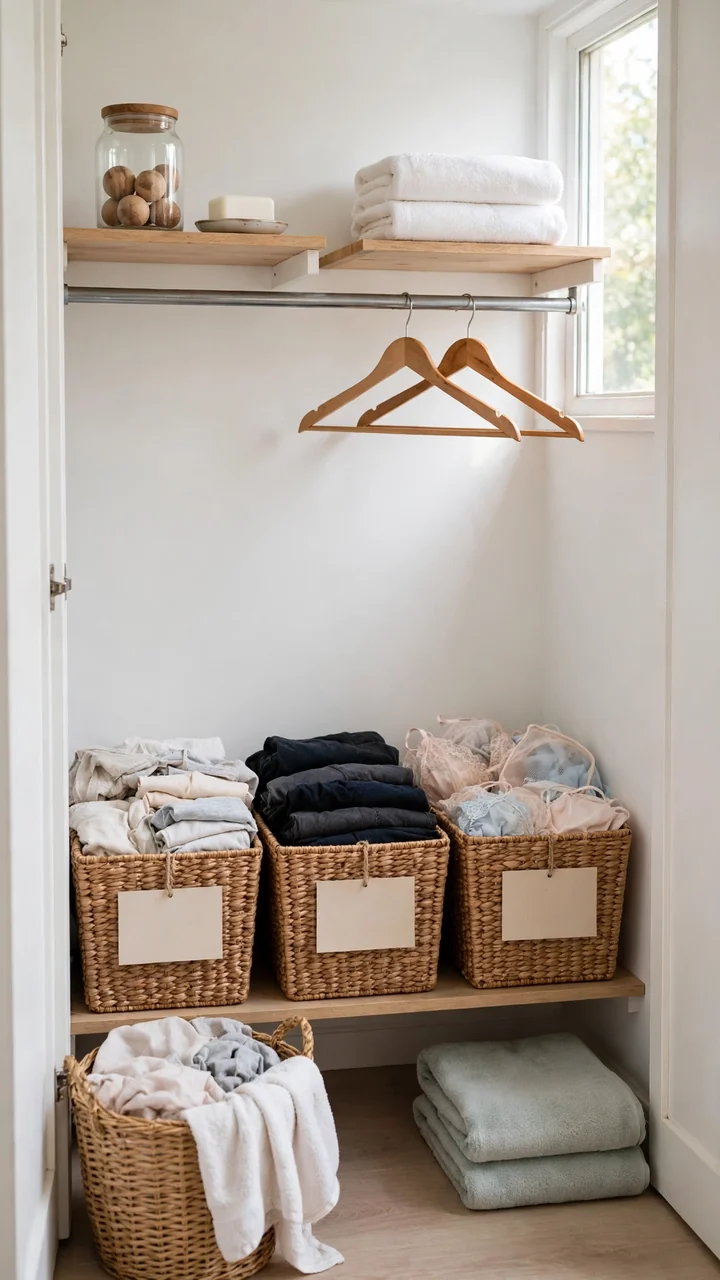
Sorting does not need three hampers and a spare room.
Three small labeled bins inside the closet do the same job in the space of one basket. One bin holds lights, one holds darks, and one holds delicates, and each bin lifts out on wash day without a second sort.
- Lights: whites and pale colours.
- Darks: jeans and dark clothes.
- Delicates: mesh bags and gentle items.
Label the front of each bin in plain words, keep the lids off so clothes land in the right bin on the first toss, and wash the bin that fills first. The closet stays tidy because sorting happens at the moment clothes come off, not on wash day.
Best for renters who share one closet and one wash day.
Bin Check
6. A Wall Mounted Drying Rack That Folds Flat When Done
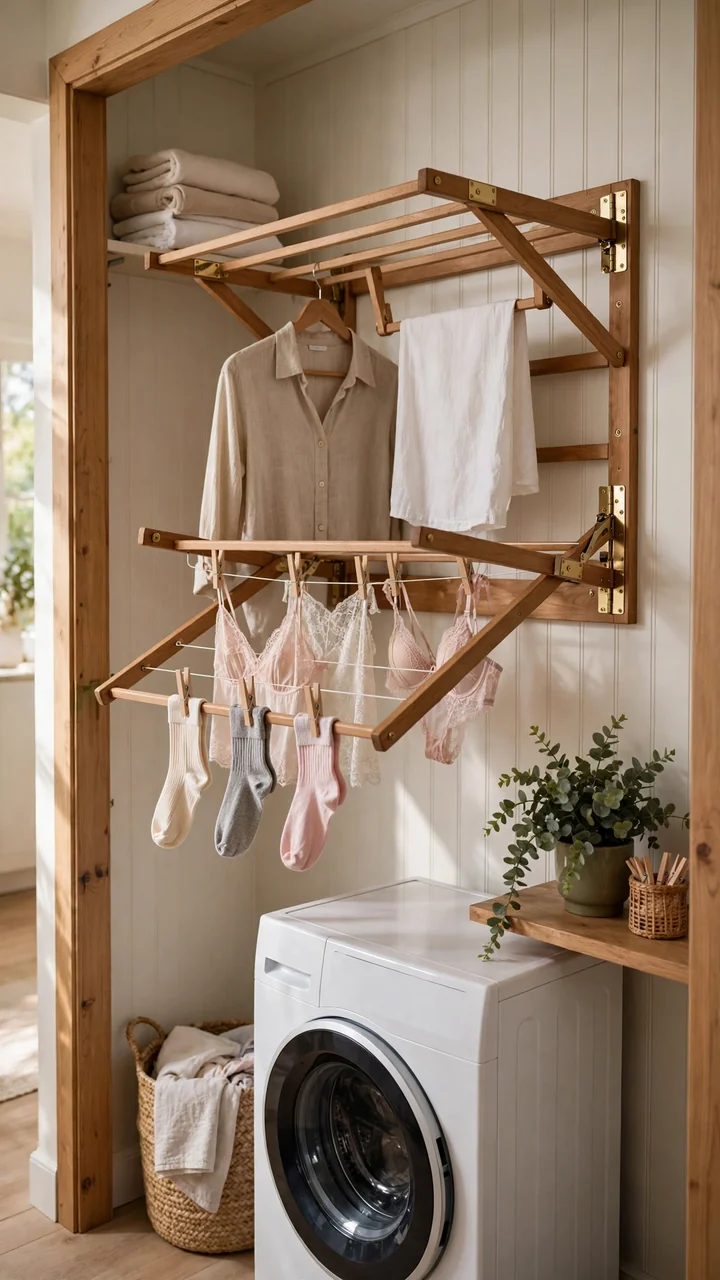
Wet clothes have nowhere to go in a closet with no line and no floor space.
A wall mounted drying rack folds flat against the wall when it is not in use, and it opens just wide enough for shirts, socks, and delicates that cannot go in the dryer. Mount it with removable hooks or screws the lease allows, keep it clear of the washer door, and fold it flat before the next load so the closet door still closes. Hang heavy items near the wall and light items at the ends, because a rack loaded wrong sags by morning.
- Folds flat against the wall.
- Holds shirts, socks, and delicates.
- Clears the washer door when folded.
Skip weak hooks for a wet towel.
Rack flat before the next load.
Heavy items near the wall.
Hooks the lease allows.
Rack left open in the doorway.
Heavy items at the ends.
Wet towels on weak hooks.
7. Detergent in a Pump Bottle on a Small Shelf Above the Machines
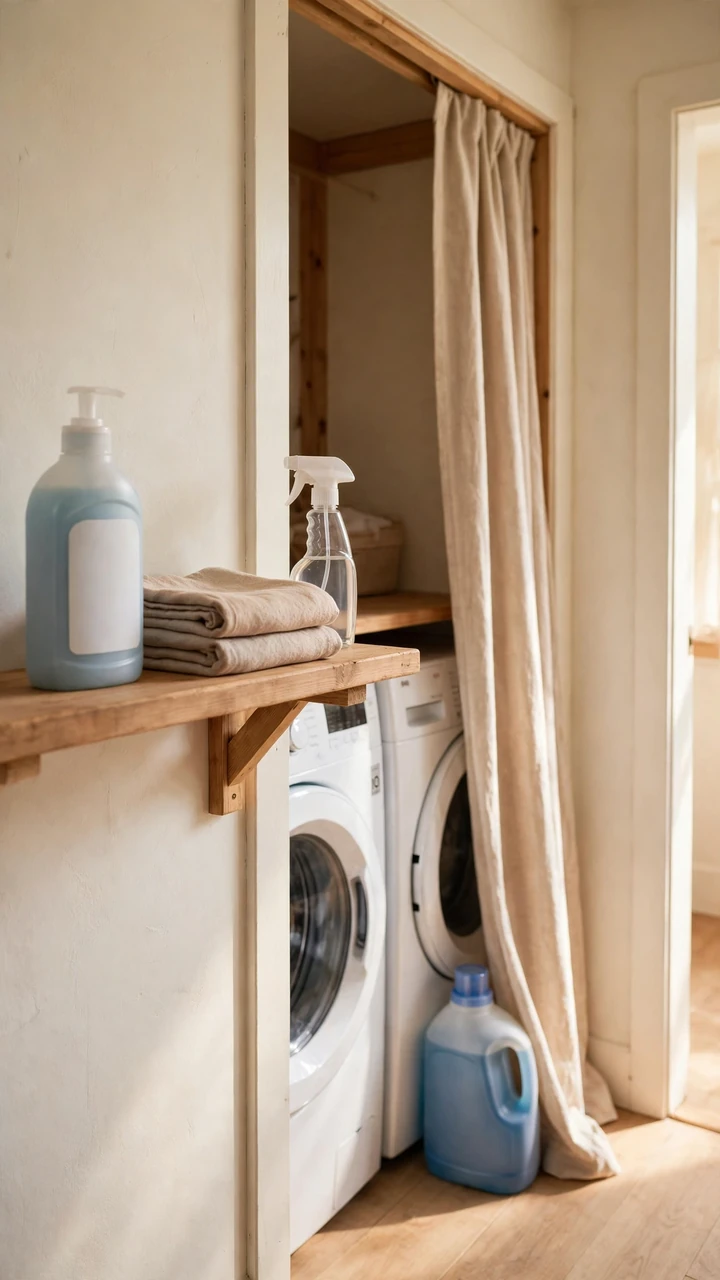
A pump bottle turns the heavy detergent jug into one easy press.
A small pump bottle on a shelf above the machines holds enough detergent for a week of washes, and it stops the spills that come from tipping a big jug over a narrow opening. Fill the bottle from the big jug over the sink, pump once for a normal load, and wipe the pump after each use so dried detergent does not clog it. Keep the big jug on the floor behind the curtain, and keep the pump bottle where hands reach it without stretching.
- Fill over the sink.
- One pump for a normal load.
- Wipe the pump after each use.
Label the bottle when two detergents share the shelf.
Set the pump bottle on the shelf above the machines.
Fill it over the sink from the big jug.
Pump once for a normal load.
8. A Pull Out Shelf Between the Machines for Folding
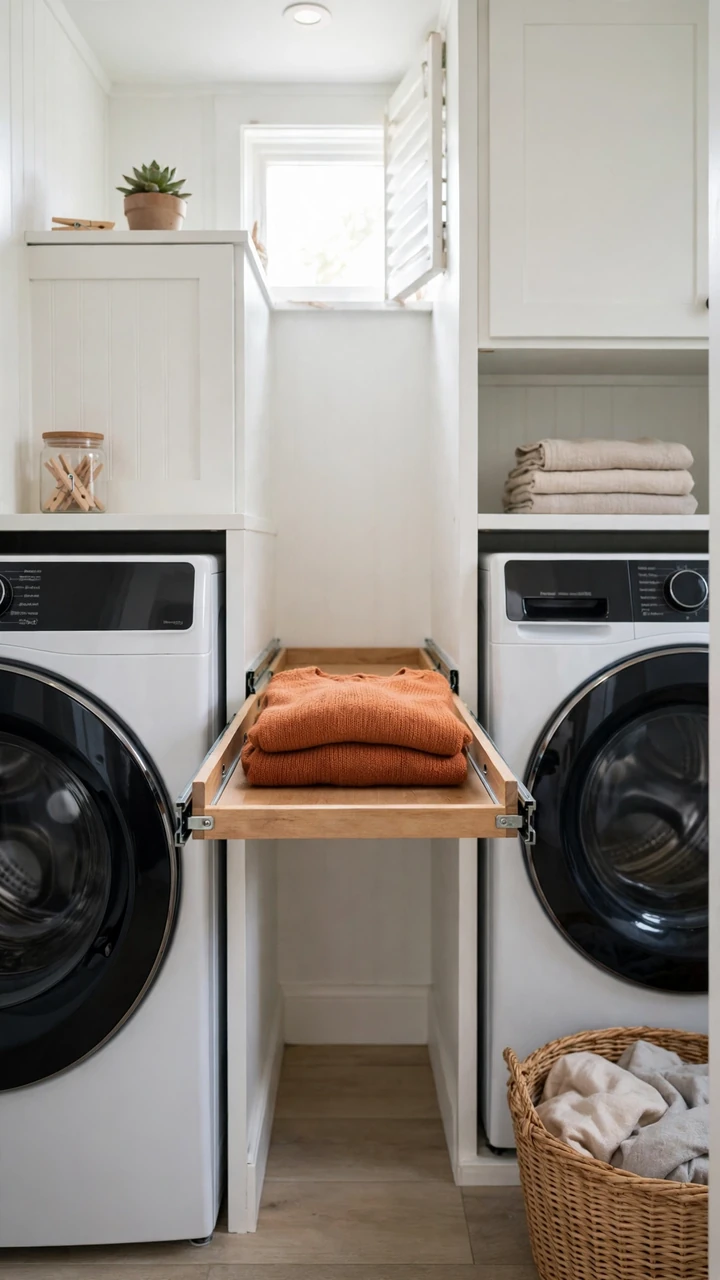
Pull the shelf out, fold the clothes, push it back.
A pull out shelf between the machines gives the closet a folding counter that hides when the wash starts. A narrow board on drawer slides fits the gap, it pulls out to the width of a folded shirt, and it pushes back flush with the machines when the door closes. Keep the shelf clear of bottles, fold straight from the dryer while clothes are warm, and wipe the board dry after a load with wet towels.
- Board that fits the gap.
- Slides that hold a full load.
- Surface that wipes dry.
Folding stops being a floor job and starts being a shelf job.
9. Command Hooks on the Closet Door for the Ironing Board and Spray Bottles
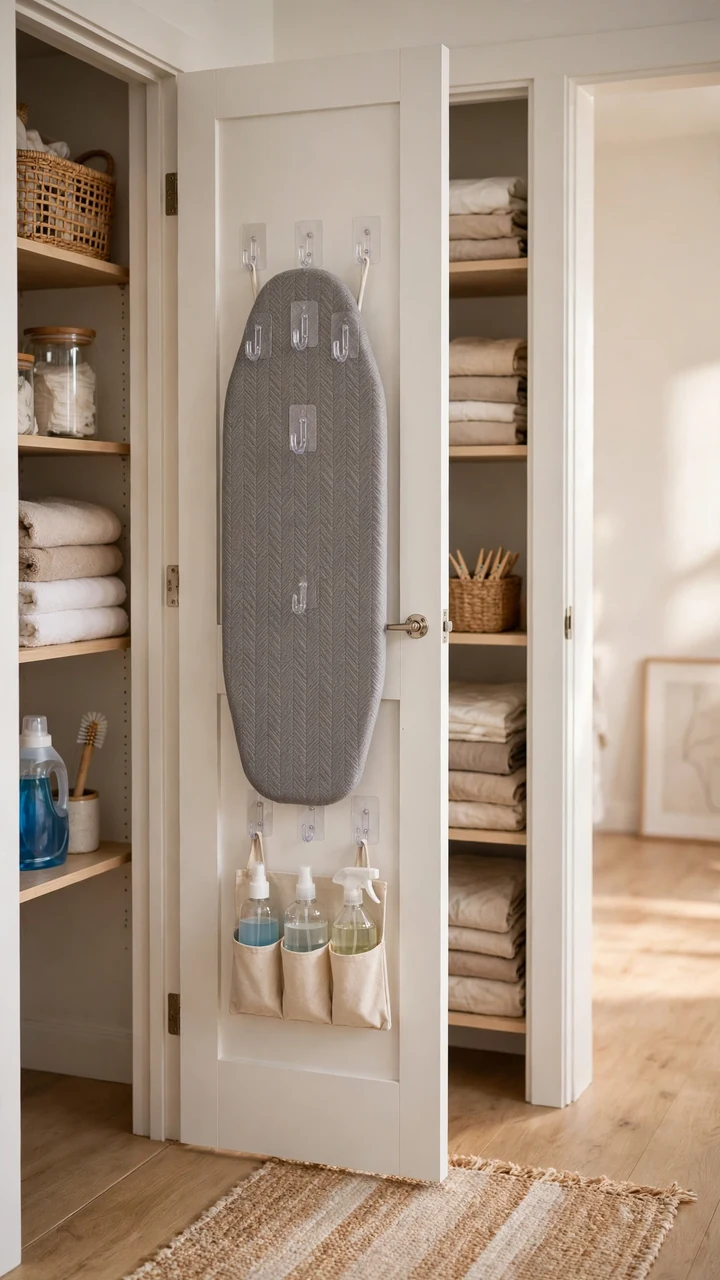
The ironing board leans by the door, the spray bottle sits on top, and both fall when the door opens.
Command hooks on the inside of the closet door hold the ironing board flat against the door and keep spray bottles in a small hanging caddy. Hang the board with its feet folded, put the caddy low enough to reach without a stool, and press each hook firm for thirty seconds before hanging anything. The board stops blocking the hallway, the bottles stop tipping, and the door still closes flat.
- Board flat against the door.
- Caddy low enough to reach.
- Hooks pressed firm for thirty seconds.
The door becomes storage, not an obstacle.
Quick Tip
Wait the hour the pack asks for before hanging the board. A hook that cures first holds longer.
10. A Mesh Bag System That Stops Socks From Vanishing
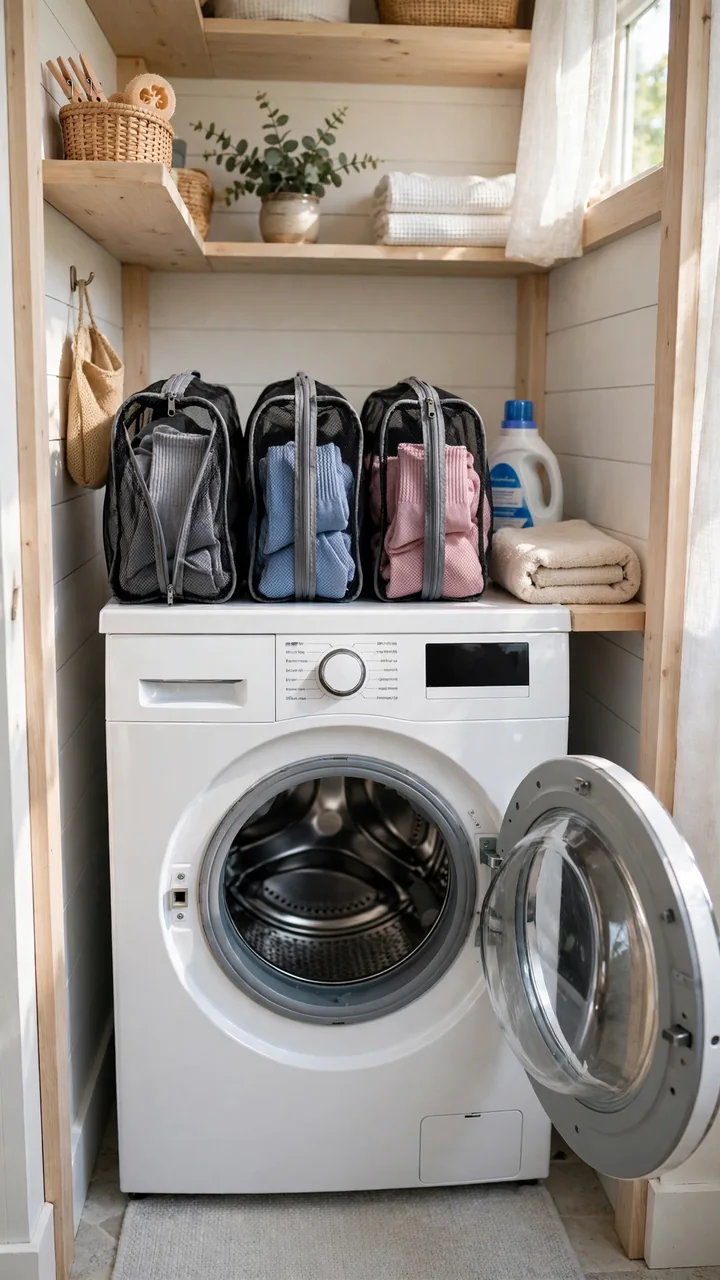
The mistake is washing socks loose and hoping they all come back.
A mesh bag system gives every pair its own bag, and the bags go in the wash together. Put one pair in each bag, zip the bag shut, and toss the bags in with the load. The socks wash clean through the mesh, they dry in the bags, and they come out as pairs. Keep three bags in a pocket on the door, one for socks, one for delicates, and one for small items that slip into the machine seal.
- One pair in each bag.
- Zip shut before the wash.
- Dry in the bags, pair by pair.
Best for anyone who has folded one sock and searched for the other.
11. Peel and Stick Wallpaper on the Back Wall That Makes a Closet Feel Finished
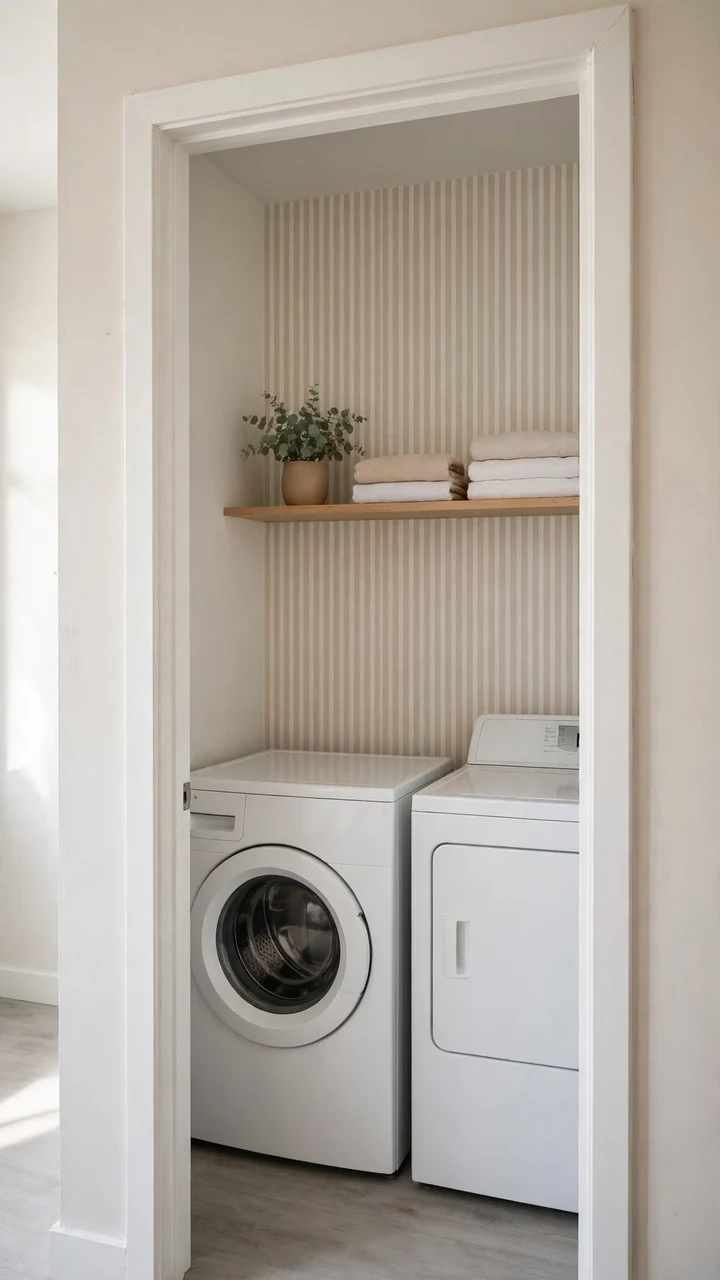
The back wall is the one wall no one paints, and it shows.
Peel and stick wallpaper covers the back wall with a pattern that makes a plain closet feel finished, and it peels off clean when the lease ends. Choose a light pattern that brightens a dark closet, cut the sheet a little smaller than the wall, and smooth it flat from the centre out so no bubble stays trapped. The pattern hides scuffs from baskets and machines, it gives the closet a finished look, and it costs less than a new curtain.
- Light pattern for a dark closet.
- Sheet cut smaller than the wall.
- Smooth from the centre out.
A soft stripe reads calm, a bold print reads loud in a small space.
Bare wall with scuffs from baskets and machines.
Light pattern on the back wall, smooth, bright, and easy to peel off.
12. A Small Stool That Holds the Laundry Basket at Waist Height
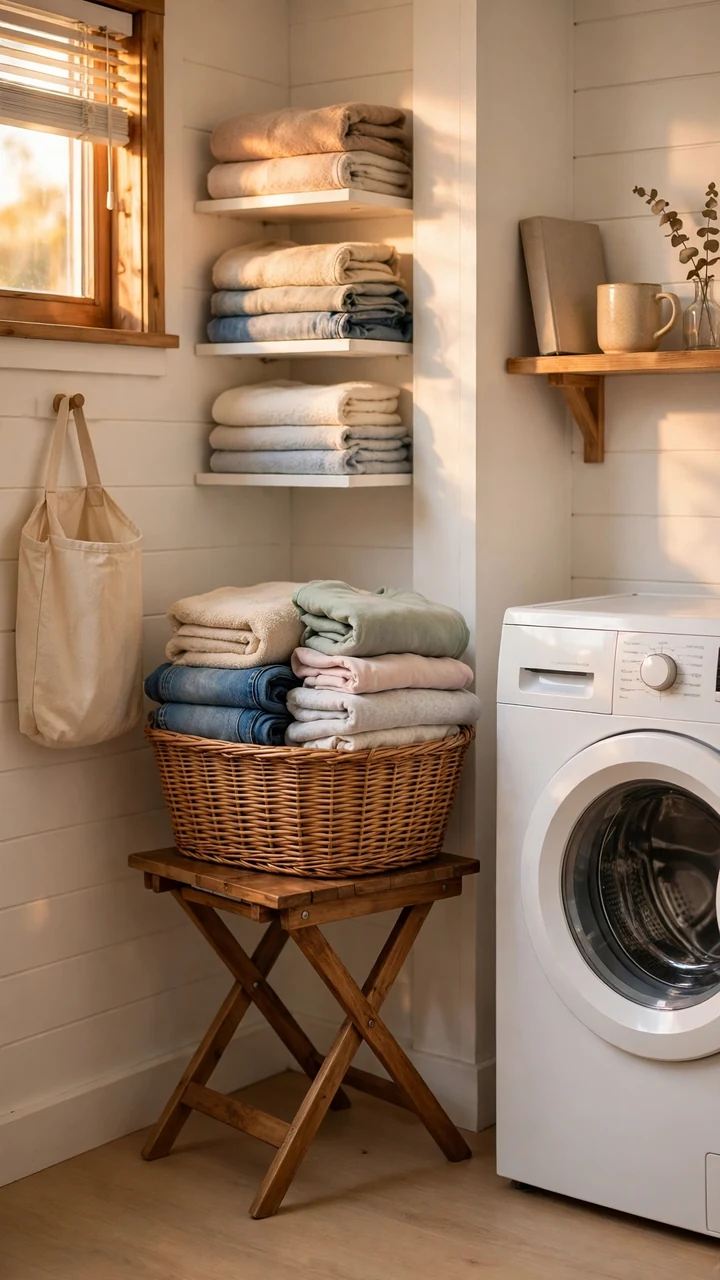
Bending to the floor for every basket hurts by the third load.
A small stool beside the machines holds the laundry basket at waist height, so sorting and folding happen without bending. Choose a stool that fits the gap beside the washer, keep the basket on top while clothes go in and out, and fold the stool flat behind the door when guests come. The stool also holds a book and a drink during a long wash, and it gives small children a safe step that stays out of the way.
- Stool that fits the gap.
- Basket at waist height.
- Folds flat behind the door.
Check the stool feet grip the floor before loading the basket.
- ▸Waist height for sorting.
- ▸Flat fold for guests.
- ▸Safe step for small children.
13. A Retractable Clothesline Across the Closet for Delicates
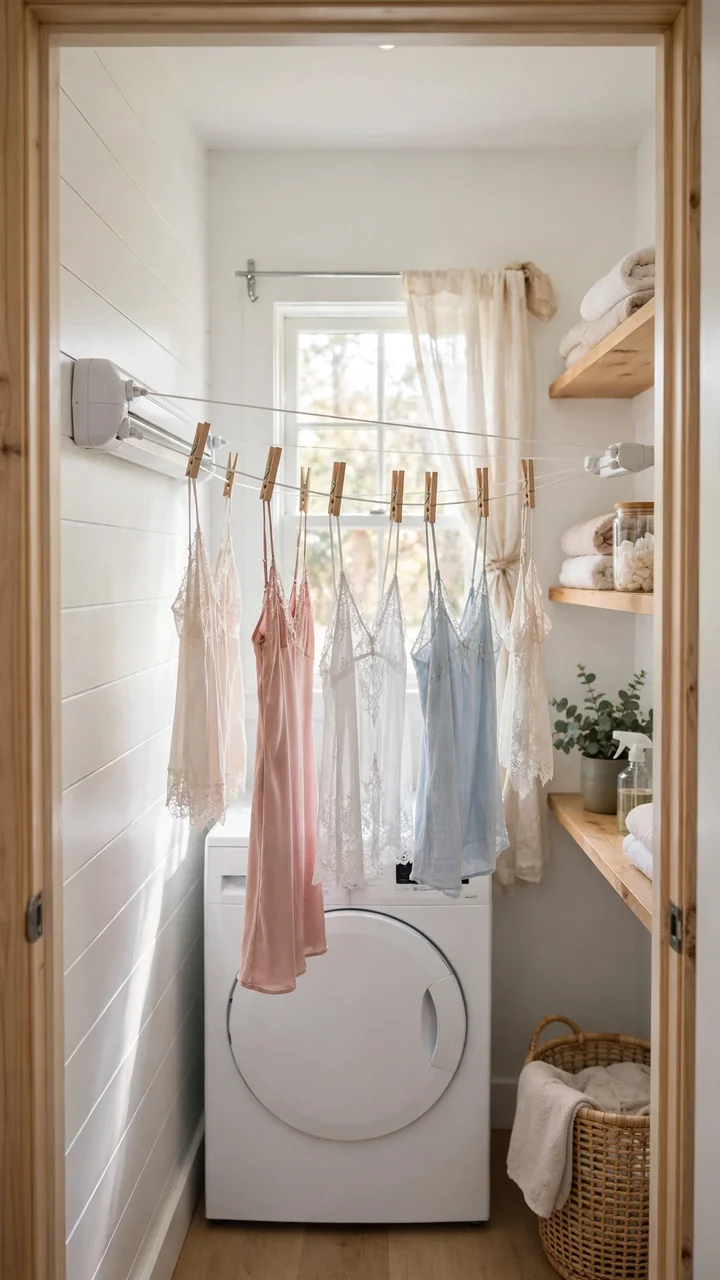
Pull the line out, clip the shirt, let it dry.
A retractable clothesline stretches across the closet only when it is needed, and it winds back into its case when the clothes come down. Fix one end to the wall the lease allows, pull the line to the hook on the far wall, and clip delicates with space between them so air moves round each piece. The line holds shirts and socks that shrink in the dryer, it leaves the floor clear, and it costs less than a second drying rack.
- Line fixed to a wall the lease allows.
- Clips with space between pieces.
- Line wound back when dry.
Delicates dry in the air, and the closet goes back to normal in one pull.
14. A Lint Bin on the Wall Beside the Dryer So Lint Never Lands on the Floor
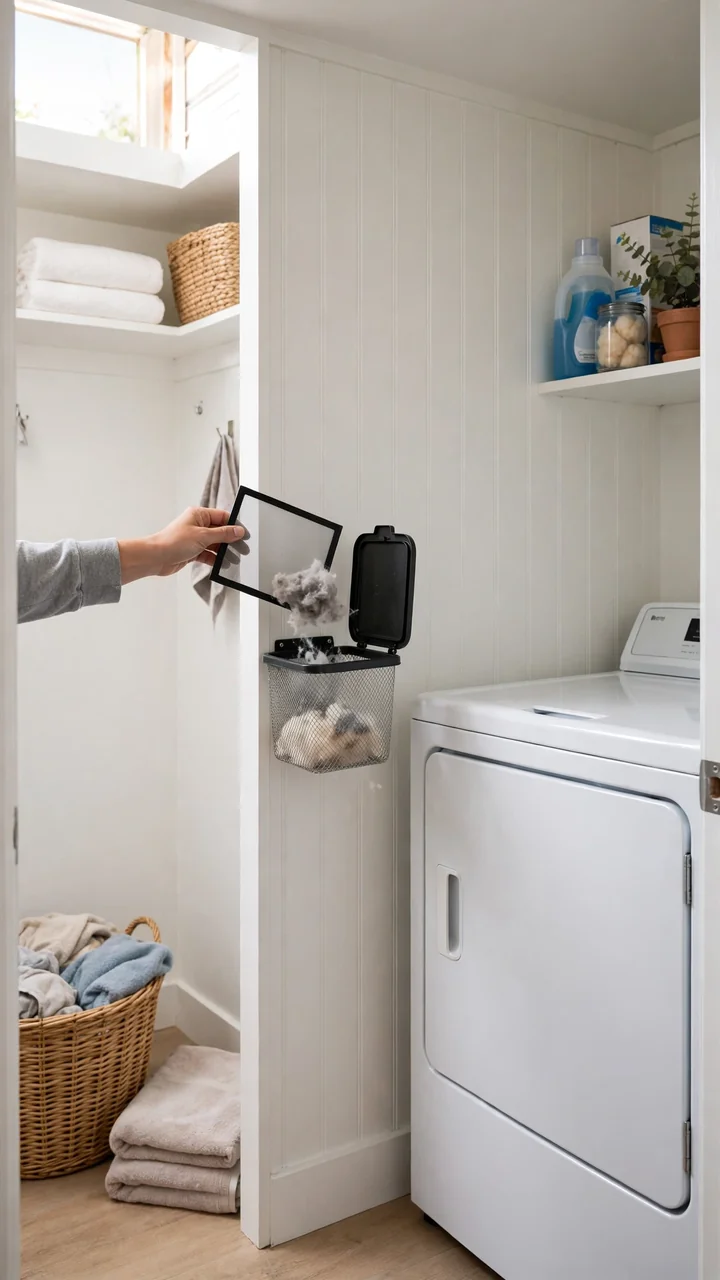
One rule keeps lint off the floor for good.
A lint bin on the wall beside the dryer gives lint a home the moment it leaves the filter. Empty the filter into the bin after every load, tap the bin shut, and empty the bin into the trash when it fills. The bin stops lint drifting onto clean clothes, it stops the filter getting forgotten, and it keeps the floor clear for the basket.
Choose a bin with a lid that shuts with one hand, because the other hand holds the filter.
- Bin beside the dryer.
- Filter emptied after every load.
- Bin emptied when it fills.
Never run the dryer with a full filter, even for one quick load.
Lint Check
15. Battery Puck Lights That Show Stains Before the Wash
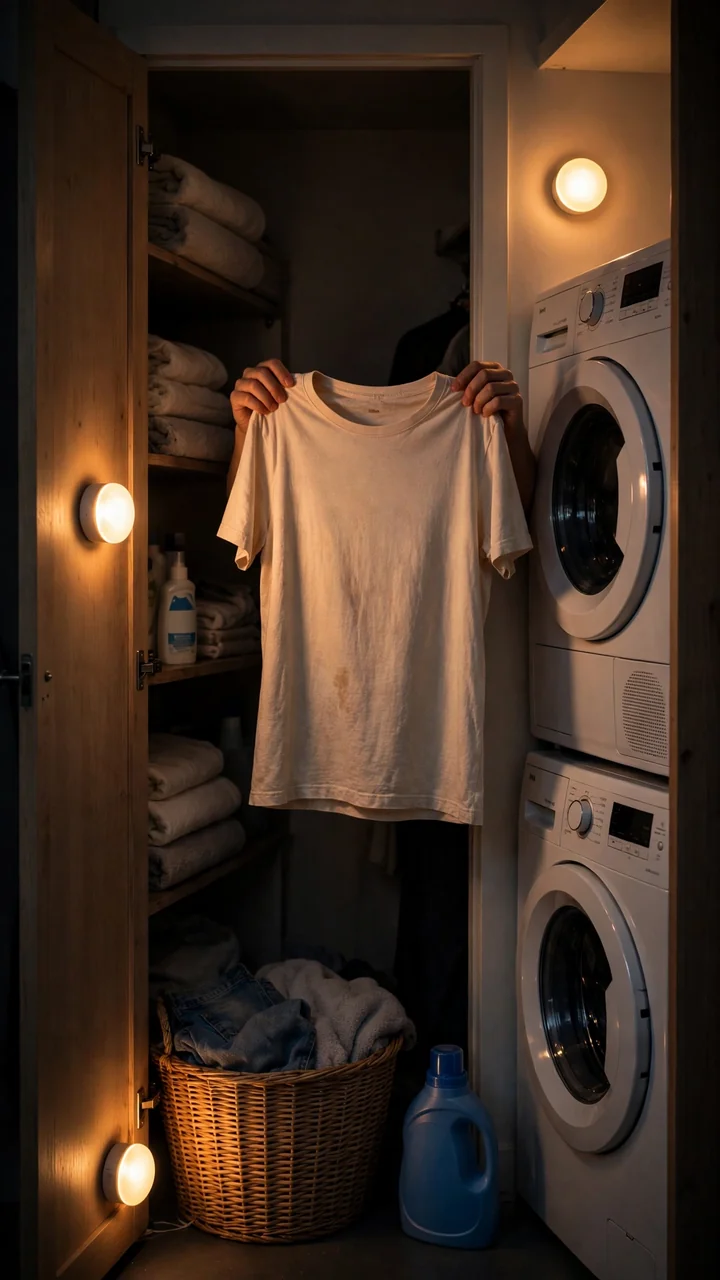
A laundry closet does not need wiring to have light.
Battery puck lights stick to the wall or the shelf with adhesive, and they switch on with a tap. Put one light above the machines so stains show before the wash, one light inside the door so labels read clear, and one light low down so the floor stays visible at night. The lights run on batteries, they come off clean, and they cost less than a call to an electrician.
- Light above the machines.
- Light inside the door.
- Light low down for the floor.
Take the lights down to change batteries, and stick them back in the same spots.
Best for closets with no window and no ceiling light of their own.
Light shows stains before the wash, and battery lights leave no holes.
16. A Single Scent for the Closet, From Detergent to Dryer Sheets
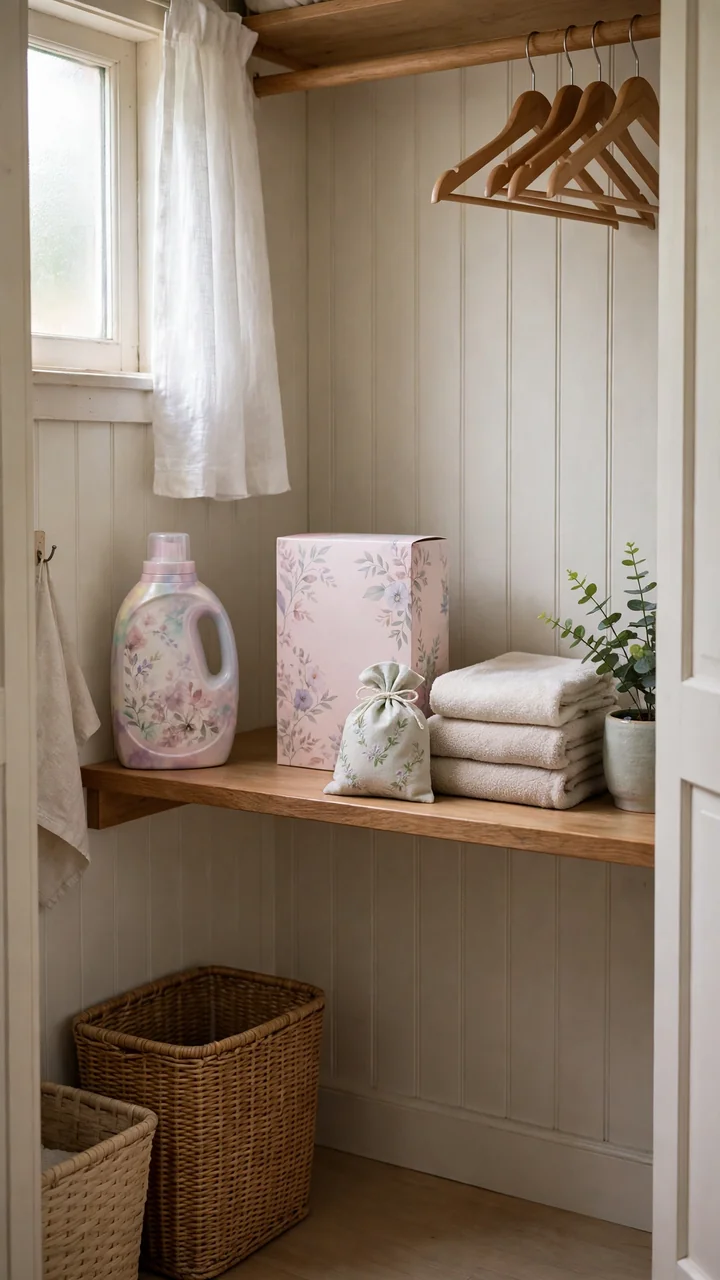
Open the door and the whole closet smells like one clean thing, not five.
A single scent ties the closet together when detergent, dryer sheets, and a sachet all smell the same. Pick one scent the household likes, use it in the detergent and the dryer sheets, and put a sachet in the same scent on the shelf. The closet smells calm when the door opens, the clothes carry the same scent from the wash to the drawer, and a guest never meets a mix of smells that fight each other.
- One scent in detergent and sheets.
- Sachet in the same scent.
- No second scent in the closet.
Test the scent on one load before buying the big bottles.
Quick Tip
Keep the scent light. A strong scent in a closed closet turns heavy fast.
17. A Door Mounted Ironing Board That Folds Down Only When Needed
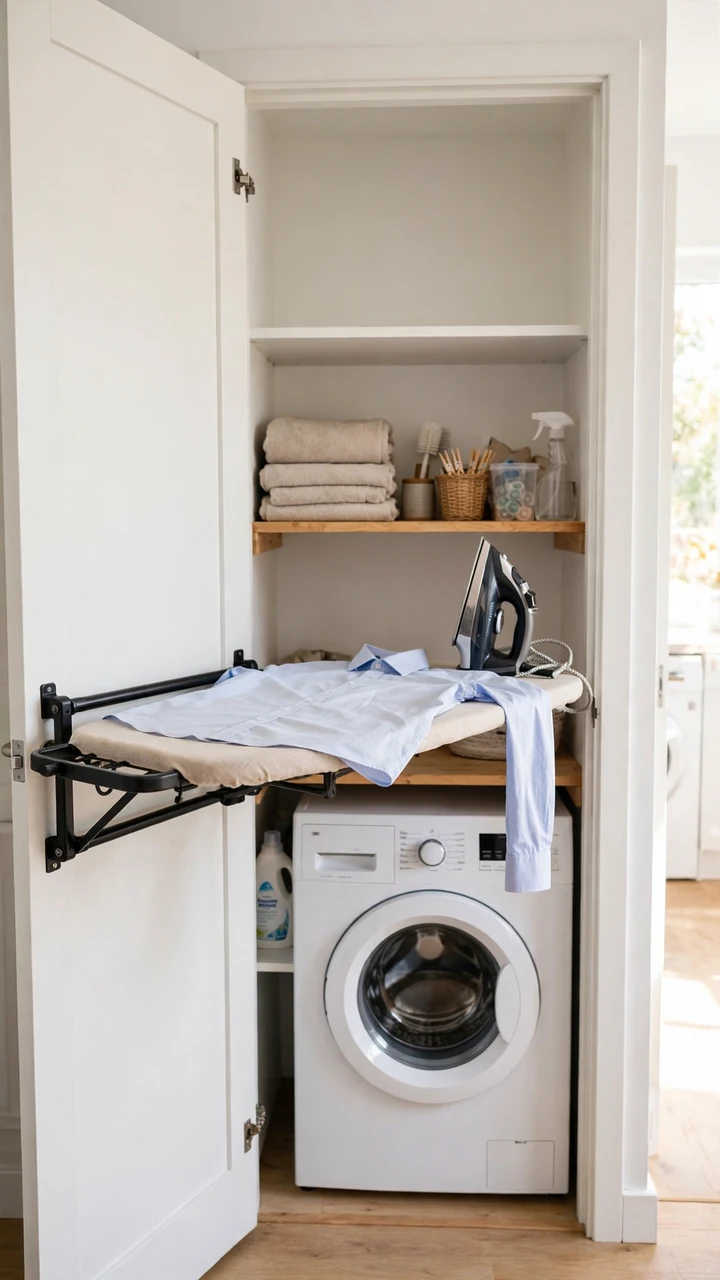
The board that folds down from the door beats the board that leans in the hall.
A door mounted board folds down only when ironing starts, and it folds flat against the door when the shirt is done. The board stays at a height that suits standing work, the cover stays clean behind the door, and the hallway stays clear for everyone else. Mount it with screws or hooks the lease allows, check the door still closes with the board folded, and keep the iron on the shelf above the machines.
- Board folds flat on the door.
- Height suits standing work.
- Iron on the shelf above.
Ironing takes a door, not a room.
Board folded flat after use.
Door closes with board folded.
Iron stored on the shelf.
Board left down in the doorway.
Iron left on the board.
Board blocking the machines.
18. A Weekly Sort and Wash Schedule on the Inside of the Door
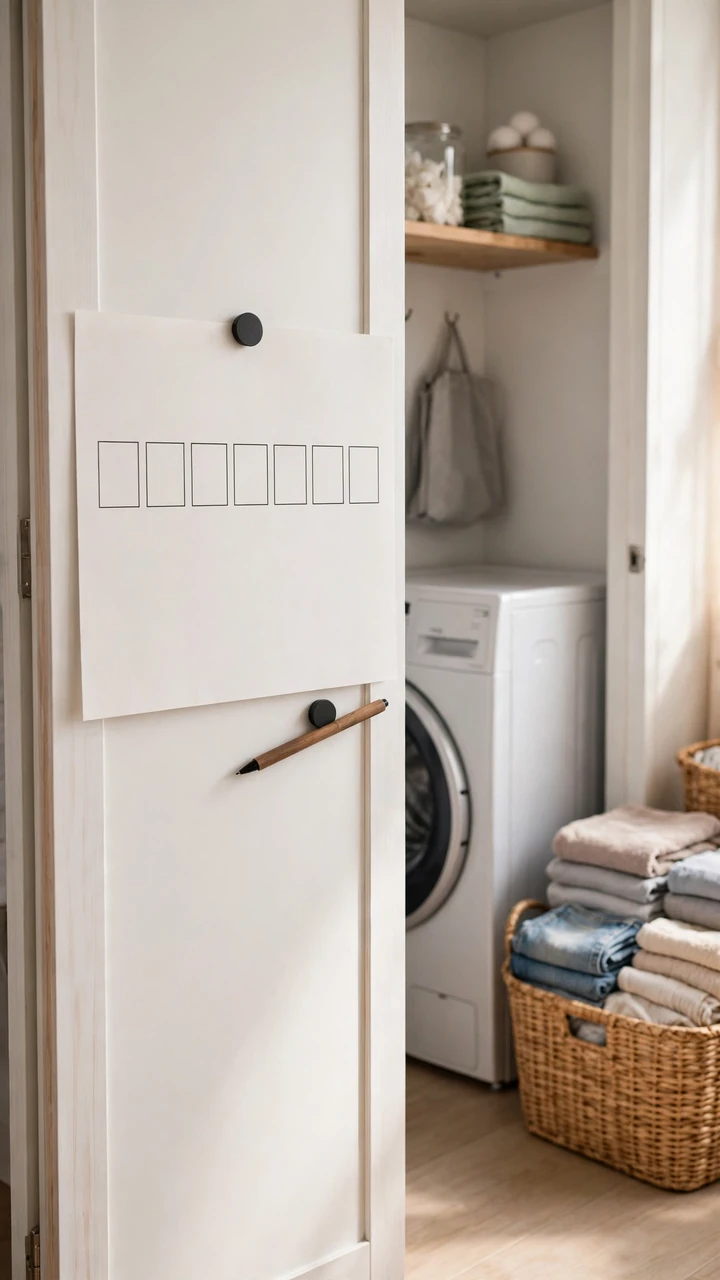
The schedule on the door ends the pile that grows all week.
A weekly sort and wash schedule on the inside of the door tells everyone in the flat what washes when. Write the days in plain words, put lights and darks on different days, and keep delicates on the day with the most time at home. The schedule stops the basket overflowing, it stops two people starting the same load, and it makes wash day a habit instead of a rescue.
- Days written in plain words.
- Lights and darks on different days.
- Delicates on the quiet day.
Change the schedule when work hours change, and pin the new copy over the old one.
One page, one pen, and a magnet hold it on the door.
Write the wash days in plain words.
Put lights and darks on different days.
Pin the schedule on the inside of the door.
19. A Waterproof Mat Under the Machines That Catches Leaks Early
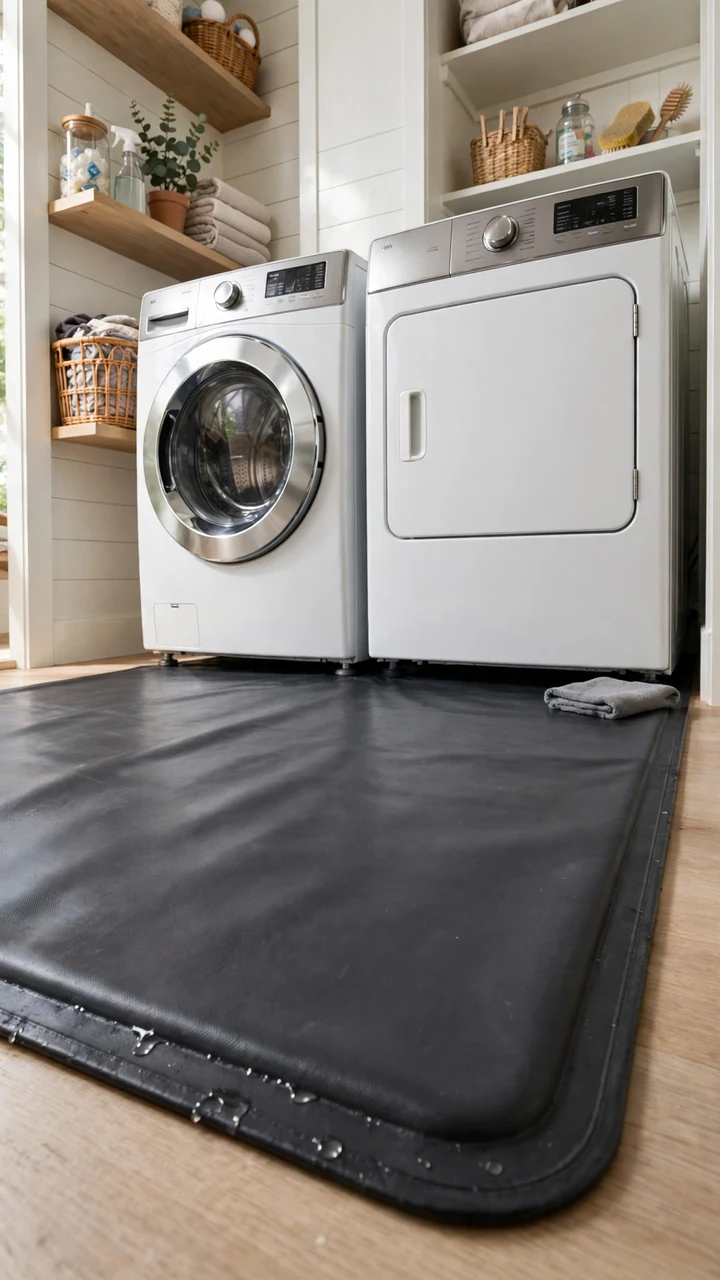
A slow leak under a washer shows up as a swollen floor, long after it starts.
A waterproof mat under the machines catches drips early and shows them before the floor soaks. Slide the mat under both machines, let the raised edge face the front, and check the mat when the wash ends. The mat keeps small leaks off the floor, it stops the machines sliding on a wet surface, and it wipes clean with a cloth.
Choose a mat that reaches past the feet on all sides, so a drip lands on the mat and not beside it.
- Mat under both machines.
- Raised edge at the front.
- Checked after every wash.
A mat does not replace a fix for a hose that leaks every load.
20. A Small Fan That Keeps Steam From Sitting in a Closed Closet
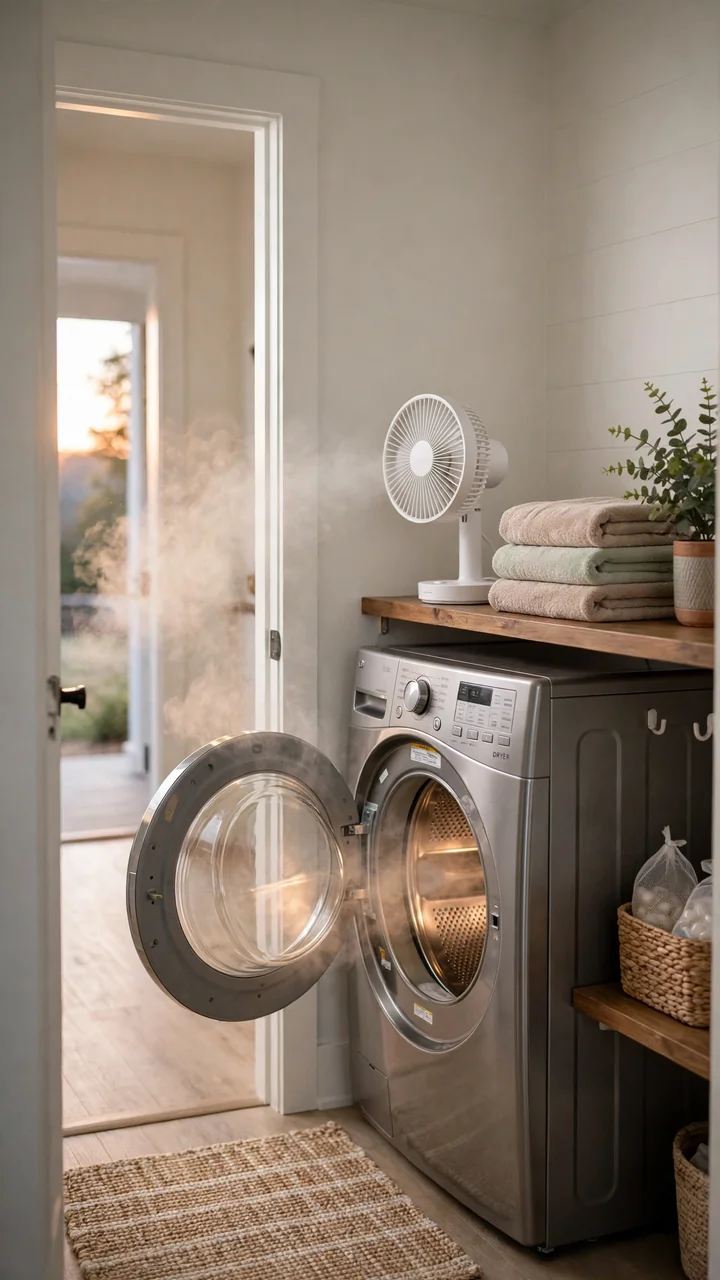
Moving air keeps a closed closet dry, and dry closets do not smell damp.
A small fan on the shelf or the floor pulls steam out of the closet while the dryer runs and keeps air moving after the load ends. Aim the fan toward the open door, run it through the wash and for a short time after, and switch it off when the closet feels dry. The fan stops steam sitting on cold walls, it stops towels smelling damp in a closed space, and it helps the puck lights and the wallpaper last longer.
- Fan toward the open door.
- Runs through the wash and after.
- Off when the closet feels dry.
A dry closet is a quiet win you notice every time the door opens.
Quick Tip
Use a fan with a timer, so it stops on its own after the wash.
21. A Magnetic Strip on the Wall for Clips, Pins, and the Lint Roller
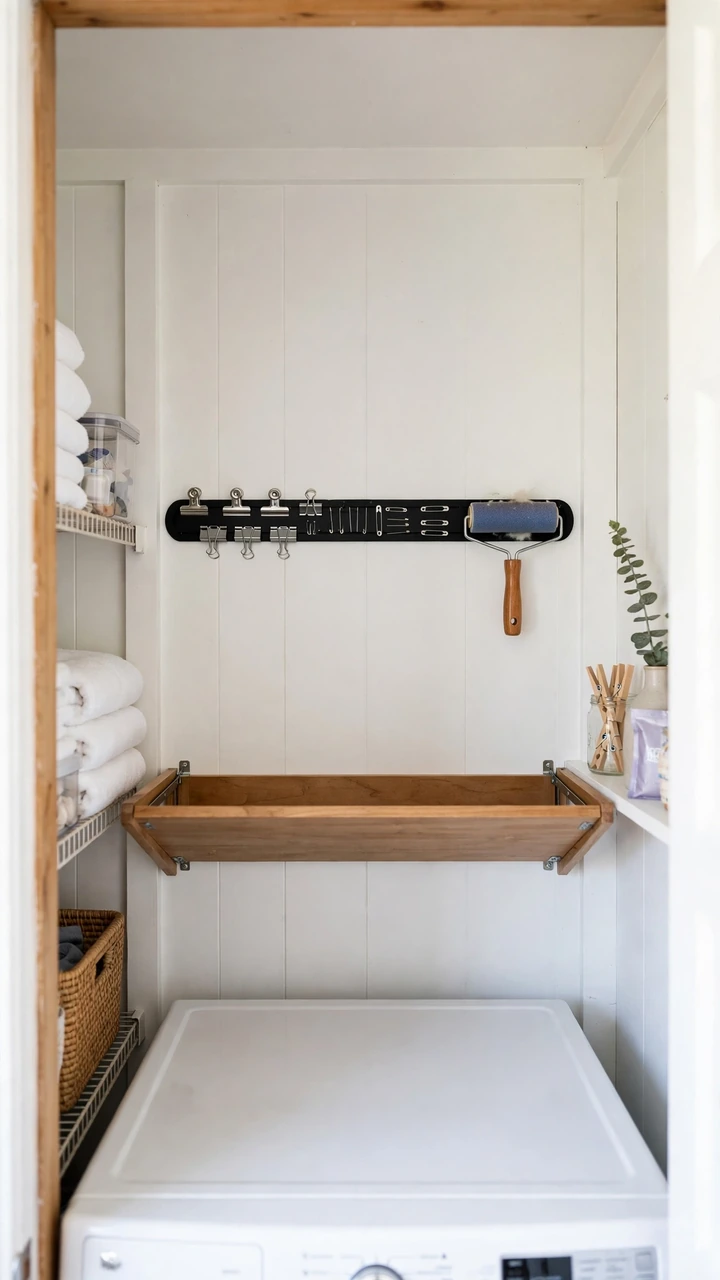
The strip on the wall holds the small metal things that always go missing.
A magnetic strip on the wall beside the machines holds clips, pins, and the lint roller where hands find them fast. Fix the strip at eye level with screws or adhesive the lease allows, keep sharp pins on the high end, and keep the lint roller at the end nearest the dryer. The strip frees the shelf for folding, it stops pins hiding in pockets and seams, and it keeps small metal tools off the floor.
- Strip at eye level.
- Pins on the high end.
- Lint roller nearest the dryer.
Wipe the strip when dust builds up, so the magnets hold firm.
22. Thrifted Glass Jars for Pods, Pins, and Lost Buttons
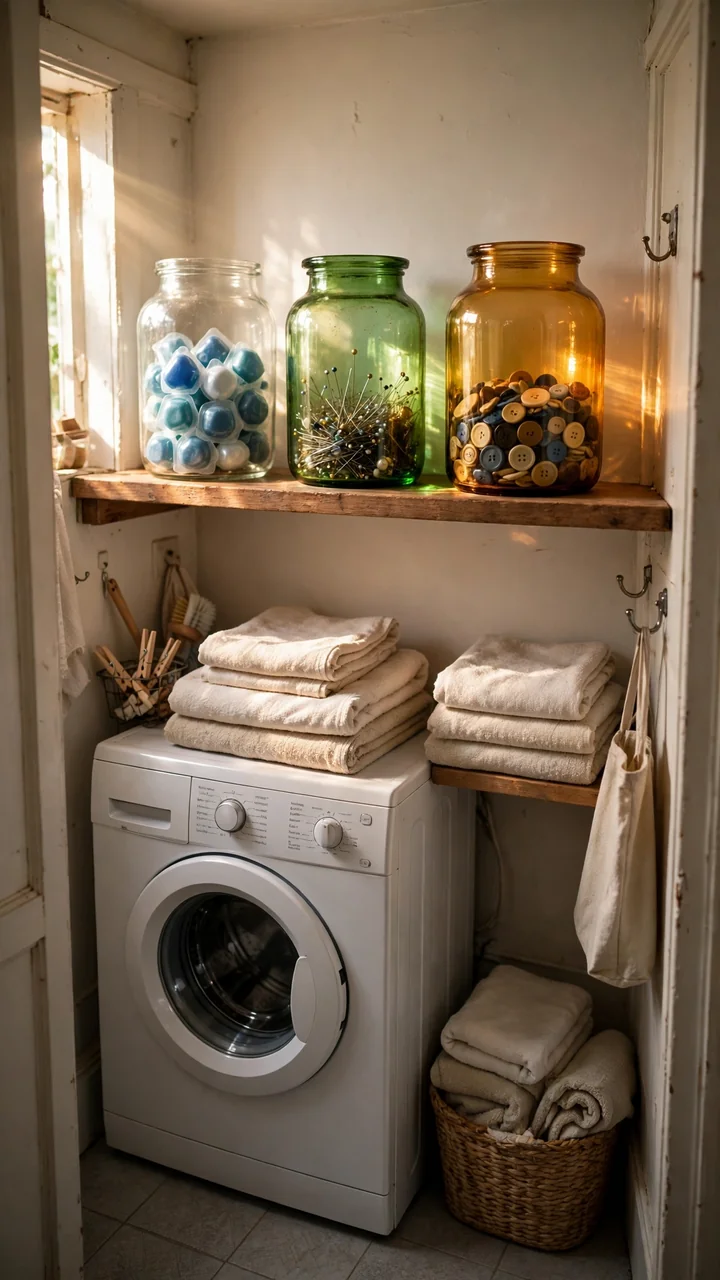
Morning light hits three glass jars on the shelf, and each one holds its own small thing.
Thrifted glass jars hold pods, pins, and lost buttons where eyes can see them, and they cost less than new storage boxes. Wash each jar before use, dry it fully so pods stay dry, and put a plain label on the front in big letters. The jars keep small supplies off the machines, they show at a glance what runs low, and they give the shelf a tidy look without new plastic.
- Jars washed and dried first.
- Plain label in big letters.
- Pods kept dry inside.
Clear glass suits the shelf, colored glass suits the jars you use less.
- ▸Pods in the tall jar.
- ▸Pins in the short jar.
- ▸Buttons in the smallest jar.
23. A Five Minute Reset After Every Wash Day That Keeps the Closet Clear
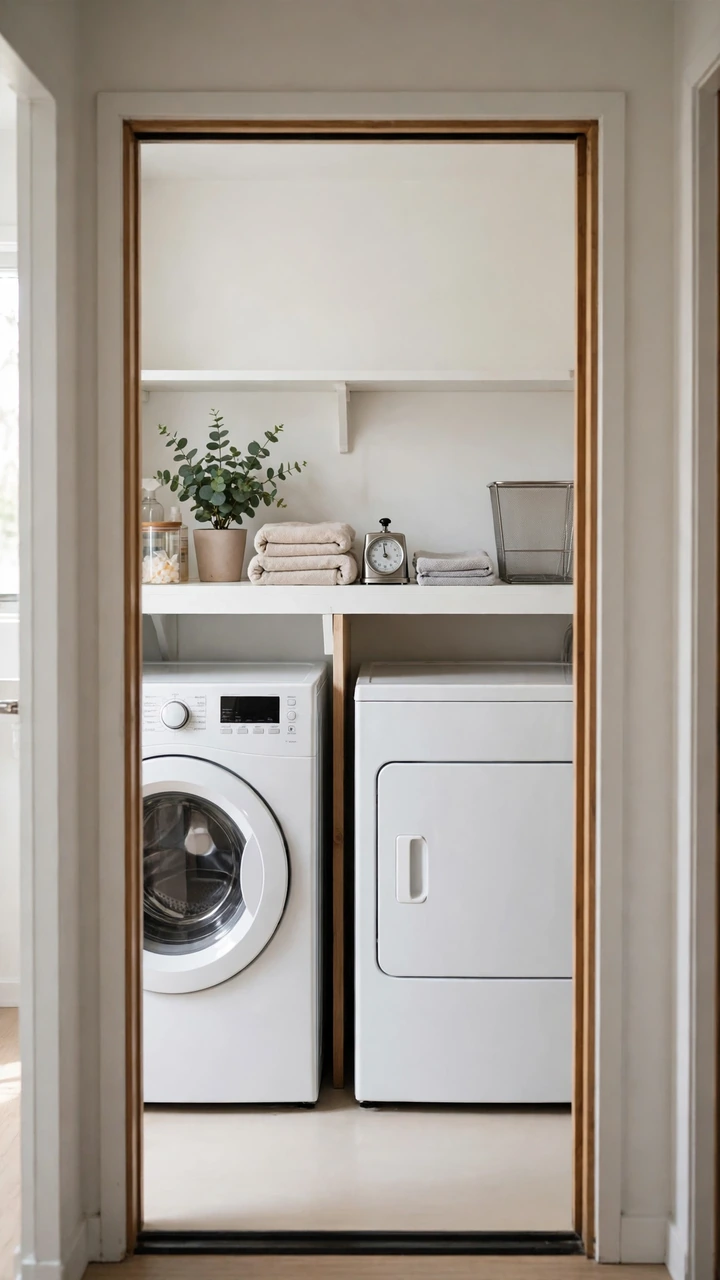
The closet drifts back to a mess a few days after every big tidy.
A five minute reset after every wash day keeps the closet clear without another big tidy. Put each item back in its own spot, wipe the shelf and the top of the machines, and take the lint bin and the trash out together. The reset stops bottles collecting on the shelf, it stops the floor pile starting again, and it keeps the closet ready for the next load.
- Items back in their spots.
- Shelf and machines wiped.
- Lint bin and trash out together.
Set a timer for five minutes, and stop when it rings.
Five minutes after the wash saves an hour of tidying later.
Bottles on the shelf, lint in the bin, basket on the floor.
Each item in its spot, shelf wiped, bin emptied, floor clear.
24. A Landing Basket by the Closet Door for Dirty Clothes That Never Reach the Floor
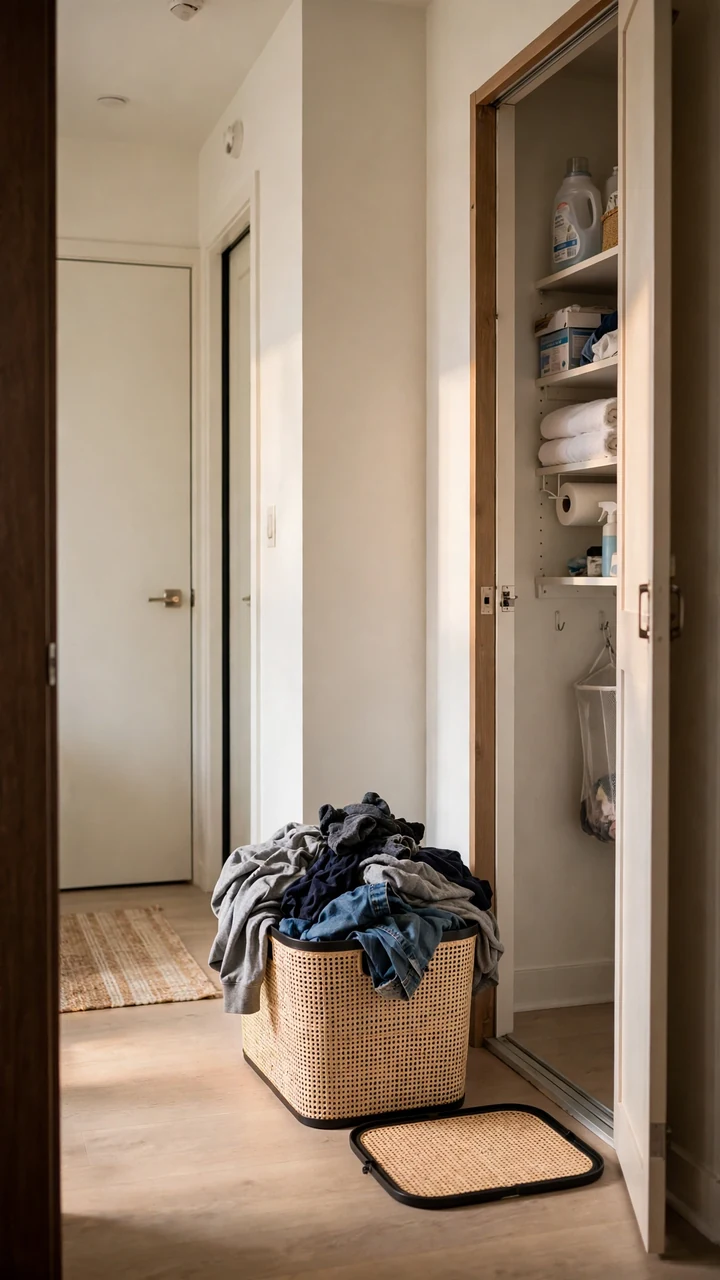
A landing basket by the door stops dirty clothes reaching the floor.
A landing basket beside the closet door gives dirty clothes a home the moment they come off. Choose a basket that fits the space by the door, keep the lid off so clothes land inside on the first toss, and carry the basket to the machines when it fills. The basket stops clothes piling on the floor, it stops clean and dirty clothes mixing on a chair, and it makes sorting start at the door.
- Basket by the closet door.
- Lid off for easy tossing.
- Carried to the machines when full.
Best for flats where the laundry closet sits by the bedroom door.
Landing Basket Check
Conclusion
A laundry closet does not need more space to work better. It needs a curtain that hides the mess, a cart that uses the gap, and a drying spot that folds away when the wash ends.
These first apartment laundry closet ideas on a budget prove that small fixes beat big spending. Pick the three that fit your closet, try them on the next wash day, and keep the ones that make the room feel calmer.
Save this list for the next time the closet feels tight, and start with the curtain, the pads, and the landing basket.
Start with these three