Not everyone has a spare bedroom to turn into a home office, and honestly, most of us do not need one. A nook, meaning any small unused gap in your house like a landing, a closet, or the end of a hallway, can hold a working desk setup just fine if you plan it out a little. I started working from a nook myself a few years back, tucked into the end of a hallway that used to hold nothing but a coat hook, and it turned out to be one of the better decisions I made in that house. This list walks through fourteen real spots in a typical home that can become a working office, along with what to put in each one and how to make it feel like a real workspace rather than an afterthought. None of these ideas require knocking down walls. Most just need a desk, some light, and a plan for where things will live.
1. Under Stairs Desk
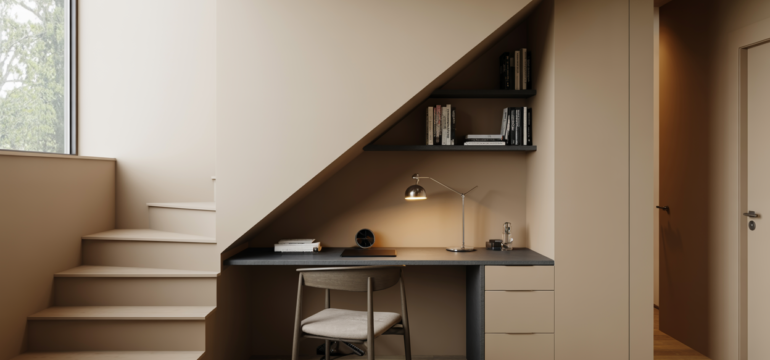
The space under a staircase is one of the most overlooked spots in a house, and it often has just enough depth for a small desk. Measure the widest and tallest points of the space first, since the slope of the stairs will limit desk placement, and choose a compact desk without bulky legs so it can slide into the angled area. A built-in desk shaped to match the stair slope looks the most finished, but a simple rectangular desk pushed against the taller end works fine too.
Add a small lamp since under-stair spots rarely get much natural light, and choose a warm bulb rather than a cool white one to keep the space feeling comfortable instead of clinical. Paint the underside of the stairs and the surrounding wall in the same light color as the rest of the room to keep the nook from feeling boxed in. This setup works well in hallways, entryways, or open living areas where a stairwell eats up unused square footage.
2. Closet Turned Office
A closet with the doors removed can become a surprisingly functional office, especially if it already has shelving you can repurpose. Take out hanging rods and use the existing shelves for storage above and below a small desk that fits the closet’s width. Choose a desk without legs that stick out too far, or even a simple shelf mounted at desk height, since closets are usually shallow and every inch matters.
Add a strip of battery-powered lights along the inside frame if the closet does not have its own overhead light, since most closets were never wired for daily task lighting. Keep the doors nearby in case you want to close up the space when you are not working, which is one of the biggest advantages of this setup over an open nook. This idea works especially well in a bedroom, a hallway, or any small home where a spare room simply is not an option.
3. Window Nook Desk
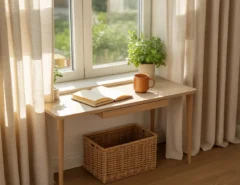
A desk placed directly under or beside a window brings in natural light, which makes almost any workspace feel better throughout the day. Look for a narrow desk that fits the width of the window without blocking too much of the view, and position your chair so you face outward rather than having the window behind you, since backlighting can make video calls look dark and washed out.
Keep window treatments simple, like a light roller shade or sheer curtain, so you can control glare on a laptop screen without losing the light entirely. A small plant on the windowsill ties the desk into the window itself rather than feeling like a separate piece of furniture placed nearby. This idea works well in a living room bay window, a bedroom window seat area, or any spot where a window looks out onto something pleasant to glance at during a break.
4. Hallway Alcove Office
Many older homes have a small alcove or recessed section in a hallway that was likely built for a table or a piece of art, and these spots make great tiny offices. Measure the depth carefully, since hallway alcoves are often shallow, and choose a slim console-style desk rather than a standard deep one so you still have room to walk past comfortably. A wall-mounted shelf above the desk adds storage without taking up any floor space.
Since hallways tend to be darker than other rooms, add a wall sconce or a small clip lamp above the desk for reliable task lighting. Keep the color palette light and the decor minimal, since a busy hallway office can start to feel cramped if it competes visually with foot traffic passing by. This idea suits apartments, older homes with narrow layouts, or anyone who wants an office that stays out of the way of daily life.
5. Bedroom Corner Desk
An unused corner of a bedroom is one of the simplest nooks to convert into a home office, especially in rooms with awkward layouts that already have some empty space. Choose a compact corner desk shaped to fit the angle of the walls, or use two smaller pieces of furniture, like a narrow desk and a slim bookshelf, arranged at an angle to fill the space naturally. Face the desk toward the room rather than the wall if possible, since this makes the corner feel more open.
Separate the office feel from the sleeping area using a rug placed just under the desk and chair, which visually marks the workspace as its own zone. Keep a small curtain or folding screen nearby if you want the option to hide the desk from view when it is not in use. This idea works in almost any bedroom, from a studio apartment to a guest room used part-time for work.
6. Built In Shelving
If a nook already has, or can have, built-in shelving added around it, this turns a plain gap in the wall into a proper little office with plenty of storage. Have shelves built floor to ceiling on either side of the desk space, leaving the center open for the desk itself and a bit of legroom underneath. This setup makes the most of vertical space, which matters most in small nooks where floor area is limited.
Paint the shelving and the surrounding trim the same color as the desk area for a seamless, custom look rather than a patchwork of different finishes. Fill the shelves with a mix of books, storage boxes, and a few personal items, keeping the lower shelves for heavier storage and the upper ones for lighter display pieces. This idea works best for anyone planning a slightly bigger renovation, since built-ins take more time and cost more than a simple desk swap.
7. Curtain Divided Nook
A curtain hung from a ceiling-mounted track is a simple way to separate a nook office from an open living space without adding a permanent wall. Choose a heavier fabric like cotton canvas or a lined linen if you want some sound dampening, or a lighter sheer fabric if you mainly want a visual break rather than privacy. Mount the track just in front of the nook opening so the curtain can slide fully closed when the desk is not in use.
Keep the desk and shelving inside simple so the curtain itself becomes the main design feature of the setup. A tieback on one side lets you keep the curtain open during work hours while still having the option to close it up at the end of the day. This idea works especially well in studio apartments, shared living spaces, or open floor plans where a nook sits along the edge of a larger room.
8. Floating Corner Desk
A floating desk mounted directly to the wall works well in tight corners where a desk with legs would take up too much floor space or block a door swing. Choose a wall-mounted desk with hidden brackets so the underside stays open and visually light, and mount it at standard desk height, which is usually around twenty-nine inches from the floor. This setup is especially useful in narrow hallway corners or small landing areas.
Add a floating shelf above the desk for a monitor or small storage, since a floating setup benefits from using the wall space efficiently in both directions. Keep a small stool or a slim chair that can tuck fully under the desk when not in use, so the corner stays clear the rest of the time. This idea is a strong pick for renters, since many floating desk brackets can be installed without major wall damage.
9. Attic Nook Office
An attic space with a sloped ceiling often has one section near a window where the ceiling is tall enough to sit comfortably, and this spot can become a cozy little office. Place the desk against the low wall under the slope rather than directly beneath the tallest point, since this uses the awkward low area for something practical instead of leaving it empty. A skylight or dormer window nearby adds valuable natural light that attic spaces often lack elsewhere.
Insulate and finish the walls if the attic is not already climate controlled, since comfort matters more here than in most other nook spots. Add a small area rug and a soft throw blanket to counter the exposed beams and slanted walls, which can otherwise feel a bit stark. This idea works well for homes with a finished or semi-finished attic and gives you a quiet, separate office away from the main living areas.
10. Kitchen Corner Desk
Many kitchens have a small built-in desk area left over from an older design trend, or an end-of-counter spot that goes unused most of the day. This corner works well as a quick-use office nook for tasks like paying bills, planning meals, or handling a short video call, since it keeps you near the center of the home. Choose a stool or chair that tucks in fully so the desk does not block kitchen traffic during busy hours.
Add a small cork board or magnetic panel above the desk for notes, mail, and a family calendar, since a kitchen nook often serves double duty as a household command center. Keep the surface clear of cooking items so it reads as a workspace and not just extra counter space. This idea is especially practical for parents or anyone who wants to stay near the kitchen while getting a bit of work done.
11. Landing Space Office
The landing at the top or bottom of a staircase often has more open floor space than people realize, and a small desk tucked against the railing or a side wall can make good use of it. Choose a narrow desk that does not block the walking path, and keep the chair positioned so it does not stick out into the stairwell when someone is seated. A small runner rug helps define the desk area without covering the whole landing.
Since landings often connect to a window at the end of a staircase, position the desk to take advantage of any natural light coming through. Add a small wall shelf above the desk for a few books or a plant, since landing walls are usually otherwise bare. This idea works especially well in two-story homes with a wider than average staircase landing.
12. Wall Mounted Desk
A slim, fold-down or fixed wall-mounted desk is one of the most space-efficient options for a true nook, since it can be installed in gaps as narrow as two feet. Choose a fold-down style if the nook doubles as a walkway when the desk is not in use, or a fixed floating desk if the space is dedicated to work full time. Mount a power strip discreetly underneath so cords stay hidden and do not dangle in the walking path.
Add a pegboard or magnetic panel on the wall above the desk for storage, since a wall-mounted desk usually has no drawers of its own. Keep the chair lightweight and easy to move, like a folding chair or a simple stool, so it can be tucked away completely when the space needs to serve another purpose. This idea is a favorite for small apartments, laundry room corners, or mudroom nooks.
13. Bookshelf Nook Office
If you have a bookshelf unit with an open gap built into the design, or you arrange two shorter bookshelves with a space between them, that gap can hold a small desk and become a cozy little office framed by books on either side. Slide a narrow desk into the opening and use the surrounding shelves for both books and work supplies, which keeps everything you need within arm’s reach.
Add a small clip lamp to one of the shelves above the desk for task lighting, since a bookshelf nook is often set back from windows and other light sources. Keep the shelf styling loose and slightly overflowing with books rather than perfectly straight, since this gives the space a lived-in, personal feel that fits the cozy nature of the setup. This idea works especially well in a living room or study, where a reading collection and a small office can share the same footprint.
14. Sunroom Corner Desk
A sunroom or three-season porch often has one corner that stays underused once the initial excitement of the space wears off, and this spot makes a bright, pleasant home office. Place a desk facing the largest window or glass wall so you get the most natural light throughout the day, and choose furniture that can handle some temperature swings if the room is not fully climate controlled, like a metal or solid wood desk rather than particleboard.
Add a small rug and a floor lamp for use during darker hours or overcast days, since sunrooms can feel quite different depending on the weather outside. Keep window treatments minimal, like a simple roller shade, so you do not block the main reason for working in this room in the first place. This idea suits homes with a sunroom that mostly sits empty, turning it into a bright, active part of the daily routine.
A nook office does not need to look like an afterthought. With the right desk size, a little light, and a plan for storage, almost any small gap in a house can turn into a spot that works for daily tasks. Start with the nook you already have and build the setup around it rather than the other way around.
FAQs
What if my nook does not get much natural light?
Add a warm-toned lamp or a small light strip along a shelf edge. A wall sconce also works well in narrow spots where a lamp would take up too much surface space.
How small can a nook be and still work as an office?
A nook as narrow as two feet can hold a slim wall-mounted or floating desk. The key is choosing furniture sized to the space rather than trying to fit a standard desk into a tight spot.
Do I need special furniture for an under-stairs or attic nook?
Not always, but a desk without bulky legs usually fits sloped or angled spaces better. Measuring the tallest and widest points of the nook before shopping saves a lot of return trips.
How do I keep a nook office from looking messy in an open room?
A curtain, a folding screen, or simply keeping storage baskets and trays on hand helps contain clutter. Choosing furniture that matches the surrounding room also helps the nook blend in rather than stand out as messy.