
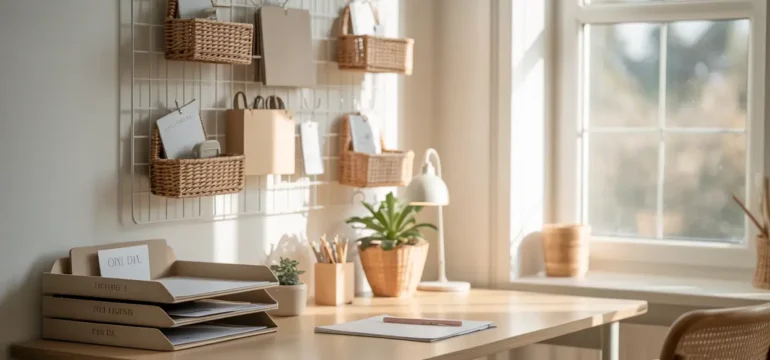
Papers have a way of multiplying overnight. One day your desk is clear, and a week later it is buried under mail, notebooks, charging cables, and a stapler you swear you just had in your hand. Storage is usually the missing piece, not more willpower or a promise to yourself to tidy up on Fridays. When everything has a spot it actually belongs in, keeping the space clear stops feeling like a chore and starts happening almost on its own. Some of these ideas take an afternoon, others take twenty minutes and a trip to a home store. None of them require ripping out cabinets or hiring anyone. Here are seventeen storage ideas that make a real difference in how calm your home office feels, from the walls down to the floor.
1. Wall Grid Organizer
A metal wire grid mounted on the wall above your desk gives you a spot to hang small baskets, hooks, and clips without using any desk surface at all. This is one of the fastest ways to get loose supplies like scissors, tape, and sticky notes up and out of desk drawers where they tend to get lost. Grids come in a range of sizes, so even a small 16 by 20 inch panel makes a noticeable difference above a compact desk.
Hang the grid at a height where you can reach the lower two rows without standing up, since anything too high just becomes decoration instead of storage you actually use. Mix a few open hooks with one or two small wire baskets for smaller items like paper clips or pens. A grid also gives you a spot to clip photos or notes, which means your bulletin board and your supply storage end up sharing the same few square feet of wall.
2. Rolling Storage Cart
A narrow rolling cart with two or three baskets is one of the most flexible storage pieces you can add to a small office, mainly because it moves wherever the work is. Slide it under the desk during the day and pull it out when you need access to supplies, or roll it into a closet entirely when guests are coming over. This works especially well in homes where the office doubles as a guest room or a corner of another room.
Use the top basket for daily items like pens and a notepad, the middle for paper and folders, and the bottom for bulkier things like a printer paper ream. Label each basket with a small tag so the system holds up even on busy weeks when you are moving fast. Because the cart is narrow, usually around 12 to 15 inches wide, it tucks into gaps that a regular cabinet never could.
3. Floating Wall Shelves
A row of two or three floating shelves above a desk adds real storage without taking up an inch of floor space, which matters most in small rooms where every square foot counts. Shelves work well for items you use often but do not want sitting on the desk itself, things like reference binders, a small printer, or a stack of current project folders.
Space the shelves about 10 to 12 inches apart so taller items like binders and boxes still fit comfortably. Keep the bottom shelf a little higher than eye level when seated, so nothing feels like it is looming over your workspace while you sit at the desk. Grouping items by color or size on each shelf, rather than piling things randomly, makes the whole wall look intentional instead of like extra storage that got out of hand.
4. Woven Storage Baskets
Baskets are one of the simplest storage fixes there is, and they work almost anywhere in a home office, on a shelf, under the desk, or in the corner of the room. Woven baskets in particular soften the look of a workspace, which matters if your office shares space with a living room or bedroom and needs to feel more relaxed than a typical office.
Use a large basket on the floor for bulkier items like a laptop bag or a yoga mat if the room doubles as workout space, and smaller baskets on shelves for things like cords, notepads, or mail that needs sorting. Choose baskets with handles so they are easy to pull down and carry to another room if needed. Because baskets hide their contents, they are especially good for the items that are useful but not exactly pretty to look at.
5. Hanging File Pockets
Wall-mounted hanging file pockets keep incoming mail, bills, and paperwork off the desk entirely while still keeping everything visible and easy to grab. This is a much better system than a single inbox tray, since separate pockets let you sort by category the moment paper comes into the house instead of letting it all pile up together and needing a big sorting session later.
Mount three or four pockets in a column near the door of your office or right above the desk, and label each one clearly, things like bills, to file, and to read work well for most households. Choose a set with a metal or acrylic frame, which holds its shape better over time than plain fabric pockets. Checking the pockets once a week keeps the system from filling up and turning back into a pile.
6. Pegboard Supply Wall
A pegboard mounted behind or beside the desk turns an entire wall into flexible, rearrangeable storage for tools, supplies, and even small plants. Unlike fixed shelving, a pegboard lets you move hooks and small shelves around whenever your storage needs change, which is especially useful if your work supplies shift from season to season or project to project.
Paint the pegboard a soft neutral color before installing it so it blends with the room instead of reading as pure workshop hardware. Add a mix of hook sizes, small shelves, and even a cup holder attachment for pens and scissors. Keeping the board loosely organized, with a bit of open space rather than every hole filled, makes it easier to add new items later without needing to rearrange the whole wall.
7. Under-Desk Drawer Cart
A slim set of stacked drawers designed to slide under a desk is one of the best ways to add storage in a small office without needing any extra floor space. These carts usually come in two or three drawer heights, which makes them useful for everything from small supplies to full hanging file folders, depending on which size you pick.
Slide the cart fully under the desk on the side opposite your chair, so it stays out of the way of your legs while you work. Use the top drawer for daily items, the middle for supplies you reach for weekly, and the bottom for files or archived paperwork. Because the whole cart tucks away completely, this is one of the few storage solutions that adds real capacity while making the room look less full rather than more.
8. Labeled Bin Shelving
A shelving unit filled with matching labeled bins turns a messy supply closet or office corner into something that looks almost like a small store display. This works especially well for households with a lot of miscellaneous office supplies, things like extra notebooks, cables, craft supplies, or printer ink that do not have an obvious home otherwise.
Choose bins in one or two colors so the shelf reads as a unit rather than a mismatched collection, and add a label to the front of each one describing exactly what is inside. Keep frequently used bins on the middle shelves at eye level, and save the top and bottom shelves for things you only need occasionally. Clear bins work well too, since they let you check contents at a glance without needing to read every label.
9. Vertical File Cabinet
A tall, narrow vertical file cabinet takes up far less floor space than a traditional wide filing cabinet while still holding a full set of hanging folders. This is a good option for offices where floor space is tight but there is room for something narrow to stand in a corner or beside the desk.
Look for a cabinet around 15 inches wide, which fits into most corners without crowding the room. Use the top drawer for current, active files you need regularly, and the lower drawers for records you need to keep but rarely touch, like old tax documents or warranties. Adding a small potted plant or a stack of books on top of the cabinet helps it blend into the room as furniture rather than reading as strictly utilitarian storage.
10. Corner Bookcase Tower
A tall, narrow bookcase built to fit into a corner makes use of a spot that is often completely wasted in small offices. Corner units typically hold just as much as a regular bookcase but in a footprint that would otherwise sit empty, which makes them one of the more efficient storage pieces you can add to a tight room.
Fill the lower shelves with heavier items like binders and reference books, since a lower center of gravity keeps the unit stable in a corner spot. Use the upper shelves for lighter items and a few decorative pieces, like a small plant or framed print, so the tower does not read as pure storage. Because corner bookcases are tall and narrow, they draw the eye upward, which can make a small office feel taller than it actually is.
11. Desk Drawer Organizer Trays
A simple set of drawer organizer trays turns a chaotic junk drawer into a spot where every pen, clip, and sticky note has its own defined space. This is one of the cheapest and fastest storage fixes on this list, and it makes a surprisingly big difference in how often you can find what you need without digging.
Measure your drawer before buying trays, since a snug fit keeps the trays from sliding around every time you open and close the drawer. Group similar items together, pens in one section, paper clips in another, and sticky notes in a third, rather than mixing everything loosely. Adding one slightly larger, empty section for miscellaneous items gives you a spot for the odd things that do not have an obvious category, which keeps the rest of the drawer from slowly filling back up with clutter.
12. Wall-Mounted Cabinet
A small wall-mounted cabinet with doors gives you closed storage without needing floor space for a full cabinet or bookshelf. This is especially useful for hiding items you use often but do not want visible all the time, like extra chargers, a small printer’s supplies, or a stack of notepads.
Mount the cabinet within easy reach of the desk, ideally at a height where you can open the doors without standing up fully from your chair. Choose a cabinet with adjustable shelves inside so you can adjust the spacing as your storage needs change over time. Painting the cabinet to match the wall color, rather than choosing a contrasting finish, helps it blend into the room and keeps the office from feeling like it has too many separate pieces of furniture competing for attention.
13. Cord Management Box
A simple box with a lid and cutout holes on the sides can hide a power strip and a tangle of charging cords completely, which does more for how tidy a desk looks than almost any other single change. Cord clutter is one of the biggest reasons a desk feels chaotic even when the surface itself is technically clear.
Place the box on the floor near an outlet, close enough that cords can reach comfortably without pulling tight. Feed each cord through one of the side holes so they stay separated instead of tangling together inside the box. Choosing a box that matches your desk finish, wood tones work especially well, makes it look like an intentional piece of furniture rather than something hiding a problem, which is exactly the effect you want.
14. Stackable Paper Trays
A set of stackable paper trays gives incoming and outgoing documents a clear home on the desk itself, without needing a full filing system for papers you are actively working with. This is different from a filing cabinet in that it is meant for short-term sorting, the kind of paperwork you touch daily rather than store long term.
Label the trays clearly, something like inbox, to sign, and to file works for most home offices. Keep the stack to three trays at most, since a taller stack becomes hard to reach into and tends to get ignored after the first couple of weeks. Emptying the top tray at the start of each day, rather than letting it build up, is the habit that actually makes this system work long term.
15. Closet Office Storage
If your home office lives inside a closet, built-in shelving above and beside the desk turns unused vertical space into real storage without needing any extra furniture in the room. This works well for closets of almost any size, since shelving can be custom fit to whatever width you are working with.
Use the shelves closest to the desk for daily supplies, and the higher shelves, which are harder to reach, for archived files or seasonal items you only need occasionally. A small rod installed on one side can even hold a bag or a light jacket, making use of every inch of the closet rather than just the floor. Because everything closes behind a door or curtain when you are done, this setup keeps storage completely out of sight from the rest of the home.
16. Ladder Shelf Storage
A leaning ladder shelf placed beside the desk adds several tiers of open storage in a slim, angled footprint that fits into gaps a regular bookcase never could. Because the shelf leans against the wall rather than standing flat, it works especially well in awkward corners or beside a window where a full bookcase would not fit properly.
Use the lower, wider shelves for heavier items like binders or a small printer, and the narrower top shelves for lighter things like a plant or a small stack of notebooks. Because ladder shelves are open on all sides, keeping items loosely grouped by category, rather than packed tightly, keeps the whole piece looking more like furniture and less like overflow storage. This is a particularly good option for renters, since it usually requires no wall mounting at all.
17. Ottoman Storage Bench
A storage ottoman placed near the desk gives you a hidden spot for bulkier items, like a laptop bag, a heating pad, or extra office supplies, while also doubling as extra seating when needed. This is a good pick for offices that share space with a living room or guest room, since the ottoman looks like normal furniture rather than obvious storage.
Choose an ottoman with a lid that lifts fully rather than tips to one side, which makes it easier to see and reach everything inside. Keep a folded blanket on top so it reads as a cozy seat first and storage second. Because the inside is fully hidden, this is one of the better spots for items you need occasionally but do not want visible in an otherwise tidy room.
Final Thoughts
A calm desk is rarely about being naturally tidy. It usually comes down to giving every item a specific spot so putting things away takes seconds instead of becoming its own chore. Start with one or two of these ideas and the rest tend to fall into place from there.
Frequently Asked Questions
What is the single easiest storage fix for a messy desk?
A cord management box makes one of the biggest visual differences for the least amount of effort, since tangled cords are often the main reason a desk looks cluttered.
How often should I reset my paper trays or file pockets?
Once a week works well for most households. Letting paper sit for longer than that usually means the pile grows faster than you can sort it.
Do I need a lot of furniture to organize a small home office?
No. A few baskets, a wall grid, and a labeled bin or two often make more difference than buying an entirely new furniture set.
What storage works best for a home office in a shared room?
Closed storage like cabinets, ottomans, and baskets with lids work best in shared spaces, since they hide office clutter when the room needs to serve another purpose.